

Why in news?
Researchers have demonstrated that a monolayer of molybdenum disulfide (MoS2) can withstand the harsh radiation of space. A radio‑frequency communication system built on a 4‑inch MoS2 wafer and launched aboard China’s Fudan No. 1 satellite remained stable for nine months in orbit and is predicted to last more than two centuries. This breakthrough highlights MoS2’s potential for future space electronics.
Background
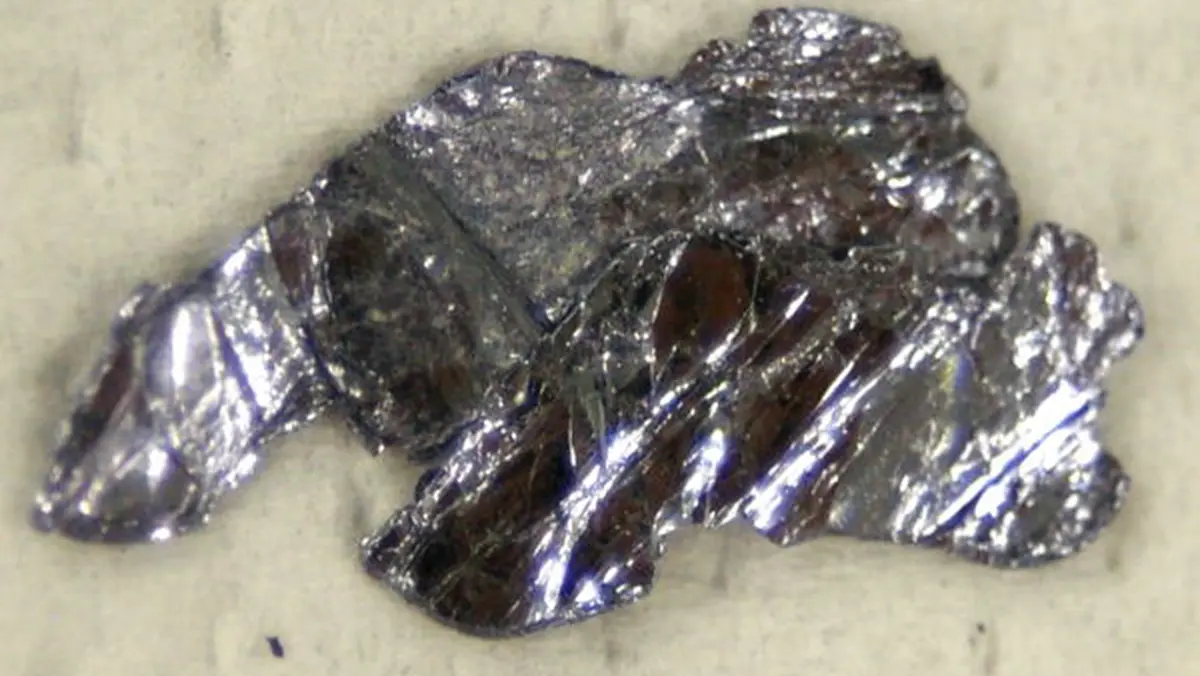
MoS2 is a naturally occurring mineral known as molybdenite. Structurally it consists of layers of molybdenum atoms sandwiched between layers of sulfur atoms in a hexagonal lattice. Because the layers are held together by weak van der Waals forces, they can slide over one another easily, making MoS2 an excellent dry lubricant. Unlike graphite, MoS2 does not rely on adsorbed water molecules for lubrication and can withstand high temperatures. In its bulk form MoS2 is a semiconductor and becomes superconducting when doped or subjected to an electrostatic field.
Properties and uses
- High melting point: MoS2 has a melting point around 1,185 °C and sublimates at about 450 °C, which allows purification by sublimation.
- Dry lubrication: Its layered structure provides low friction without the need for oil or water. MoS2 coatings are used on machine parts, automobile engines and firearms to reduce wear.
- Electronics: In monolayer form, MoS2 exhibits a direct bandgap, making it suitable for transistors, sensors and flexible electronics. Doped MoS2 can display superconductivity.
- Space applications: The recent satellite experiment shows that MoS2-based circuits can tolerate radiation and survive for decades, opening possibilities for lightweight, low‑power spacecraft electronics.
Significance
- Advanced materials research: MoS2 belongs to the family of two‑dimensional materials like graphene. Its mechanical strength and electronic properties make it a promising candidate for next‑generation devices.
- Industrial lubrication: Because MoS2 does not depend on humidity, it can be used where oil or grease is impractical, such as in high‑temperature or vacuum environments.
- Space technology: Radiation‑tolerant MoS2 circuits could reduce the weight and power consumption of satellites, enabling longer missions and deeper space exploration.
Source: TH