
Why in news?
Prime Minister Narendra Modi referred to Māori ideas during an Indian community event in Auckland. He used “waka”, meaning canoe, for the shared India–New Zealand journey. He also discussed hospitality, family and guardianship concepts. The visit was the first by an Indian Prime Minister in 40 years.
Background
Māori are the Indigenous Polynesian people of Aotearoa New Zealand. Aotearoa is a widely used Māori name for New Zealand.
“Māori” can describe the people, language and culture, and the plural form remains Māori, without adding the English letter “s”.
Māori society contains many tribes and local communities. It should not be treated as one uniform group with identical traditions.
Where did the first Māori ancestors come from?
Polynesian navigators explored the Pacific using stars, winds, waves, birds and ocean currents. Their knowledge supported very long open-sea voyages.
Ancestors of Māori travelled from East Polynesia to New Zealand. Most evidence places their main settlement between about 1250 and 1300.
They arrived in ocean-going waka, or canoes. Large migration craft probably included double-hulled vessels suited for people, plants and supplies.
Communities adapted tropical Polynesian knowledge to a cooler environment, and they developed new food systems, settlements, clothing and building methods.
Over generations, separate kin groups formed across both main islands. Each developed local histories, dialects and relationships with particular lands.
What does “waka” mean?
A waka is a canoe or vessel, and the same Māori word can serve as singular or plural.
Different waka were built for travel, fishing, warfare and ceremony, and size, decoration and construction varied with their purpose.
Waka also carry ancestry and collective identity, and many tribes trace descent through the people of a remembered migration canoe.
Therefore, waka can represent more than transport, and it can symbolise people travelling together towards a shared purpose.
The Prime Minister used this symbolic meaning in Auckland. He compared bilateral relations with a canoe beginning a new voyage.
Remember: Waka literally means a canoe or vessel. In public language, it can also represent shared ancestry or collective journey.
How is traditional Māori society organised?
- Whānau: This is an extended family connected by kinship and shared duties.
- Hapū: This is a local kin group, often translated as sub-tribe.
- Iwi: This is a larger tribal grouping containing related hapū.
- Whakapapa: This means genealogy and the relationships linking people, ancestors and land.
- Rangatira: This is a leader whose authority carries responsibilities towards the community.
These English translations are only guides. Māori terms carry historical and cultural meanings that one English word cannot fully capture.
What is a marae?
A marae is a communal meeting place and cultural centre, and it is not merely one building.
The complex often includes a carved meeting house, dining hall and open courtyard. Protocol governs welcomes, speeches, remembrance and gatherings.
The meeting house may represent an ancestor, and its carved parts can symbolise the ancestor’s body and genealogy.
Marae remain important for ceremonies, funerals, debate, education and community decisions. Urban marae also serve people living away from ancestral areas.
What is a haka?
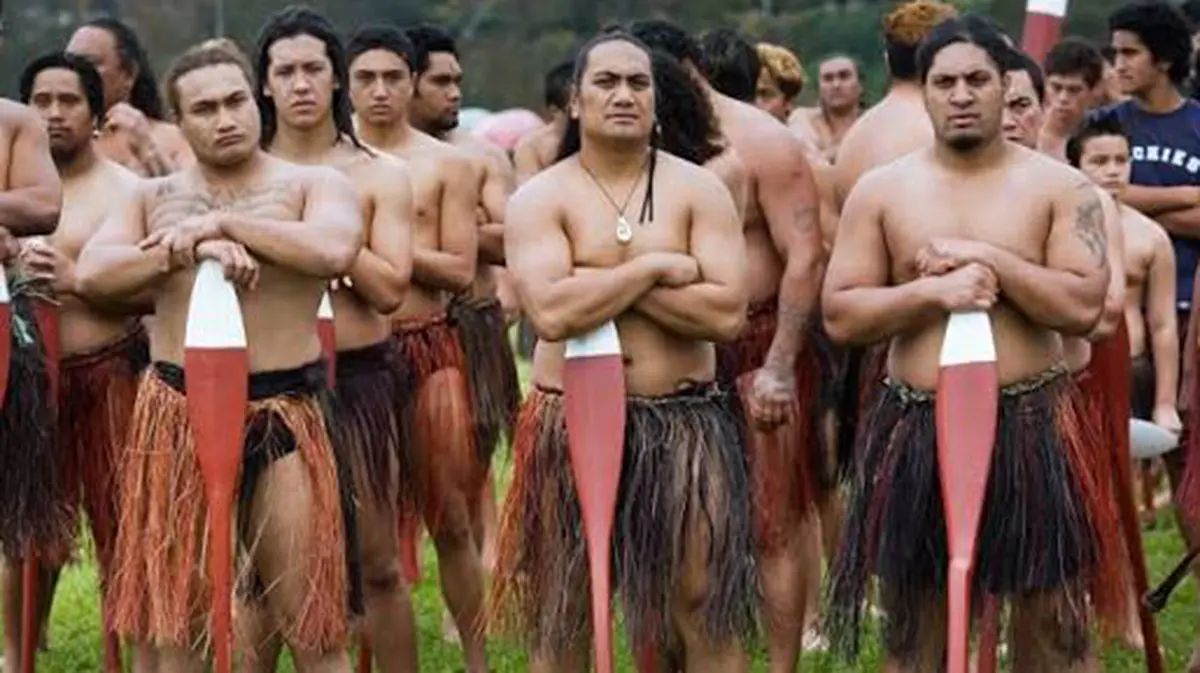
Haka is a group posture dance or performed challenge, and it combines rhythm, voice, movement, facial expression and coordinated energy.
Some haka prepared warriors or challenged opponents, and others welcome visitors, celebrate achievement, mourn the dead or express identity.
Do not oversimplify: Haka is not only a “war dance”. Its purpose depends upon the words, occasion and performing community.
Which values appeared in the Auckland speech?
- Manaakitanga: This involves care, respect, hospitality and uplifting the dignity of others.
- Whānau: The speech compared its broad family meaning with Indian family traditions.
- Kaitiakitanga: This expresses guardianship and responsibility towards nature and inherited resources.
- Waka: The speech used the canoe as a symbol for partnership.
Kaitiakitanga does not simply mean ownership of nature, and it stresses duties towards land, water, living beings and future generations.
What is te reo Māori?
Te reo Māori means the Māori language, and it belongs to the Eastern Polynesian branch of the Austronesian language family.
European settlement and English-only schooling weakened intergenerational transmission, and many children were once discouraged or punished for speaking Māori.
Language revival gained strength during the 1970s, and community-led language nests and Māori-medium schools later taught children through Māori.
The Māori Language Act, 1987, recognised Māori as an official language. The Māori Language Act, 2016, renewed the legal framework.
Macrons mark long vowels and can change meaning, and writing Māori words accurately therefore matters.
What happened after European contact?
European explorers reached New Zealand from the seventeenth century. Traders, missionaries and settlers arrived in increasing numbers during the early nineteenth century.
Introduced diseases caused deaths because Māori communities lacked prior immunity, and new weapons also changed conflicts among iwi.
British settlement expanded rapidly after 1840, and disputed land purchases and confiscations later removed much land from Māori control.
Warfare, displacement and economic disruption weakened many communities, and Māori population numbers fell sharply during the nineteenth century.
What is the Treaty of Waitangi?
Representatives of the British Crown and Māori rangatira first signed the treaty on 6 February 1840. About 540 rangatira eventually signed copies.
The English and Māori texts do not convey identical meanings. This difference remains central to later political and legal debates.
The English text described a transfer of sovereignty to the Crown. The Māori text used kawanatanga, commonly understood as governance.
The Māori text also guaranteed tino rangatiratanga over lands, communities and treasured things. This phrase conveys continuing authority or self-determination.
Colonial governments often ignored treaty promises, and land loss and conflict produced grievances that continued across generations.
How did redress and cultural revival develop?
Four Māori parliamentary seats were created in 1867. Māori movements also continued demanding land rights, political voice and cultural protection.
Parliament created the Waitangi Tribunal in 1975, and it investigates claims about Crown actions conflicting with treaty principles.
Its jurisdiction later reached historical claims dating from 1840, and negotiated settlements have included apologies, money, land and cultural recognition.
Settlements do not erase every disadvantage or historical loss. They provide an agreed process for particular claims and future relationships.
Language education, broadcasting, scholarship and public ceremony strengthened cultural revival. Māori words and protocols now appear widely in national life.
How large is the Māori population?
The 2023 Census recorded 887,493 people of Māori ethnicity, equalling 17.8 percent of the usually resident population.
Ethnicity and Māori descent are different census measures. One person may report multiple ethnic identities, so group percentages can overlap.
Statistical caution: The Māori ethnic count was 887,493, while the separate, higher Māori descent count should not be substituted.
Conclusion
Māori identity joins ancestry, language, land and living community practice. Understanding waka and related ideas gives the Auckland reference its full meaning.