
Why in news?
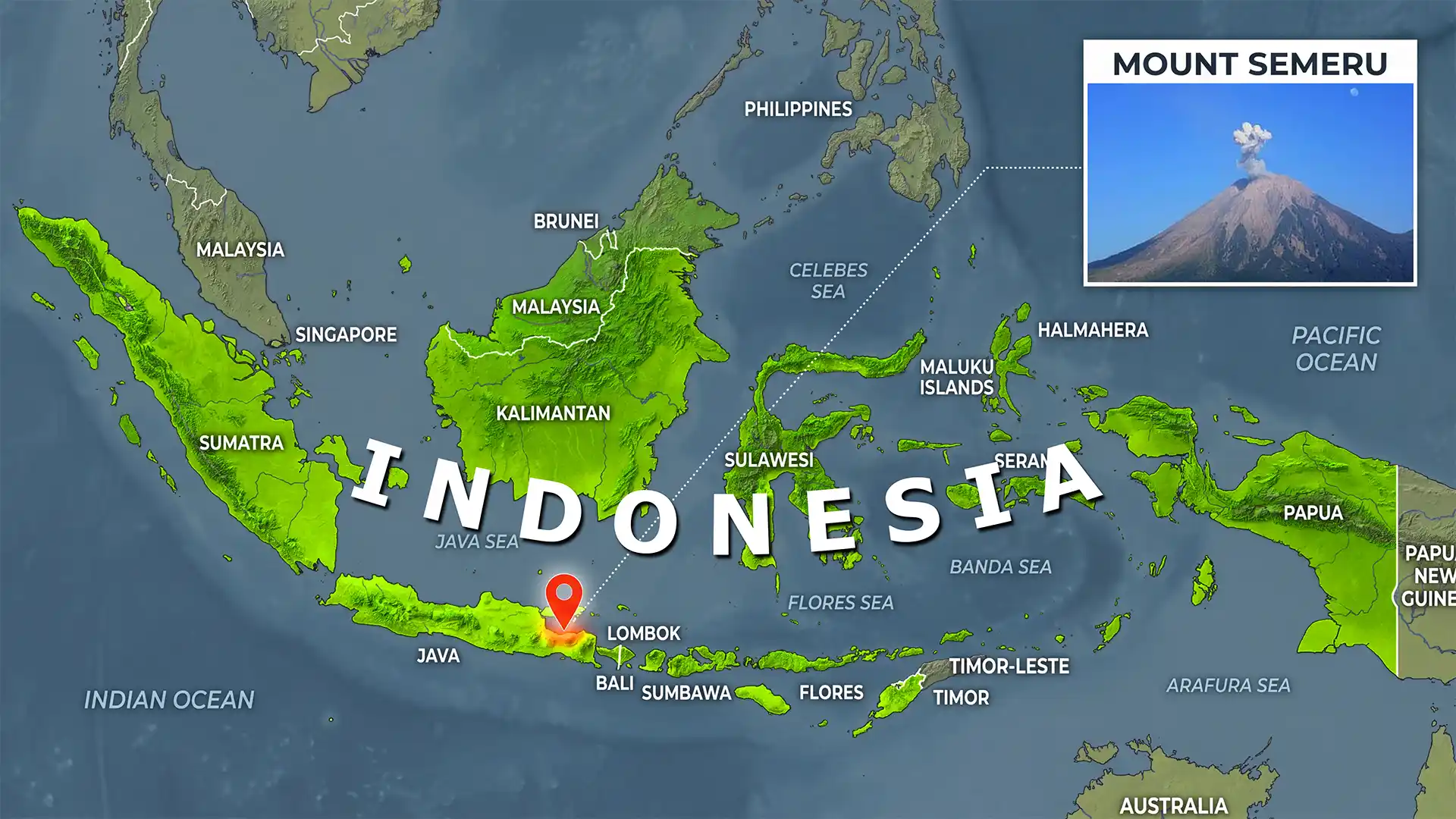
Indonesia’s Mount Semeru, the tallest volcano on the island of Java, erupted multiple times on 6 April 2026, sending ash plumes high into the atmosphere. Authorities issued alerts and advised residents to stay clear of the danger zone around the volcano.
Background
Mount Semeru rises 3,676 metres above sea level in East Java and is part of the Bromo Tengger Semeru National Park. Known locally as “Mahameru,” or “Great Mountain,” it sits on the convergent boundary where the Indo‑Australian tectonic plate is subducting beneath the Eurasian plate. Semeru is one of Indonesia’s most active volcanoes and contributes to the archipelago’s reputation as part of the Pacific “Ring of Fire.” Its frequent eruptions fertilise surrounding soils, supporting agriculture but posing constant hazards.
Recent eruption and safety measures
- Multiple eruptions: On 6 April 2026, the volcano erupted at least seven times between midnight and morning. The most intense explosion at around 6:51 a.m. sent ash columns approximately 1.1 kilometres above the summit.
- Alert zones: Indonesia’s volcanology agency maintained the second‑highest alert level. Residents were advised to stay outside a 5‑kilometre radius and avoid a 13‑kilometre stretch along the Besuk Kobokan river due to risks of pyroclastic flows and cold lava (lahars).
- Historical context: The volcano erupted in December 2021, killing dozens, and has experienced periodic outbursts in February and March 2026. Its behaviour underscores the need for continual monitoring.
Significance
- Disaster preparedness: The eruption highlights the importance of early warning systems and evacuation planning for communities living around active volcanoes.
- Environmental impact: Volcanic ash can damage crops, contaminate water and affect air quality. Ash clouds also pose risks to aviation.
- Scientific insight: Studying Semeru’s eruptions helps volcanologists understand subduction‑zone dynamics and improve hazard forecasting.
Conclusion
Mount Semeru’s recurrent activity reminds us that life on volcanic islands involves balancing the benefits of fertile soils against the perils of sudden eruptions. Vigilant monitoring and public awareness are essential to minimise harm when nature shows its power.
Source: National Herald

