

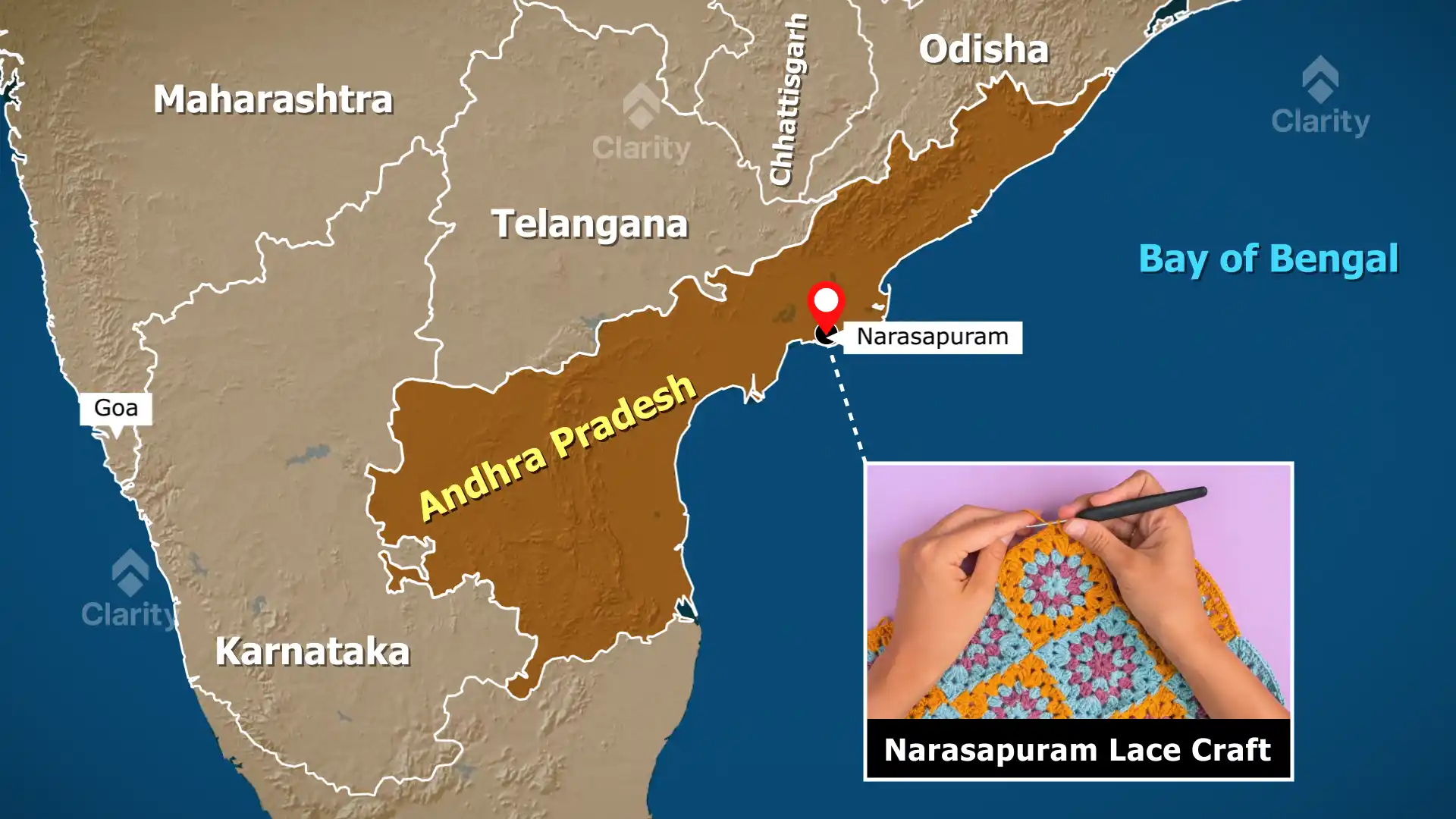
Why in news?
During his December 2025 Mann Ki Baat radio address, Prime Minister Narendra Modi praised the crocheted lace products made by self‑help groups in Narsapuram, Andhra Pradesh. His remarks brought national attention to this traditional craft and its contribution to women’s livelihoods.
Background
Narsapuram (also spelt Narasapur) is a town on the banks of the Godavari River in West Godavari district. Scottish missionaries introduced the crochet technique to local women in the late 19th century. Over time, the craft evolved into a distinctive style known as Narsapuram lace, which uses fine cotton threads to create delicate patterns. The industry flourished after famines and economic hardship in the early 20th century, providing an income source for rural households. In recognition of its uniqueness, Narsapuram lace received a Geographical Indication (GI) tag.
Characteristics of the craft
- Handmade crochet: Artisans use a simple crochet hook to interlock loops of thread into intricate floral, geometric and paisley designs. Each piece is made by hand, without the aid of machines.
- Variety of products: The craft produces doilies, pillow covers, bedspreads, table‑runners, garments and even home‑decor items. Beads and sequins are sometimes added to embellish export‑quality pieces.
- Materials: Fine cotton is the primary material. Artisans also incorporate silk, rayon and synthetic threads for decorative pieces.
- Women’s empowerment: According to government reports, more than 500 types of lace products are produced in around 250 villages by nearly 100,000 women. Local banks and the National Bank for Agriculture and Rural Development (NABARD) support the industry through training and market linkages, helping women earn a steady income.
Conclusion
Narsapuram lace craft is both an artistic tradition and a source of livelihood. Continued support through skill development, marketing and quality control will enable the artisans to reach wider markets while preserving this heritage art form.
Sources: Deccan Chronicle