

Why in news?
The National Aeronautics and Space Administration (NASA) reportedly invited the Indian Space Research Organisation (ISRO) to discuss Moon Base participation.
What the invitation means
The ninth United States–India Civil Space Joint Working Group met on 5 and 6 August. Delegations gathered at the Indian Space Research Organisation headquarters.
Reporting after the meeting said the National Aeronautics and Space Administration invited Indian participation. No binding agreement or defined workshare was announced.
An invitation to discuss participation is therefore an opening, not a mission commitment. India would still assess scientific, financial and strategic terms.
The Moon Base proposal
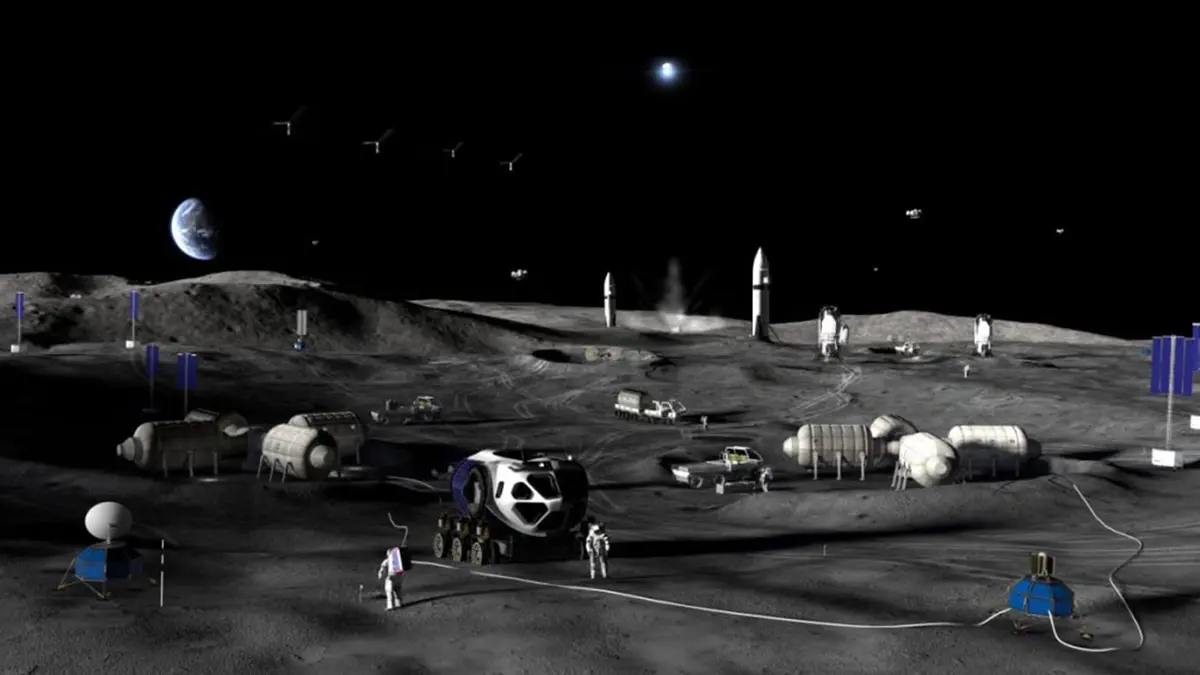
NASA announced the initiative in March 2026. It envisages a phased presence near the Moon’s south polar region.
Robotic systems would prepare infrastructure before sustained human operations. NASA expects international and commercial partners to contribute specialised capabilities.
The south polar region attracts interest because permanently shadowed areas may contain water ice. Lighting conditions also vary sharply across the terrain.
Accords and programmes are different
India signed the Artemis Accords in 2023. Those principles do not automatically enrol India in every American lunar programme.
Why India may engage
India has growing lunar experience through Chandrayaan missions. It also works with Japan on the planned Lunar Polar Exploration mission.
Cooperation could widen access to instruments, communications and surface operations. It may also offer Indian industry demanding new technical work.
Existing collaboration provides a base. The NASA–ISRO Synthetic Aperture Radar mission and Axiom-4 astronaut mission involved substantial joint work.
Questions before commitment
India would need clarity on cost, intellectual property and decision-making. Mission safety and technology-transfer limits also require detailed negotiation.
Any role should complement national priorities rather than displace them. Transparent milestones would help Parliament and the public assess value.
Lunar activity also raises governance questions. Partners must manage scientific access, resource use and harmful interference within international law.
Possible Indian contributions could include instruments, navigation or surface systems. No such allocation should be assumed before an official agreement.
Interoperability standards would affect every partner. Hardware must communicate reliably and function in extreme lunar dust and temperature conditions.
A clear exit and review mechanism would protect public resources. Long programmes need adaptation when technology, budgets or scientific priorities change.
Potential without presumption
The invitation could deepen an important partnership. Its value depends on a clearly negotiated Indian role and measurable scientific returns.
Conclusion
Moon Base talks open a significant option for India. They should be judged after the proposed responsibilities become public.