

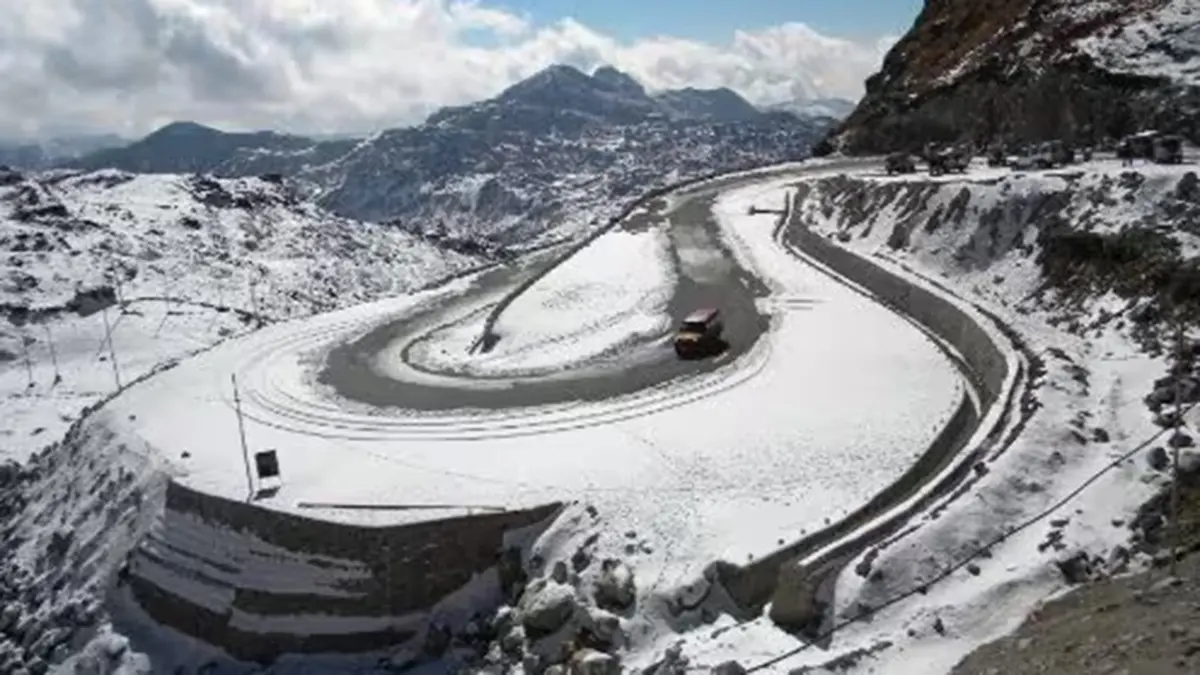
Why in news?
Border trade through Nathu La resumed on 1 August 2026.
The route had missed six consecutive trading seasons since 2020.
Registered traders attended the reopening ceremony in eastern Sikkim.
The renewed trade operates through existing bilateral rules and notified marts.
Background
Nathu La is a high Himalayan pass in Sikkim's eastern frontier. It connects Sikkim with the Tibet Autonomous Region of China. The pass stands about 4,310 metres above mean sea level.
Gangtok lies roughly 54 kilometres west of the border pass. The route approaches the Chumbi Valley on the Tibetan side. It once formed a branch of wider trans-Himalayan commercial networks.
Chronological development of the route
- Merchants historically moved wool, salt and other goods across Himalayan passes.
- India closed Nathu La after the India–China conflict during 1962.
- Serious military clashes also occurred around Nathu La during 1967.
- India and China signed a border-trade memorandum during December 1991.
- A protocol signed during July 1992 detailed practical trading arrangements.
- A 2003 memorandum added Nathu La to the authorised border-trade system.
- Trade through the pass formally restarted on 6 July 2006.
- A pilgrimage route towards Kailash Mansarovar opened through Nathu La during 2015.
- Border trade stopped from 2020 amid the pandemic and bilateral tensions.
- The seasonal channel finally reopened on 1 August 2026.
How does border trade operate?
This arrangement is narrower than normal international trade through major ports. Only registered traders holding valid trade passes may use the route. Governments notify permitted goods, trading periods and designated market locations.
Sherathang in Sikkim serves as India's trade mart for arriving Chinese traders. Renqinggang in Yadong County serves registered traders travelling from India. Customs, security and local administrations supervise movement through the pass.
Mountain weather generally confines physical trade to a limited seasonal window.
Why is the reopening significant?
Economic importance: Trade can support transporters, handlers and small businesses within eastern Sikkim. It can also reduce isolation within remote border communities. However, notified goods and modest volumes limit its national commercial scale.
Diplomatic importance: The route creates a controlled channel for routine contact between both administrations. Such functional cooperation may support stability despite wider political disagreements; reopening nevertheless does not resolve the disputed India–China boundary.
Strategic importance: Nathu La lies near the sensitive Sikkim–Tibet frontier and Chumbi Valley. Its civilian use therefore operates alongside a substantial security presence. Reliable roads can support trade, tourism, pilgrimage and strategic mobility simultaneously.
Important pass comparison
| Pass | Indian side | Neighbouring region | Key association |
|---|---|---|---|
| Nathu La | Sikkim | Tibet Autonomous Region | Border trade and pilgrimage route |
| Shipki La | Himachal Pradesh | Tibet Autonomous Region | Sutlej enters India nearby |
| Lipulekh | Uttarakhand | Tibet Autonomous Region | Kailash Mansarovar route |
| Jelep La | Sikkim sector | Chumbi Valley | Historic trade route |
Conclusion
The reopening restores a small but symbolically important channel across the Himalayas. Its durability will depend upon stable relations, infrastructure and predictable seasonal rules.