

Why in news?
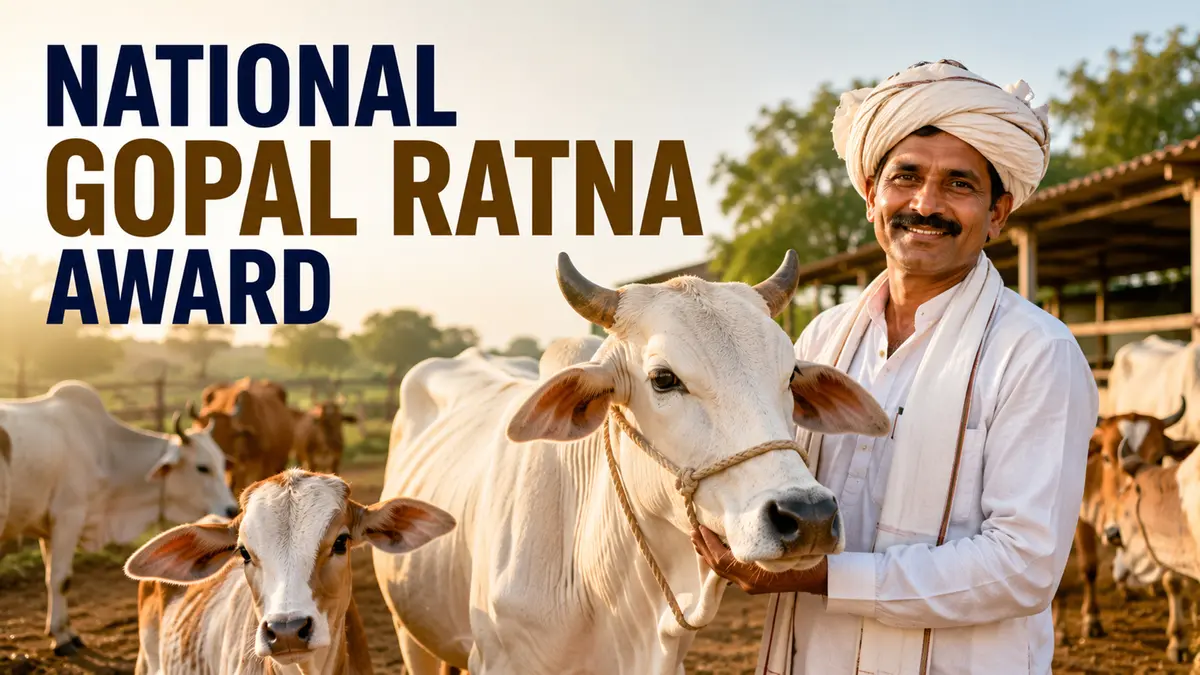
The Department of Animal Husbandry and Dairying announced the 2026 National Gopal Ratna Awards on 7 August. Nominations open on 10 August. The online window closes on 10 September. Applications use the National Awards Portal.
The awards are scheduled for 26 November, observed as National Milk Day; they recognise three parts of organised dairying.
Eligible groups include farmers and dairy institutions. Artificial-insemination technicians form the third category.
Origin and purpose
The awards form part of the Rashtriya Gokul Mission; the mission began in December 2014. It develops and conserves indigenous bovine breeds; it also seeks genetic improvement in cattle and buffalo populations.
The Department says the awards have been held annually since 2021; they give national visibility to good husbandry.
Effective dairy institutions and skilled breeding services also receive recognition. Milk volume alone is not the stated purpose.
Indigenous breeds may offer heat tolerance and disease resilience; they can also suit local fodder and farming systems. Maintaining them protects genetic diversity; however, every indigenous animal will not perform equally in every environment.
Productivity depends on nutrition, health and reproductive management. Housing, water and markets are also important.
Breed suitability must be judged against local conditions; conservation should retain diverse traits and viable breeding populations.
Policy should not select only one high-yield line. Narrow selection may weaken other useful characteristics.
Categories and awards
| Category | Who is recognised | 2026 award structure |
|---|---|---|
| Best dairy farmer | A farmer maintaining indigenous cattle or buffalo breeds. | ₹5 lakh, ₹3 lakh and ₹2 lakh for the first three positions, plus ₹2 lakh for the special regional award. |
| Best dairy institution | Dairy Cooperative Society, Milk Producer Company or Dairy Farmer Producer Organisation. | ₹5 lakh, ₹3 lakh and ₹2 lakh for the first three positions, plus ₹2 lakh for the special regional award. |
| Best artificial-insemination technician | A technician providing artificial-insemination services. | Merit certificate and memento; the official announcement specifies no cash prize for this category. |
Each category includes a special regional award; it covers the North-Eastern Region and Himalayan States or Union Territories. The provision recognises different terrain, breeds and market access. Service-delivery costs can also be higher.
The detailed notification controls eligibility and required records. Portal conditions and official evaluation rules also remain binding.
Why each category matters
Farmers make daily decisions about feed, breeding and housing; they also manage calf care, welfare and disease reporting. Dairy cooperatives and producer organisations collect milk and test quality; they make payments and supply inputs.
Collective institutions can give small producers bargaining power. Transparent governance determines whether that benefit reaches members.
Artificial-insemination technicians carry genetic material and data to villages. Timing, hygiene and correct identification affect outcomes.
Record quality can determine whether breeding produces improvement or confusion; a high procedure count alone shows little. Artificial insemination can spread useful traits without transporting bulls; rapid genetic concentration still creates risks.
Overusing a small number of sires reduces diversity and can increase inbreeding. Selection must therefore remain broad.
Milk yield cannot be the only goal. Fertility, longevity, heat tolerance and disease resistance also matter.
Sound programmes need pedigree and performance data; they also need balanced goals, semen quality control and animal identification. Advice should respect the farmer’s production environment; a technically superior animal may be unsuitable for local conditions.
Recognition should encourage verifiable practice
A strong process should reward sustained animal health and welfare. Clean milk and transparent payments also deserve weight. Reliable records, responsible antibiotic use and breed conservation matter. Environmental management should be assessed as well.
One peak yield or an attractive facility proves little. Resilience must appear across repeated performance.
Broader policy implications
Awards can spread useful examples and give village workers status; they cannot replace veterinary hospitals or vaccination. Disease surveillance, quality fodder and drinking water remain essential. Dairying also needs cold chains, fair procurement and affordable credit.
Farmers facing heat stress require shade and ventilation; water planning and heat-tolerant breeding can strengthen adaptation.
Local fodder crops and early disease warnings can reduce risk; these systems require continuing public investment.
Evaluation needs safeguards against inflated claims. Milk records should be independently verifiable. Cooperatives should make timely and transparent payments. Technicians should be assessed on conception outcomes and biosecurity.
Record quality matters more than procedure counts alone. Public explanations of winner selection would create a learning resource.
Greater transparency can also improve confidence in the awards; recognition should rest on evidence.
Conclusion
The awards highlight people and institutions supporting India’s dairy economy; they also draw attention to indigenous bovine resources. Their deeper value depends on the rewarded behaviour. Healthy animals, diverse genetics and reliable services should guide selection.
Fair producer institutions matter equally. Celebration is useful when it strengthens systems rather than replacing them.