
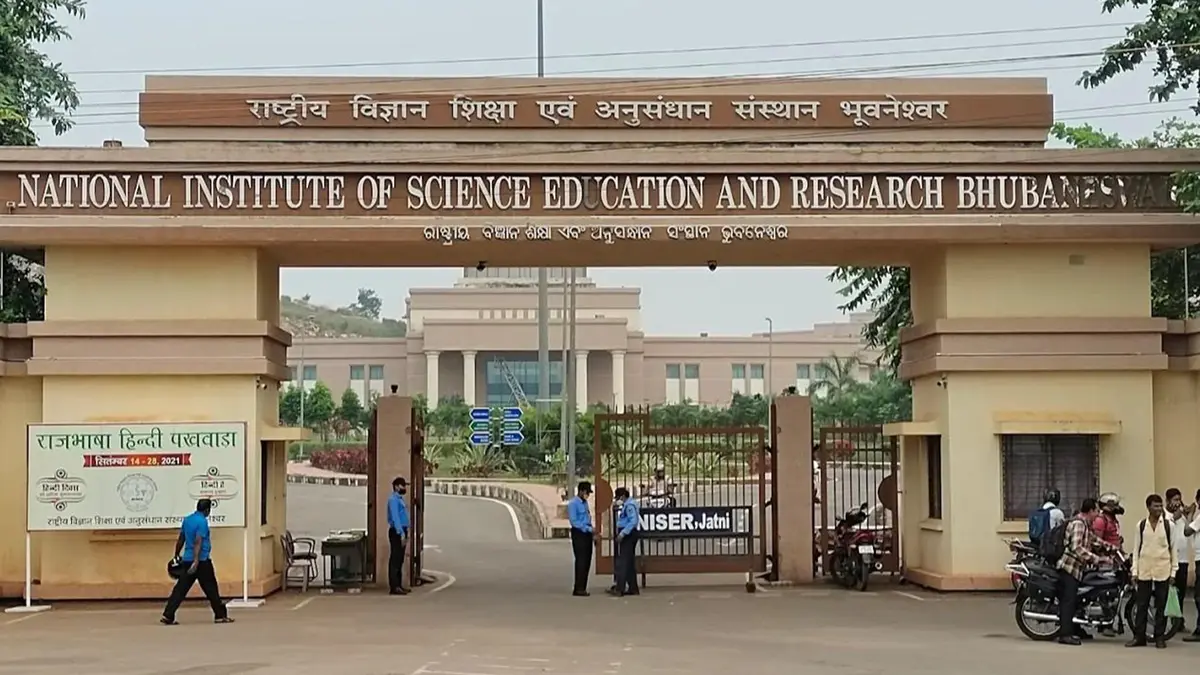
Why in news?
The Vice-President addressed NISER’s 15th Graduation Ceremony in Bhubaneswar, and he linked scientific capability with national development. The address stressed research integrity, interdisciplinary work and responsible innovation, and it also highlighted Homi Bhabha’s scientific legacy.
Background
India needed more institutions joining undergraduate teaching with advanced scientific research. Traditional universities and specialised laboratories often performed these roles separately.
The Union government therefore created new science-education institutions during the 2000s, and NISER became part of this broader effort.
Prime Minister Manmohan Singh laid its foundation stone on 28 August 2006. Academic activities began in 2007.
The institute now operates from Jatni, around 20 kilometres south of Bhubaneswar. Its residential campus contains laboratories, classrooms, a library and student housing.
What is NISER?
NISER means the National Institute of Science Education and Research. It is an autonomous institute under the Department of Atomic Energy (DAE).
The Department of Atomic Energy reports directly to the Prime Minister, and its responsibilities extend beyond nuclear power.
DAE also supports fundamental science, mathematics, medicine and advanced technology, and NISER helps create trained scientific human resources.
Relationship with HBNI
NISER is a constituent institution of the Homi Bhabha National Institute (HBNI). HBNI is a deemed-to-be university established by DAE.
Teaching and research occur at NISER, and HBNI provides the university framework and awards degrees.
Do not confuse NISER with IISERs. NISER works under DAE. Indian Institutes of Science Education and Research (IISERs) work under the Education Ministry.
Main academic purpose
NISER integrates classroom learning with research from the undergraduate stage, and students receive broad scientific training before choosing deeper specialisation.
The flagship course is a five-year Integrated Master of Science programme, and NISER also offers Integrated PhD and PhD programmes.
Admission to the Integrated MSc mainly occurs through the National Entrance Screening Test. The common abbreviation is NEST.
Major academic schools
- The School of Biological Sciences covers modern life sciences, and the School of Chemical Sciences covers experimental and theoretical chemistry.
- The School of Computer Sciences studies computation and related methods.
- The School of Earth and Planetary Sciences studies Earth systems and planets.
- The School of Humanities and Social Sciences broadens scientific education.
- The School of Mathematical Sciences covers pure and applied mathematics.
- The School of Physical Sciences covers major fields of physics.
Three broad functions
- Science education: NISER trains undergraduate and postgraduate learners; Scientific research: Faculty and students study frontier scientific questions.
- Outreach and policy: The institute promotes scientific temper and supports public policy.
Why is basic science important?
Basic science seeks to understand natural processes, and its immediate commercial use may not always be visible.
However, later technologies often grow from earlier fundamental discoveries, and quantum theory, for example, eventually supported electronics and modern computing.
Strong research institutions also train people for national laboratories, universities and technology sectors. This creates long-term scientific capacity.
The 15th Graduation Ceremony
Vice-President C. P. Radhakrishnan addressed the ceremony. Odisha’s Governor and Chief Minister also attended.
Union Education Minister Dharmendra Pradhan joined the event, and senior Department of Atomic Energy officials and NISER faculty were present.
The address urged graduates to combine ambition with responsibility. It also encouraged interdisciplinary research on climate, disease, artificial intelligence and advanced materials.
Conclusion
NISER combines science teaching, research and national capacity building, and its DAE status distinguishes it from IISERs. The institute’s success depends on sustained academic freedom, integrity and public purpose.