
Why in news?
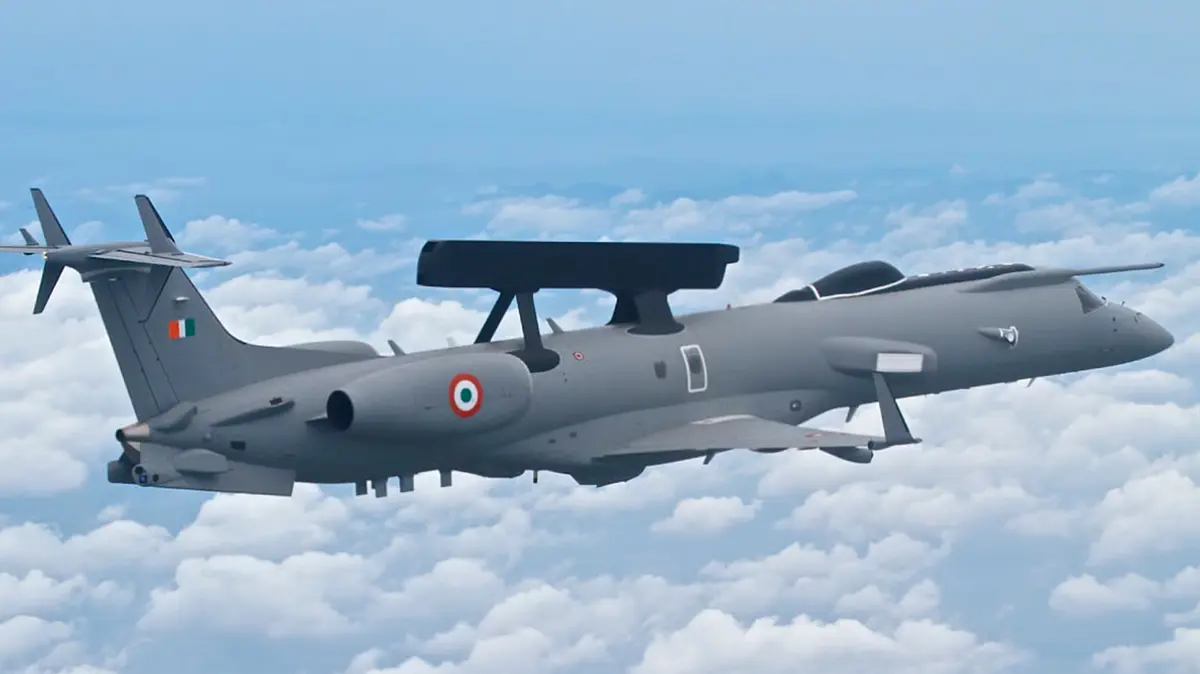
The Indian Air Force recently granted final operational clearance to the indigenous Netra AEW&C system. This happened on 25 June 2026 and marks a major milestone for the project. It means the aircraft and radar can be fully deployed for surveillance missions.
Background
Netra is an airborne early warning and control (AEW&C) platform. It was developed by the Defence Research and Development Organisation (DRDO) with the Centre for Airborne Systems. Work began in the early 2000s, and the first prototype flew in 2011. The system uses a Brazilian Embraer EMB‑145 jet fitted with a locally made active electronically scanned array (AESA) radar. The radar sits inside a dorsal dome on top of the fuselage. Earlier, only a few units were delivered to the Indian Air Force in 2017 and 2019. The final operational clearance confirms that design, performance and user trials are complete.
Key features
- Wide coverage: The AESA radar provides surveillance over almost 240 degrees. It can detect fighter aircraft and other targets at ranges between 250 km and 375 km, depending on altitude. Planned upgrades under the Netra Mk‑1A and Mk‑2 programmes aim to offer full 360‑degree coverage and ranges beyond 500 km.
- Multiple roles: Netra can track dozens of targets simultaneously. It supports air defence by guiding interceptors and can manage friendly aircraft during complex operations. It also performs command and control and signals intelligence tasks.
- Indigenous design: The project integrates Indian radar, communications and data links on a foreign airframe. This reduces dependence on imported airborne warning systems and builds local expertise.
- Operational use: Netra played a role during India’s air strikes on Balakot in 2019. It has since been used for coastal surveillance and joint exercises. The final clearance means the fleet can now be deployed more widely.
Significance
- Force multiplier: Airborne warning platforms give early warning of hostile aircraft and missiles. They also help manage large formations of friendly fighters. This makes them essential for modern air warfare.
- Self‑reliance: India currently lacks enough airborne surveillance platforms. Netra and its successors will improve situational awareness and reduce reliance on foreign AWACS systems.
- Future development: Work has begun on heavier AEW&C systems using Airbus A321 or C‑295 aircraft. These variants should carry larger radars and provide better range and endurance.
Conclusion
The final clearance of Netra shows that India can develop sophisticated airborne sensors. With upgrades and additional units, the system will enhance national security and support the vision of Atmanirbhar Bharat in defence.