
Why in news?
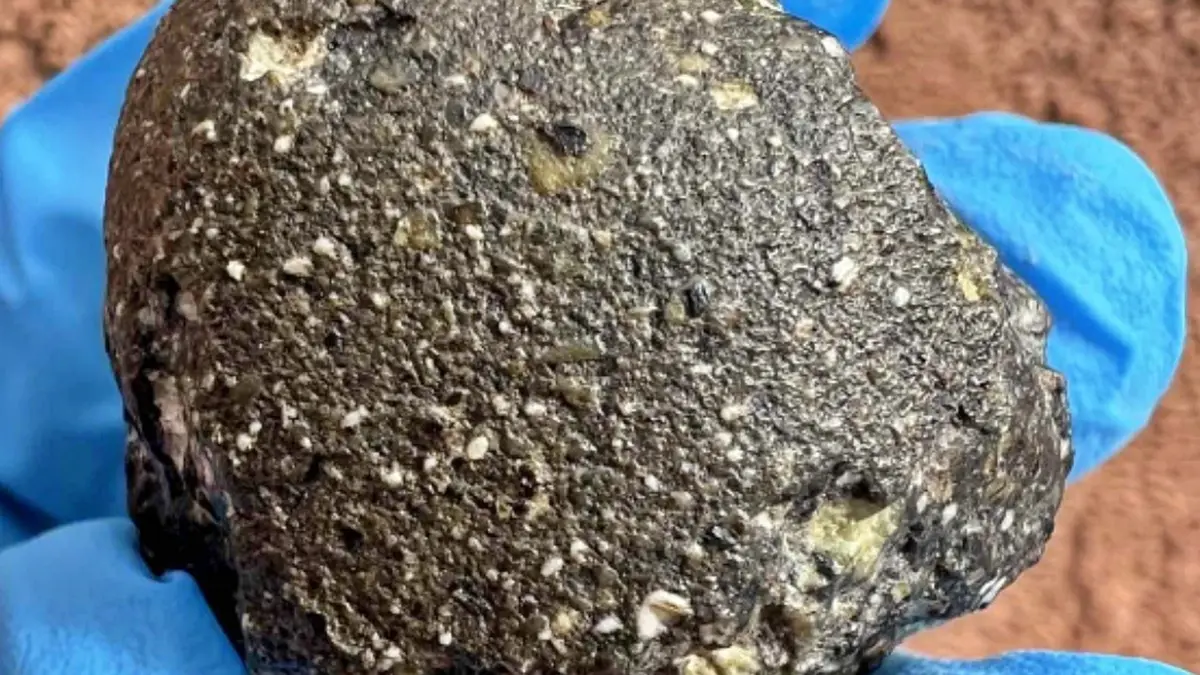
Chinese scientists have identified a new lunar mineral named Cerium–Magnesium Changesite, also known as Magnesiochangesite‑(Ce). It was discovered in tiny crystals within a meteorite that fell in China in January 2024.
Background
The mineral was found in Pakepake 005, a 44‑gram lunar breccia collected from the Taklamakan Desert in Xinjiang on 22 January 2024. This meteorite, ejected from the Moon by an impact long ago, contains fragments of lunar basalt and rare phosphate minerals. Using high‑resolution instruments, researchers spotted minute transparent crystals measuring only 3–25 micrometres.
What makes the mineral special?
- Composition: Magnesiochangesite‑(Ce) is a rare‑earth–bearing phosphate rich in cerium and magnesium. Its crystal structure resembles terrestrial changesite but with cerium replacing calcium.
- Optical properties: The crystals are colourless, transparent and exhibit strong luminescence under ultraviolet light.
- Scientific value: The mineral provides clues about the Moon’s volcanic history and the separation of rare‑earth elements in lunar basalts. Such data can improve models of lunar mantle composition.
- Potential applications: Researchers suggest that insights from this mineral could guide the design of new optical materials such as light‑emitting diodes and phosphors.
Context and significance
- Magnesiochangesite‑(Ce) is the 11th lunar mineral identified so far and the second new lunar mineral announced by China after the discovery of Changesite‑(Y) in lunar samples returned by Chang’e 5.
- The meteorite’s discovery underscores the value of studying lunar meteorites that fall to Earth, which complement samples returned by missions.
- Understanding lunar rare‑earth minerals may one day support resource utilisation on the Moon and inform future missions.
Source: India Today

