

Why in news?
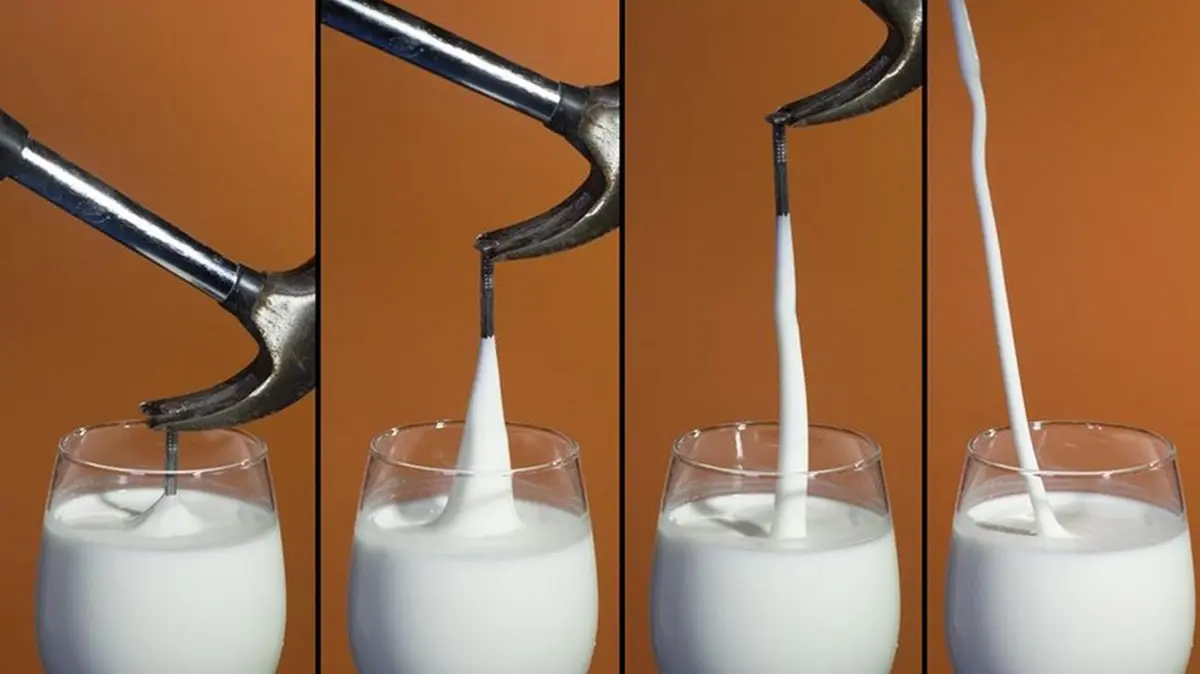
Physicists have recently investigated how a cornstarch‑and‑water mixture, often used in science demonstrations, behaves when struck at very high speeds. Contrary to the common belief that the mixture instantly solidifies under impact, the study shows that at extreme velocities it initially flows like a liquid before becoming stiff.
Background
Cornstarch is a fine carbohydrate powder extracted from the endosperm of maize kernels. It is widely used as a thickening agent in soups and sauces, a component of baking powders, and a raw material in adhesives, pharmaceuticals and biodegradable plastics. When mixed with water in roughly equal proportions, it forms a shear‑thickening fluid known to children as “oobleck” that flows under gentle motions but resists sudden force.
What the new study found
- Three impact regimes: Experiments dropping liquid droplets onto cornstarch suspensions at speeds ranging from 0.2 to 10 metres per second revealed three behaviours. At low speeds, the drop spreads like an ordinary liquid. At moderate speeds, the suspension stiffens and recoils due to shear thickening. At very high speeds, the surface briefly behaves like a liquid for a fraction of a millisecond before solidifying.
- Transient fluid layer: The researchers found that the apparent liquefaction at high speeds arises because a thin lubrication layer forms between the impacting drop and the bulk fluid, allowing the drop to slide before the particles jam and the fluid stiffens.
- Unified model: By combining experimental data and theory, the team developed a model predicting the transition between fluid‑like and solid‑like behaviour based on impact velocity, particle concentration and fluid viscosity.
Significance
- Materials design: Understanding the complex dynamics of shear‑thickening fluids can inform the development of protective gear, body armour and impact‑resistant coatings that remain flexible under normal conditions but harden upon impact.
- Industrial applications: Insights from the study could improve processing of slurries and suspensions in industries such as food, pharmaceuticals and ceramics where controlling flow properties is essential.
- Educational value: The results refine our understanding of a popular classroom experiment and demonstrate that even simple mixtures can exhibit rich physics.
Conclusion
The familiar cornstarch suspension turns out to be more complex than it looks. At extreme impact velocities, it briefly flows like a liquid before rapidly locking up. Such findings remind us that everyday materials can harbour surprising behaviour when pushed to their limits.
Source: The Hindu