
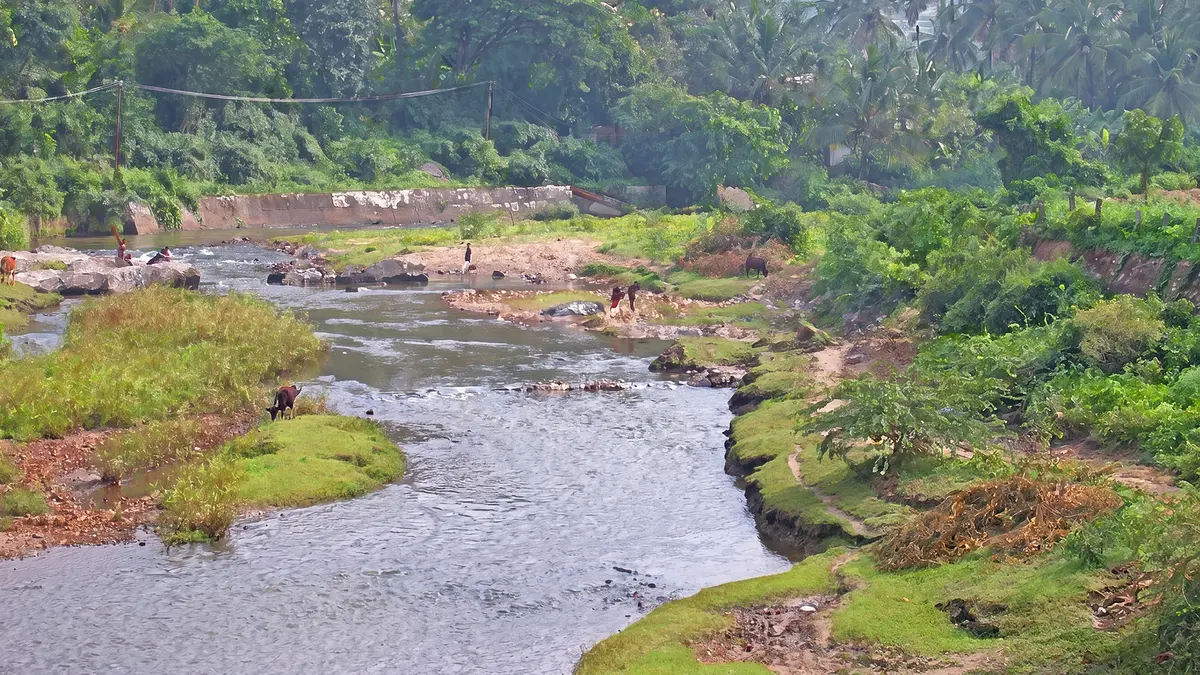
Why in news?
Members of the Noyyal Farmers’ Protection Association in Tamil Nadu have urged the Tiruppur City Municipal Corporation to stop dumping and burning garbage along the banks of the Noyyal River. They say that household, medical and plastic waste are being deposited on the riverbanks and set on fire, aggravating pollution. Officials have promised to remove the dumped waste and commission a new solid‑waste management park.
Background of the river
The Noyyal River is a tributary of the Cauvery River. It begins as small streams in the Vellingiri Hills of the Western Ghats and flows roughly 158 kilometres eastwards through the districts of Coimbatore, Tiruppur, Erode and Karur before joining the Cauvery at Noyyal village. Historically, the river and its network of tanks and canals formed the backbone of irrigation in the region.
Historical irrigation system
- Chola engineering: Between the 10th and 13th centuries CE, the Chalukya Cholas constructed an interconnected system of tanks, anicuts (small dams) and feeder channels along the Noyyal. These earth‑bund reservoirs captured monsoon flows, regulated floods and provided water for agriculture. Many of the original structures are still in use today and irrigate over 9,000 acres of farmland.
- Major tanks: Notable reservoirs include the Perur Big Tank, Coimbatore Big Tank and Valankulam. Water from the tanks recharges groundwater, supplies municipalities and supports local biodiversity.
Recent environmental concerns
- Waste dumping and burning: Farmers report that municipal workers dump unsorted garbage on the riverbanks and then set it alight, releasing toxins and further polluting the already degraded river.
- Industrial pollution: Over the last few decades, dyeing and textile units in Tiruppur and Coimbatore have discharged untreated effluents into the Noyyal, turning parts of the river into a channel of sewage and chemicals. This has diminished its role as a drinking‑water source.
- Demand for restoration: Local residents and environmental groups are calling for effective waste management, strict enforcement against industrial discharges and rejuvenation of the river’s tank system.
Significance
- Agricultural lifeline: The Noyyal’s tanks irrigate thousands of acres, ensuring stable crop yields in a semi‑arid region. Their continued use illustrates ancient sustainability practices.
- Cultural heritage: The river system is a living example of Chola hydrological engineering. Preserving it safeguards both heritage and water security.
- Environmental imperative: Addressing pollution will improve water quality for farmers, recharge groundwater and protect downstream ecosystems in the Cauvery basin.
Source: The New Indian Express

