
Why in news?
A Chinese destroyer conducted live-fire training near Japan-administered Okinotori. Russian and other Chinese vessels were also nearby. Japan protested over navigation safety, while China rejected Japan’s claimed maritime rights.
Background
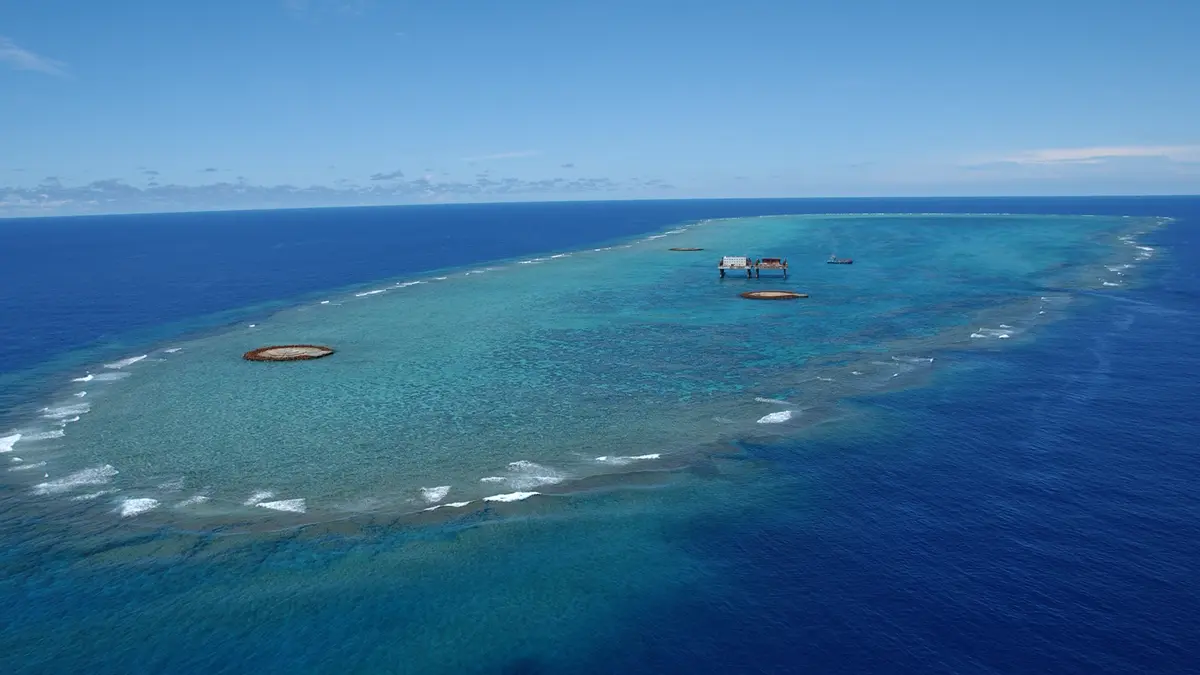
Okinotori is a remote Philippine Sea atoll, meaning a ring-shaped coral reef enclosing a shallow lagoon.
Japan administers Okinotori as part of Ogasawara Village within Tokyo Metropolis.
It is Japan’s southernmost administered island and lies around 1,700 kilometres from central Tokyo.
It is also Japan’s only administered territory south of the Tropic of Cancer.
Physical geography
- The table reef measures about 4.5 kilometres east-to-west and 1.7 kilometres north-to-south.
- The reef covers roughly 5.8 square kilometres and has an eleven-kilometre perimeter.
- Only Kitakojima and Higashikojima remain above water during high tide.
- Concrete protective works surround both tiny islets against erosion and storm damage.
The atoll developed above a Kyushu–Palau Ridge seamount through coral accumulation across millions of years.
Its coral layer is over 1,500 metres thick and developed across roughly fifteen million years.
The official Tokyo profile calls it the ridge’s only sea-level seamount apart from Palau.
A short chronological history
- A Spanish ship may have recorded the feature during 1543, although other theories remain.
- Japan named it Okinotori and placed it under Tokyo’s jurisdiction during 1931.
- The United States administered it from 1952, before returning it to Japan during 1968.
- Japan began direct protective works during 1987 and established its claimed zone during 1996.
- A lighthouse started operating during 2007, while Japan designated the atoll as a remote island during 2010.
- Port construction began during 2011, and a new observation base opened during 2019.
Climate and extreme conditions
The atoll has a tropical climate because it lies south of the Tropic of Cancer.
Its official annual averages are 26.8°C for air and 27.7°C for seawater.
Typhoon waves can exceed sixteen metres, while winds may cross fifty metres per second.
The Tokyo Government describes these as Japan’s roughest waters.
Why does such a tiny place matter?
Maritime zones can determine access to fisheries, seabed minerals and scientific research.
Japan bases an exclusive economic zone of about 420,000 square kilometres upon Okinotori.
This claimed maritime area is larger than Japan’s entire land area.
The surrounding Pacific also lies near important military and ocean-navigation routes.
What is an exclusive economic zone?
An exclusive economic zone may extend up to 200 nautical miles from lawful baselines.
The coastal state receives sovereign rights over natural resources within this zone.
It also has limited jurisdiction over research and environmental protection, but the zone is not sovereign territory.
Other states generally retain navigation and overflight freedoms there.
Key distinction: A territorial sea involves sovereignty. An exclusive economic zone mainly grants resource-related rights and defined jurisdiction.
Why do Japan and China disagree?
Article 121 of the United Nations Convention on the Law of the Sea governs islands.
The convention is commonly shortened to UNCLOS after its full name is introduced.
An island must be naturally formed, surrounded by water and exposed during high tide.
Such islands can normally generate territorial seas and exclusive economic zones.
However, Article 121 creates an important exception for certain rocks.
Rocks unable to sustain human habitation or economic life of their own cannot generate such zones.
Japan treats Okinotori as an island capable of supporting an exclusive economic zone.
China considers it a reef or rock that cannot create that zone.
The dispute concerns maritime entitlement, not simply Japan’s everyday administration of the features.
What happened during the naval incident?
Japanese forces observed three Chinese vessels and one Russian frigate on 19 July.
A Chinese guided-missile destroyer then conducted live firing about 180 kilometres south-west of Okinotori.
The location fell within the exclusive economic zone claimed by Japan.
Nearby vessels received a radio warning immediately before the firing.
Japan still protested because the activity could endanger vessels using those waters.
China described its actions as lawful high-seas activity, while Japan reported no entry into its territorial sea.
“First” clarified: Japan said this was its first public disclosure of such Chinese firing there. It did not establish the first exercise ever conducted.
Why is the issue strategically important?
The case combines maritime law, strategic geography and growing China–Russia military cooperation.
It also shows how a small exposed feature can support enormous maritime claims.
Climate, erosion and sea-level change make its physical protection important for Japan.
Conclusion
Okinotori’s tiny islets create a dispute far larger than their visible land area.
The central question is whether they can lawfully generate an exclusive economic zone.