

Why in news?
A study published in Nature Communications on 18 August 2026 explained the narwhal tusk’s unusual structure. Researchers found opposite twists within its outer cementum and inner dentine. These layers counterbalance rotational forces as the tusk grows. The arrangement helps a long spiral tooth remain broadly straight instead of coiling. The study combined imaging, mechanical testing and samples obtained through regulated Greenlandic subsistence hunting.
The narwhal and its distinctive tooth
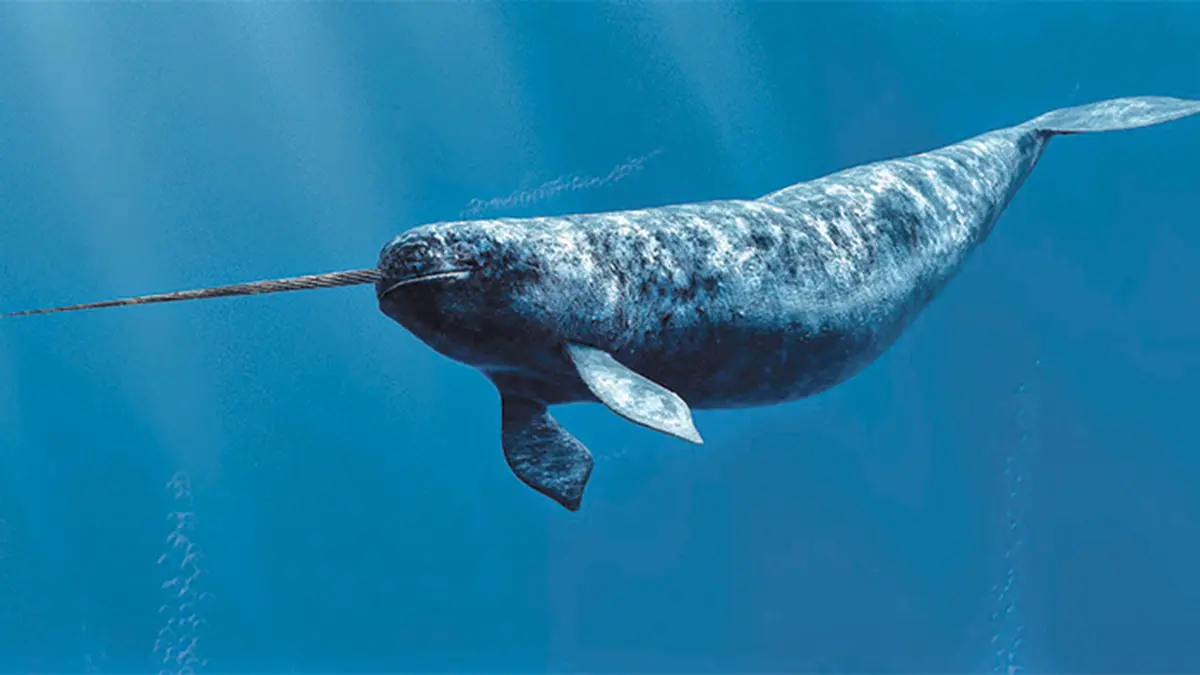
The narwhal’s scientific name is Monodon monoceros. It is a medium-sized whale adapted to Arctic seas. Most adult males develop one long tusk from the upper left jaw. The tusk is an enlarged tooth, not a horn. Some females also develop one, while rare animals have two.
A male tusk usually projects forward in a left-handed spiral. It can grow for many years without forming a corkscrew shape. That combination created a biological puzzle. Visible spiral markings suggest rotation. Yet the whole structure normally remains almost straight along its length.
Where narwhals live
Narwhals inhabit Arctic waters around Canada, Greenland and parts of eastern Russia. Many populations migrate between summer coastal areas and offshore winter habitat. They use cracks and openings within sea ice for breathing. Deep dives allow feeding on fish, squid and other marine prey.
Baffin Bay lies between Canada’s Baffin Island and Greenland. It supports major narwhal populations and seasonal migration. Sea ice, deep channels and coastal fjords shape their movement. Climate-driven ice change can alter access to prey and traditional hunting areas. Shipping noise creates another growing pressure.
How the study examined the tusk
The research used material from male narwhals connected with Greenlandic Inuit subsistence hunts. It included two specimens and six split tusks held by Greenlandic institutions. Researchers applied computed tomography and mechanical tests. They also used advanced X-ray methods at European synchrotron facilities.
These methods mapped tiny mineralised collagen structures without relying only on surface appearance. Imaging connected microscopic organisation with the full tusk. Mechanical splitting revealed stored rotational forces. The combined approach allowed the researchers to test how separate tissue layers interact.
Two layers twist in opposite directions
The outer cementum contains collagen fibrils arranged with a left-handed twist. The inner dentine has a right-handed organisation. Most microscopic mineralised fibres still run largely along the tusk. The opposite patterns create balanced mechanical tendencies across the whole tooth.
When researchers split tusks lengthwise, the two halves released stored torque. Each half could rotate by more than 180 degrees. This behaviour showed that the intact layers restrain each other. The design distributes stress while allowing steady forward growth.
Why straightness is useful
A severely curved tusk could become mechanically unstable and harder to use. Straight growth preserves reach while limiting damaging bending. The layered structure also combines stiffness with controlled strain. Nature achieves this through tissue organisation rather than a uniform solid material.
The finding may inform engineered composites. Designers often seek light structures that resist twisting and cracking. Opposing fibre directions can balance internal forces. Any engineering use would require separate testing and manufacturing work. The whale study provides a principle, not a ready product.
What the tusk does
Narwhal tusks contain many nerve endings and can detect environmental changes. Males also use them during social displays. Observations show contact between tusks and occasional feeding-related behaviour. No single function fully explains the feature. Evolution may preserve structures that serve several roles.
The new paper mainly explains structure and growth. It does not settle every behavioural or evolutionary question. Its sample also came from a limited regional collection. Wider comparative work could test variation across age, sex and population. That limit does not weaken the observed tissue pattern.
Conservation context
Narwhals depend on a rapidly changing Arctic environment. Reduced sea ice can reshape migration and predator exposure. Industrial activity may increase underwater noise and collision risks. Management also considers regulated subsistence hunting. Good decisions need population-specific data because different groups face different conditions.
A spiral surface, but a straight structure
The tusk does not grow by simply rotating like a drill. Its two main tissues contain opposite microscopic twists. Their forces counterbalance each other. This layered organisation produces the familiar spiral surface while limiting whole-tusk curvature.
Conclusion
The study turns a striking Arctic feature into a clear lesson about biological engineering. Opposing tissue twists allow strength, controlled growth and overall straightness. The result also shows why structure matters across several scales. Further research should test broader samples and possible material applications. Protecting narwhal habitats remains equally important because remarkable anatomy cannot be separated from a changing Arctic.