

Why in news?
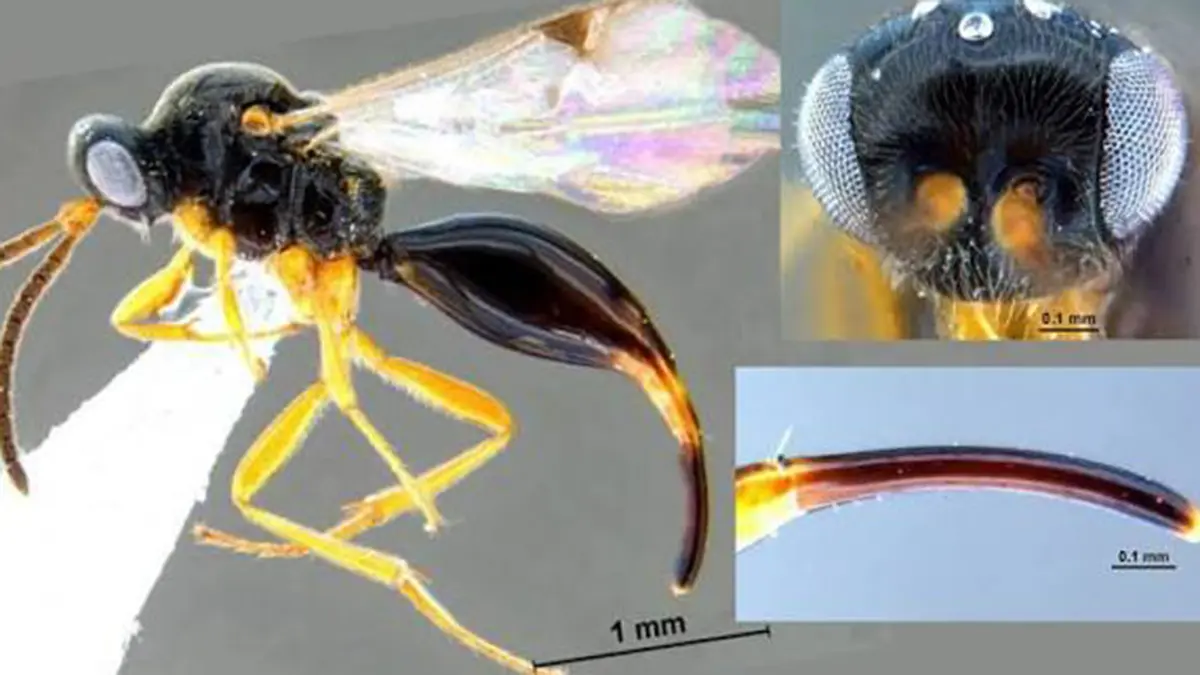
Researchers have described Oxyserphus narendrani, a small wasp collected in Assam's Dibru-Saikhowa National Park. A Research Matters feature on 22 September brought attention to the species description published earlier this month. The study establishes India's first confirmed record of its genus, a group of closely related species. The authors also identify it as that genus's first formally described species from the Oriental biogeographic region. That region broadly covers tropical South and Southeast Asia. This does not mean it is the region's first parasitoid wasp. The discovery fills a specific gap in insect classification. Its anatomy is now documented, but its host, wider distribution and population remain unknown.
From a field collection to a named species
The specimen was collected on 19 November 2024, well before the announcement attracted public attention. Rahul Mondal caught the female in a yellow pan trap during fieldwork. Such a trap samples insects attracted to its colour. The specimen subsequently entered the National Zoological Collections of the Zoological Survey of India in Kolkata. Rupam Debnath and Keloth Rajmohana examined it against published descriptions and identification keys. Their paper appeared in the journal Species on 12 September 2026.
This sequence explains what a scientific discovery means here. The insect was not newly created, and publication does not establish when its lineage evolved. Scientists recognised that a collected animal did not fit previously described species. They then documented the differences so others could examine the identification. The preserved female is the holotype, the name-bearing reference specimen. Keeping that specimen accessible makes the description testable beyond the original researchers' photographs and observations.
What distinguishes this wasp?
The female measures 3.30 millimetres including its egg-laying structure, called the ovipositor. Its head is black, much of its body is brownish-black, and its legs are yellow. Colour alone was not enough to establish a new species. The researchers compared grooves, surface sculpture, wing features and relative body measurements. Under a microscope, these small structures provide repeatable characters. They help distinguish close relatives that could look almost identical in an ordinary photograph.
One useful comparison concerns the Australian species Oxyserphus sulcatus. That species has several fine grooves on a particular side plate near the front of the body. The Indian specimen has one complete horizontal groove and a shallower, incomplete groove above it. Its ovipositor sheath is also shorter relative to the hind tibia, a leg segment. The description uses several characters together. It does not treat a single colour difference or an unusually small individual as sufficient evidence.
The species name honours the late T. C. Narendran, an Indian specialist in parasitoid-wasp taxonomy. Taxonomy is the science of recognising, describing and classifying organisms. Earlier records indicated that the genus occurred in the Oriental region, but did not formally describe a regional species. The genus belongs to the family Proctotrupidae within Hymenoptera, the insect order containing wasps, bees and ants. These nested groups locate the species within a broader evolutionary framework. They also let researchers compare records across countries without relying on changing local names.
What is known about its ecological role?
A parasitoid develops in or on another organism and eventually kills that host. This differs from ordinary predation, where an animal typically consumes multiple prey during its life. Some members of Oxyserphus are associated with beetle larvae. However, the new species was collected as an adult, not reared from a known host. The paper explicitly records its biology as unknown. Assigning it a particular crop pest, or promising a new pest-control tool, would go beyond this evidence.
The same caution applies to abundance. Only one specimen of the genus emerged from the material examined for this study. That makes further sampling valuable, but it does not establish a threatened population or a tiny total range. Trap type, season, habitat and collecting effort affect what researchers find. A species can be poorly represented in collections because it is overlooked. Repeated surveys would help separate genuine rarity from limited detection.
The floodplain setting in Assam
Dibru-Saikhowa lies in upper Assam, in the Dibrugarh–Tinsukia landscape. The Brahmaputra and Lohit border its northern side, while the Dibru lies to the south. Its habitat includes wet forests, grasslands and canebrakes shaped by a dynamic river environment. This geographical setting matters because insect communities depend on vegetation, moisture and host availability. A protected landscape is therefore more than a refuge for its most visible mammals and birds.
The national park covers 340 square kilometres; the surrounding biosphere reserve covers a larger area. Those two designations should not be treated as identical boundaries. Equally, an Assam collection establishes a known locality, not proof that the wasp occurs nowhere else. The authors call for surveys across habitats and regions. They also recommend combining anatomical study with molecular evidence linked to preserved specimens. That would strengthen future comparisons without replacing the physical reference collection.
Conclusion
Oxyserphus narendrani gives an overlooked component of India's biodiversity a documented identity. Its most immediate contribution is a reliable reference for recognising further specimens and studying their relationships. The next questions concern its host, range and life history. Answering them will require additional fieldwork rather than assumptions drawn from its relatives. A precise species description is the beginning of that ecological understanding, not a completed account of the animal's role.