

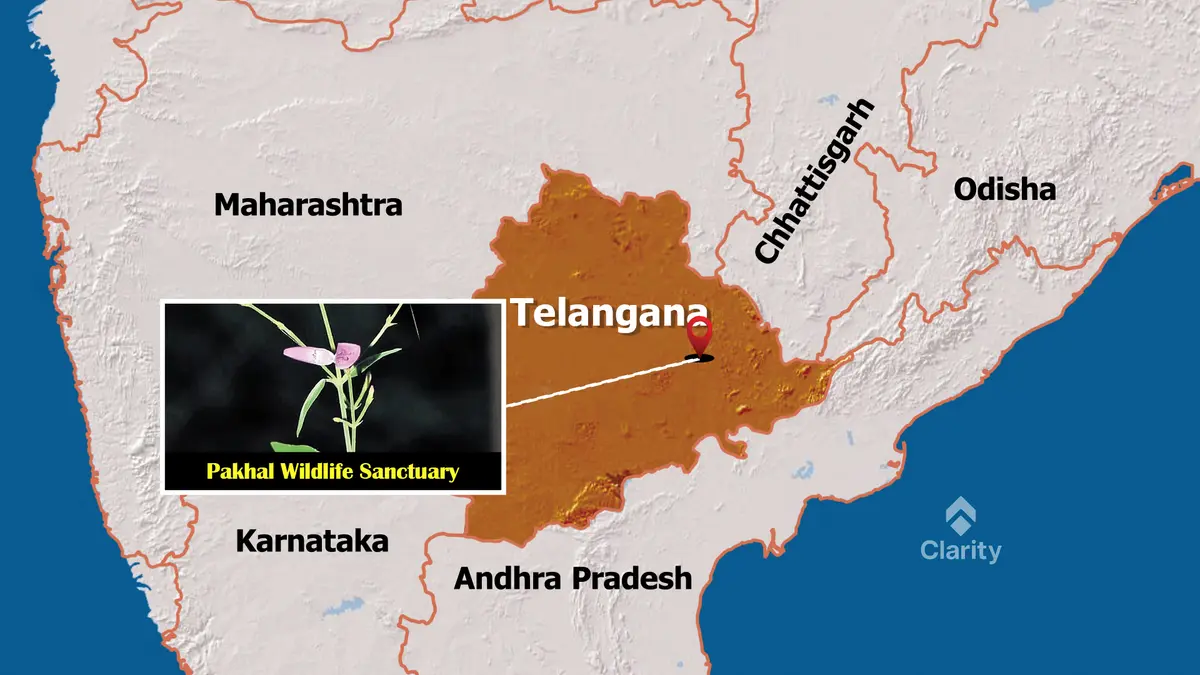
Why in news?
Botanists from the Botanical Survey of India (BSI) have reported a new flowering plant species, Dicliptera pakhalica, in the Pakhal Wildlife Sanctuary of Telangana. The discovery, described in the journal Brittonia, highlights the sanctuary’s rich and still‑unexplored biodiversity.
Background
Pakhal Wildlife Sanctuary surrounds the ancient Pakhal Lake in Warangal district, Telangana. The lake, covering about 30 km², was constructed in 1213 AD by Kakatiya ruler Ganapati Deva to irrigate farmlands. The sanctuary itself was notified in 1952 and spans roughly 839 km² of mixed dry and moist deciduous forest. It supports diverse fauna, including nilgai, chital, sloth bear, leopard, jackal and a variety of birds.
The newly discovered plant belongs to the Acanthaceae family, which includes herbs and shrubs with opposite leaves and tubular flowers. The species was found growing along rocky stream banks inside the sanctuary. Because it is known only from its type locality and has a limited population, researchers have classified it as “Data Deficient” under IUCN guidelines.
Key findings
- Distinct morphology: Dicliptera pakhalica has ovate leaves and bright purple‑pink tubular flowers arranged in terminal spikes. It differs from related species in its flower structure, calyx shape and number of seeds.
- Flowering season: The plant blooms between November and January and sets seed from December to February.
- Restricted range: At present, the species is known only from a few clumps within the sanctuary. The limited distribution makes it vulnerable to habitat disturbance and highlights the need for further surveys.
About Pakhal Wildlife Sanctuary
- Landscape: The sanctuary features rolling hills, flat plateaus and riverine forests around Pakhal Lake. Vegetation is mainly dry deciduous, dominated by teak, bamboo and thorny scrub.
- Heritage lake: Pakhal Lake, created by diverting local streams, continues to irrigate villages and supports migratory birds such as bar‑headed geese and open‑billed storks.
- Fauna: In addition to ungulates and predators, the area hosts reptiles like python and monitor lizard. The surrounding villages depend on forest produce and ecotourism for livelihood.
Significance
- Biodiversity hotspot: The discovery of a new species underscores the importance of protecting Pakhal’s habitats from deforestation and unregulated tourism.
- Scientific value: Detailed taxonomic studies help scientists understand evolutionary relationships within the Acanthaceae family and guide conservation priorities.
- Community awareness: Local communities can benefit from ecotourism and training programmes that encourage sustainable use of forest resources while preserving unique flora.
Conclusion
The identification of Dicliptera pakhalica enriches India’s botanical inventory and highlights the untapped diversity within the Pakhal Wildlife Sanctuary. Continued research and careful management are necessary to ensure that such rare species thrive alongside human activities.
Source: The New Indian Express