

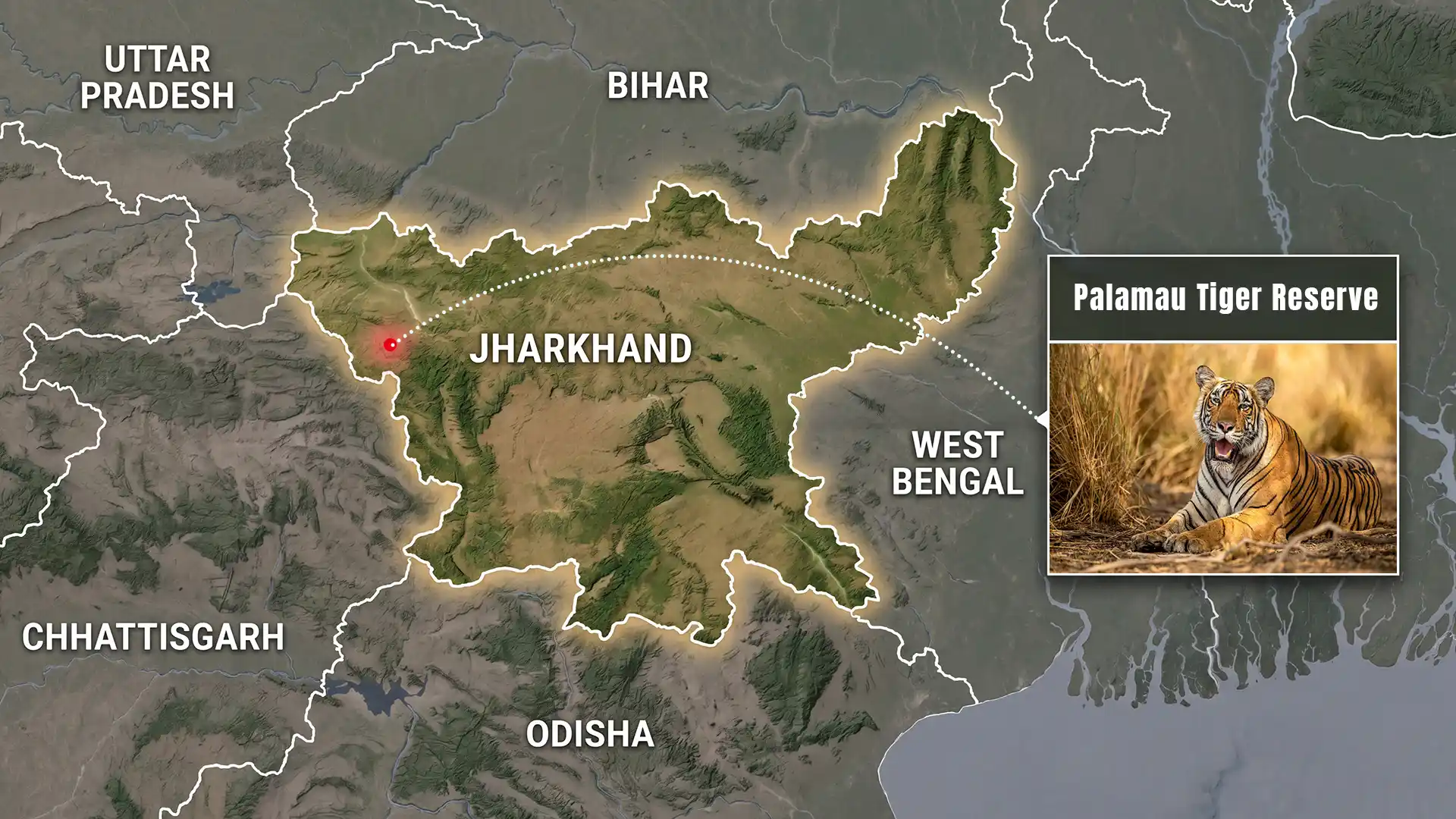
Why in news?
The Jharkhand government has prepared a proposal to set up India’s first dedicated human–elephant conflict research centre in the Palamu Tiger Reserve. The centre will use artificial intelligence to analyse data on elephant movements and human–elephant interactions, with the goal of developing practical solutions to reduce conflicts.
Background
Palamu Tiger Reserve is located in the western part of Latehar district on the Chhotanagpur plateau in Jharkhand. Established as part of Project Tiger in 1973–74, it was among the first nine tiger reserves in India. The reserve covers about 1,130 square kilometres and includes a core area (critical tiger habitat) and a buffer zone. It lies between the Netarhat forest to the south and the Auranga River to the north and serves as the watershed for the Koel, Burha and Auranga rivers. The reserve’s forests of sal, mixed deciduous trees and bamboo support tigers, leopards, elephants and many other species.
Research centre details
- Site and purpose: A 15‑acre site inside the reserve has been identified for the research facility. It will conduct in‑depth analysis of data related to human–elephant conflict and produce solution‑oriented reports to help mitigate such incidents.
- Use of AI: The centre will employ artificial intelligence to study elephant vocalisations, behaviour and movement patterns. It will monitor how elephants communicate when foraging, mating or signalling danger and analyse seasonal and regional variations in their behaviour.
- Captive elephants: The facility will work with captive elephants to collect detailed behavioural data. Insights gathered will inform strategies to reduce conflicts in the wild.
- Importance: Human–elephant conflict is a major conservation challenge in India, causing crop damage, injuries and sometimes loss of life on both sides. A dedicated research centre can provide evidence‑based recommendations for early warning systems, habitat management and community awareness.
About the reserve
- History: Palamu was one of the first reserves created under Project Tiger and has the distinction of being the first sanctuary where a tiger census was conducted using pugmark tracking in 1932. Before designation, the area was managed for timber extraction and grazing. After protection measures were introduced, grazing and logging were restricted, fire control and soil conservation were improved and wildlife habitats recovered.
- Landscape: The reserve consists of sal and mixed deciduous forests with bamboo groves and grassy openings. It forms part of the watershed for three rivers and includes waterfalls and a hot spring.
- Biodiversity: Besides tigers, leopards and elephants, the reserve supports gaurs, sambar, chital, barking deer and nilgai. About 170 bird species have been recorded, along with several globally threatened species. However, the area faces threats such as poaching, illegal logging, grazing, forest fires and proposed mining projects.