
Why in news?
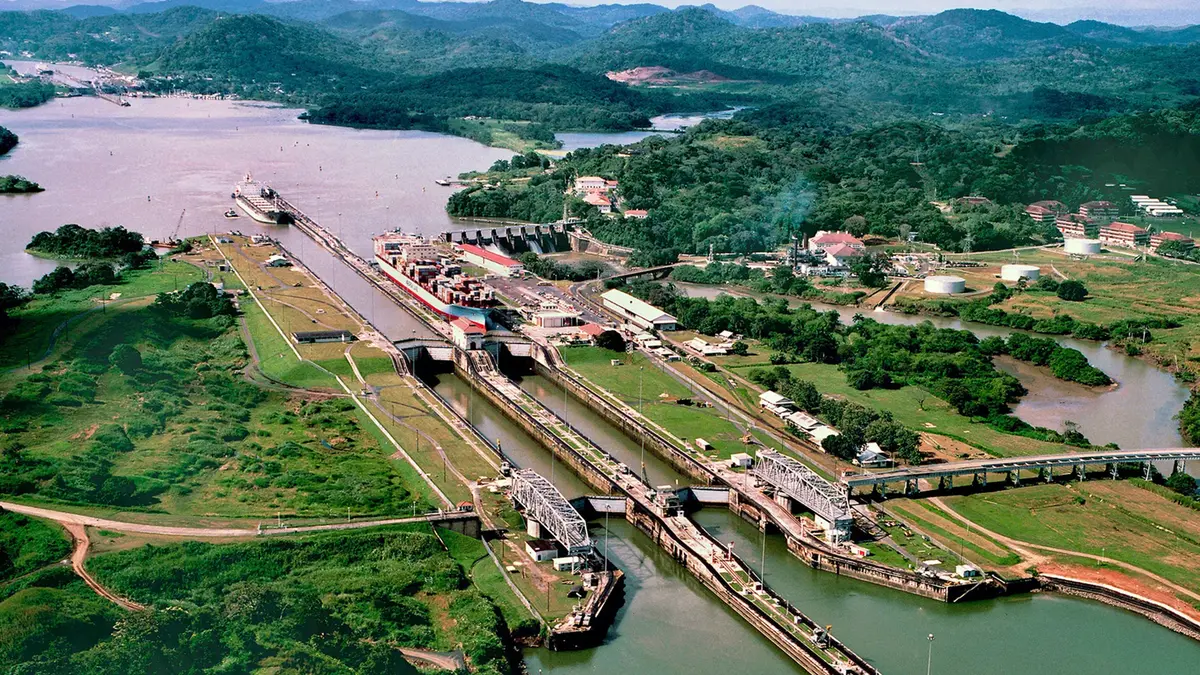
The head of the Panama Canal Authority recently stated that the canal is operating at top capacity, accommodating about 36 to 38 ships per day. The surge in traffic results from commercial vessels, especially liquefied natural gas tankers, diverting away from the conflict‑affected Red Sea and Suez Canal. With ships choosing the Pacific‑Atlantic route across Panama, the waterway has become congested.
Background
The Panama Canal is an 82‑kilometre artificial waterway that connects the Caribbean Sea to the Pacific Ocean across the narrow Isthmus of Panama. Locks at each end lift ships up to the 26‑metre‑high Gatun Lake and lower them back to sea level on the other side. Construction began under French engineers in the late 19th century, but the project was completed by the United States in 1914. Control of the canal gradually passed to Panama, which has operated it since 1999. A third lane of locks, opened in 2016, allows larger ships to transit, but each passage still uses roughly 200 million litres of freshwater.
Current challenges
- Increased demand: Geopolitical tensions and the risk of attacks on shipping in West Asia have prompted many vessels to reroute via Panama. The canal’s schedules are now filled weeks in advance.
- Water constraints: The canal depends on rainfall to refill Gatun Lake. Prolonged drought conditions in Panama occasionally force authorities to restrict the number of daily transits or the maximum draft of ships to conserve water.
- Global trade impacts: Congestion at the canal can delay cargo shipments, raise freight costs and affect supply chains. Shipping companies must weigh the time saved by using the canal against potential delays and fees.
Significance
- Shorter routes: By connecting two oceans, the canal eliminates the long journey around South America’s Cape Horn, saving vessels thousands of kilometres and weeks at sea.
- Strategic importance: With the Suez Canal facing disruptions, Panama has become a vital artery for global trade, particularly for energy cargoes.
- Sustainability concerns: The canal’s operation depends on freshwater that could otherwise serve local communities. Climate‑resilient infrastructure and water conservation measures will be critical as demand grows and rainfall patterns change.
Conclusion
The Panama Canal, an engineering marvel over a century old, remains central to world commerce. Recent geopolitical tensions have underscored both its strategic value and its vulnerability to overcrowding and climate variability. Ensuring its smooth functioning will require cooperation among shipping lines, canal authorities and governments worldwide.
Source: The Hindu

