

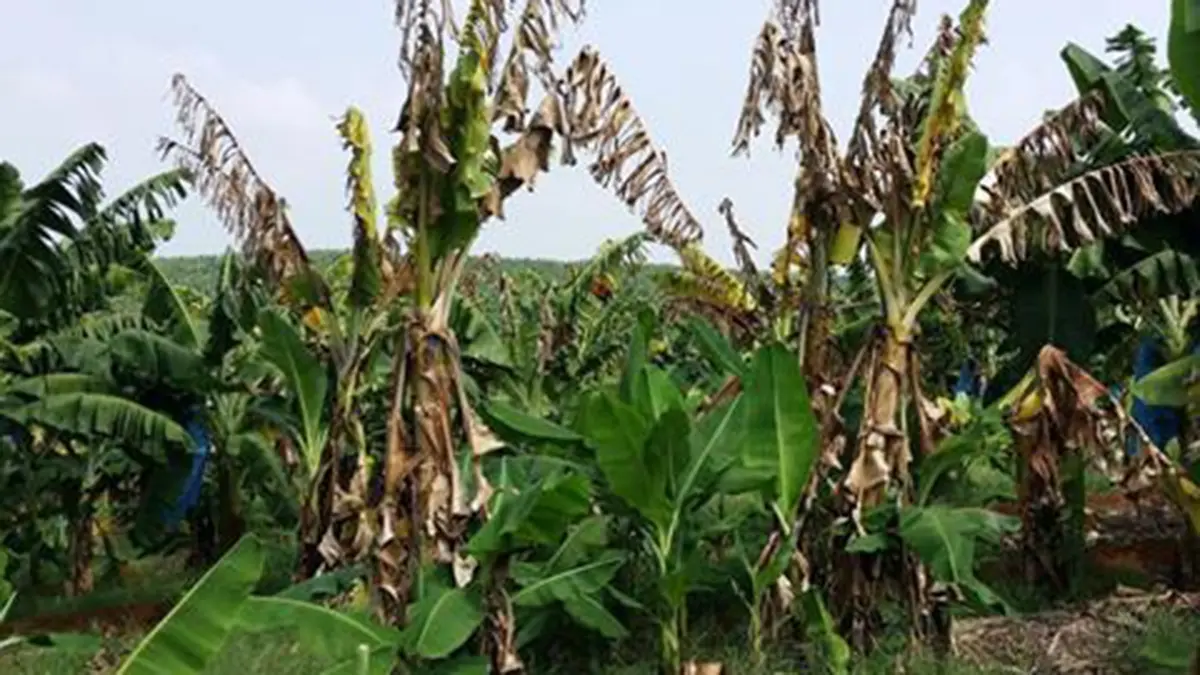
Why in news?
Scientists from the University of Queensland in Australia announced on 20 February 2026 that they have identified a genetic region in a wild banana variety that provides resistance to the devastating Panama disease. By crossing the resistant Calcutta 4 banana with susceptible varieties, they have developed progeny that withstands the virulent subtropical race 4 (STR4) of the pathogen, offering hope for breeding disease‑resistant bananas.
Background
Panama disease, or fusarium wilt, is caused by the soil‑dwelling fungus Fusarium oxysporum f. sp. cubense. It infects banana plants through their roots, blocking water and nutrient transport and ultimately killing the plant. The disease devastated commercial banana plantations in the mid‑20th century and continues to threaten the globally dominant Cavendish variety. Because the fungus persists in soil for decades and there is no effective chemical control, developing resistant plants is the most promising solution.
Discovery of resistance
- Research approach: The Queensland team used forward genetics, disease screening, genome sequencing and bulked segregant analysis to locate the resistance trait.
- Calcutta 4: This wild diploid banana contains natural resistance to STR4 but produces fruit that are not commercially edible. Scientists crossed it with susceptible diploid bananas and compared the DNA of resistant and susceptible progeny.
- Chromosome 5: The resistance was mapped to a region on chromosome 5. Developing molecular markers for this locus will allow breeders to identify resistant seedlings early, speeding up breeding programmes.
What is Panama disease?
- Cause: A fungal pathogen living in soil, it infects banana roots and blocks xylem vessels.
- Symptoms: Initial yellowing and wilting of older leaves, followed by darkening of the stem and eventual plant death. Infected plantations develop a skirt of dead leaves around the base.
- Crops affected: The globally cultivated Cavendish bananas are highly susceptible, and the disease has been described as “banana cancer” because of its destructive impact.
Significance of the breakthrough
- Breeding resistant varieties: Identifying the resistance gene opens the door to developing commercially viable, disease‑resistant bananas, protecting the livelihoods of millions of farmers and ensuring food security.
- Global food impact: More than 400 million people rely on bananas for a significant portion of their calories; protecting plantations from Panama disease is vital.
- Future work: Scientists need to create markers for early screening and breed plants that combine resistance with desirable fruit traits.
Source: Down To Earth