

Why in news?
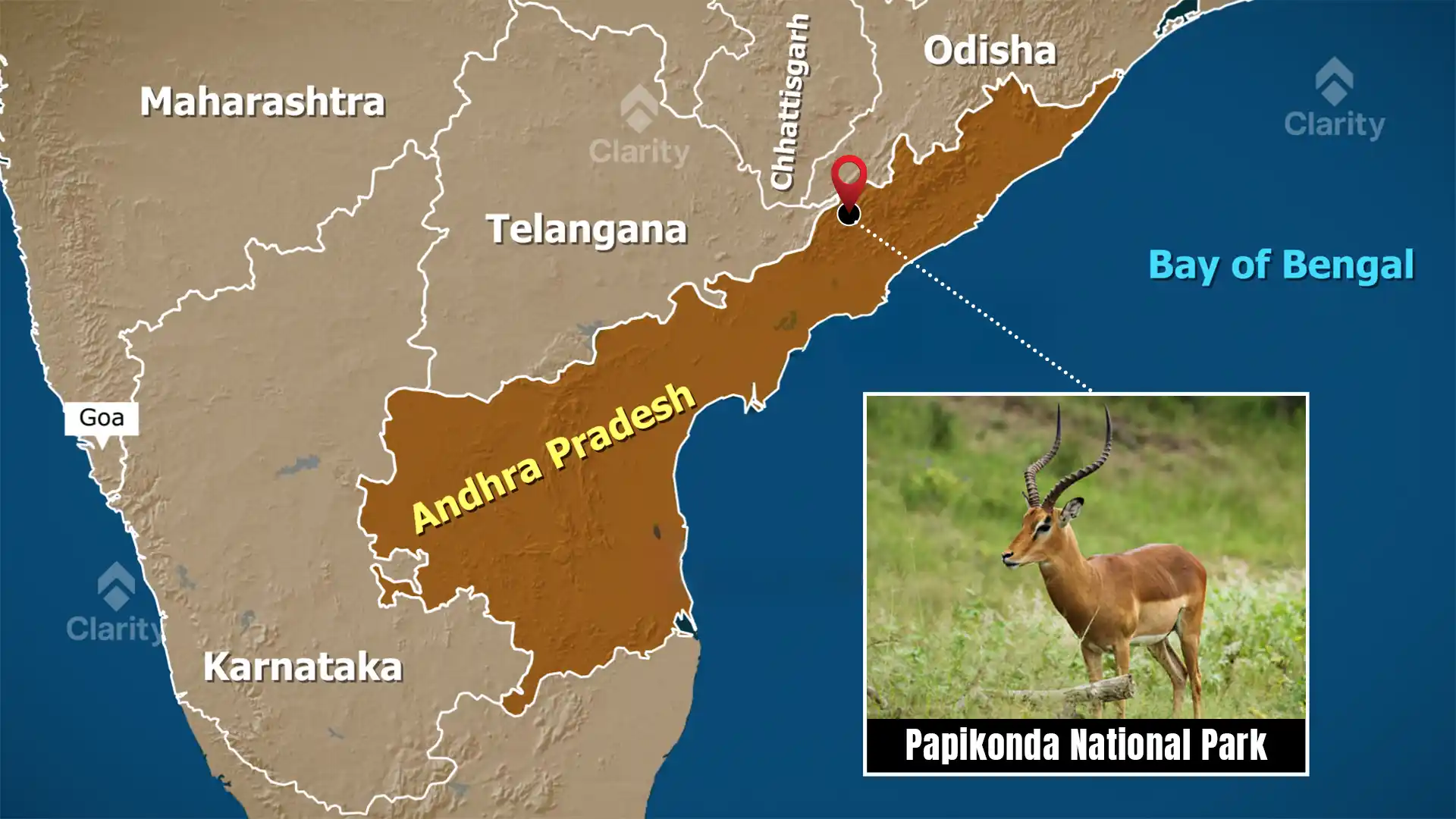
A male tiger nicknamed “Explorer” was recently reintroduced into Papikonda National Park in Andhra Pradesh after travelling over 650 kilometres across multiple states. The relocation, part of “Operation Stripes,” marks the first confirmed tiger presence in the park in decades.
Background
Papikonda National Park lies along the Godavari River in the Eastern Ghats of Andhra Pradesh. Established as a wildlife sanctuary in 1978 and upgraded to a national park in 2008, it covers about 1,013 square kilometres across Alluri Sitharama Raju and Eluru districts. The park’s elevation ranges from 20 metres near the riverbanks to 850 metres on forested hills, receiving around 1,168 mm of annual rainfall.
Natural features
- Diverse forests: The park’s vegetation includes moist and dry deciduous forests dominated by Pterocarpus marsupium, Terminalia species, mango (Mangifera indica) and Sterculia.
- Rich wildlife: Camera traps have recorded Bengal tigers, leopards, rusty‑spotted cats, jungle cats, sloth bears, civets and wild boar. Herbivores include sambar, spotted deer, gaur and four‑horned antelope.
- Avian diversity: Recognised as an Important Bird and Biodiversity Area (IBA), the park hosts endangered species like the black‑bellied tern, pale‑capped pigeon, Malabar pied hornbill and yellow‑throated bulbul.
- Reptiles: The Indian golden gecko, endemic to the Eastern Ghats, and king cobras have been reported here.
Operation Stripes and the tiger’s journey
The adult male tiger originated from the Kawal–Amrabad landscape in Telangana. Over several months, it travelled through forest corridors, swam across rivers including the Godavari, and ventured into Odisha and Chhattisgarh before entering Papikonda. Wildlife officials fitted the tiger with a satellite collar and monitored its movement. Its successful integration into the park demonstrates the potential for restoring tiger populations in the Eastern Ghats.
Significance
- Restoring apex predators: The return of a tiger signals healthy forest connectivity and may help control herbivore populations.
- Conservation awareness: Operation Stripes highlights the need to safeguard wildlife corridors and curb habitat fragmentation.
- Ecotourism potential: A charismatic species like the tiger can attract visitors and generate livelihood opportunities for local communities when managed sustainably.
Sources: The Hindu