Why in news?
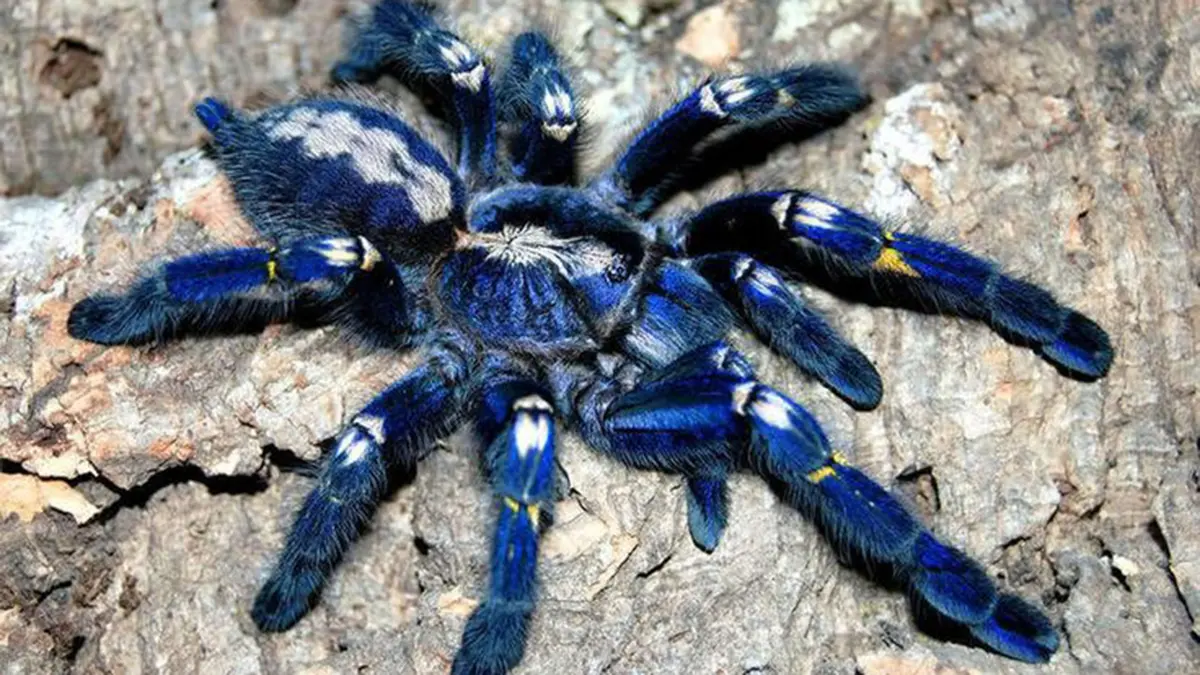
Andhra Pradesh Deputy Chief Minister Pawan Kalyan recently shared photographs of a bright blue spider on social media, describing it as a “rare jewel of the Eastern Ghats.” The spider in question is the Peacock Tarantula (Poecilotheria metallica), an arboreal species that was once found near the town of Gooty but is now critically endangered. The post has sparked renewed interest in the spider’s extraordinary colours and its precarious survival.
Background
The Peacock Tarantula, also known as the Gooty or Sapphire Tarantula, is endemic to a small patch of dry deciduous forest in Andhra Pradesh. Early reports placed its range within a 100 square kilometre area between Nandyal and Giddalur in the Eastern Ghats. This arboreal spider spends its life in tree hollows and bark crevices, emerging at night to hunt insects. Females live up to 12 years, whereas males survive for about 4 years. The species is listed as Critically Endangered by the IUCN due to habitat loss from logging, fuelwood collection and conversion of forests to agriculture, as well as illegal collection for the pet trade.
What gives the tarantula its blue colour?
- Structural colour: Research has shown that the Peacock Tarantula’s intense blue is not due to chemical pigments but to microscopic structures in its hairs. Layers of materials with different densities within each hair reflect blue wavelengths while cancelling others. Even museum specimens retain their colour because it is built into their structure.
- Convergent evolution: Similar shades of blue have evolved independently in unrelated tarantula species through different nanostructural arrangements. This suggests that physics favours certain optical solutions for blue, although scientists still debate the functional advantage of the colour.
- Possible functions: Hypotheses include camouflage against the mottled bark of trees, signalling to predators or mates and thermoregulation. Some studies have discovered that tarantulas possess more colour-sensitive opsins than previously thought, meaning they may perceive colour better than assumed.
Threats to survival
- Habitat loss: Mature trees with natural hollows are being felled for timber, fuelwood and agriculture, leaving the tarantulas with fewer nesting sites.
- Illegal pet trade: The spider’s striking blue colour makes it highly sought after by exotic pet collectors. Removal of even a few individuals from the wild can severely impact its tiny population.
- Unknown population size: No formal estimates of population remain, and the species has not been reliably recorded in the wild for several years. It may be surviving only in scattered pockets or in captivity.
Significance
- Ecological value: As an apex arthropod predator in its niche, the tarantula helps control insect populations and contributes to the health of forest ecosystems.
- Scientific inspiration: The nanostructures that create the tarantula’s colour are inspiring engineers to develop fade-resistant structural colours for textiles and coatings, demonstrating how biological designs can influence technology.
- Conservation message: The species’ plight highlights the need to protect small patches of forest and regulate the wildlife trade. It also shows how viral posts can raise awareness about little-known species.
Conclusion
The Peacock Tarantula is a vivid symbol of India’s hidden biodiversity. Protecting its remaining habitat, curbing the illegal pet trade and conducting targeted surveys are essential steps if this electric-blue spider is to continue dazzling future generations.
Source: The Hindu