

Why in news?
An international team of researchers announced that large peatland lakes in the central Congo Basin are releasing carbon that is thousands of years old. The discovery, published in February 2026, challenges the assumption that tropical peatlands are stable carbon sinks.
Background
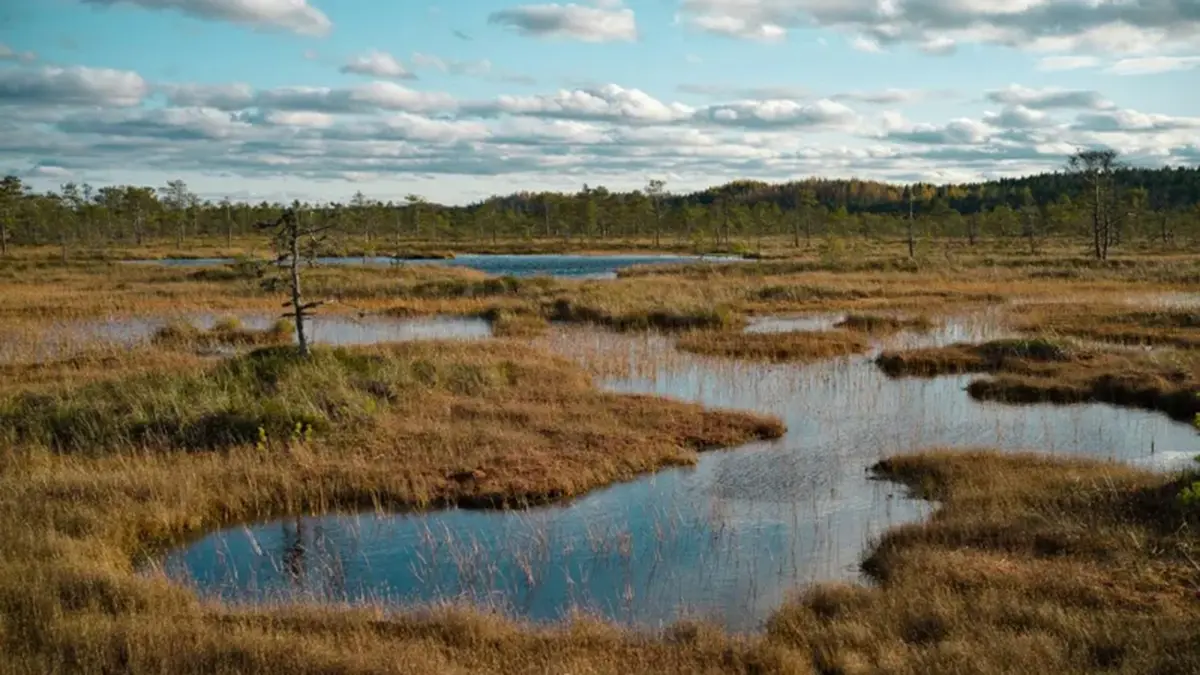
Peatlands are water‑logged wetlands where dead plant matter accumulates faster than it decays, forming peat. Because decomposition is slowed by saturated soils, peatlands lock away enormous amounts of carbon. Although they cover only about 3 % of Earth’s land surface, peatlands store an estimated 600 billion tonnes of carbon—roughly twice as much as all the world’s forests. Protecting these ecosystems is therefore essential to slow climate change.
Congo Basin peatlands
- Largest tropical peat complex: The Congo Basin spans six Central African countries and contains the world’s largest tropical peatlands, holding about 29 billion tonnes of carbon.
- Carbon sink: The Basin absorbs more carbon dioxide than it emits, helping regulate the global climate.
- Threats: Climate change, drainage for agriculture, logging and infrastructure development degrade peatlands. Draining and burning peat releases vast amounts of carbon dioxide.
Discovery of ancient carbon release
Researchers from ETH Zurich studied blackwater lakes, such as Lac Mai Ndombe and Lac Tumba, in the central Congo Basin. They measured carbon dioxide bubbling from these lakes and found that up to 40 % of the carbon came from peat deposited thousands of years ago. This suggests that ancient carbon can leak from peatlands via lakes, raising concerns that peatlands may become net sources of greenhouse gases if disturbed or if the climate becomes drier.
Importance of conservation
The United Nations Environment Programme notes that peatlands absorb more carbon than they emit but are already at risk from climate change and development. International agreements like the Brazzaville Declaration encourage countries to conserve and restore peatlands. Protecting the Congo Basin’s peatlands will require controlling deforestation, preventing drainage and supporting sustainable livelihoods for local communities.
Conclusion
Peatlands are ancient climate regulators. The revelation that old carbon is leaking from Congo Basin lakes underscores how fragile these ecosystems are. Urgent conservation and restoration efforts are needed to keep peatlands functioning as carbon sinks and to avoid releasing more greenhouse gases into the atmosphere.