
Why in news?
A new project is removing invasive African catfish from Periyar Tiger Reserve. The removed fish will become safe, marketable products. Local tribal groups will receive processing and packaging training. The model links freshwater recovery with community income.
Background
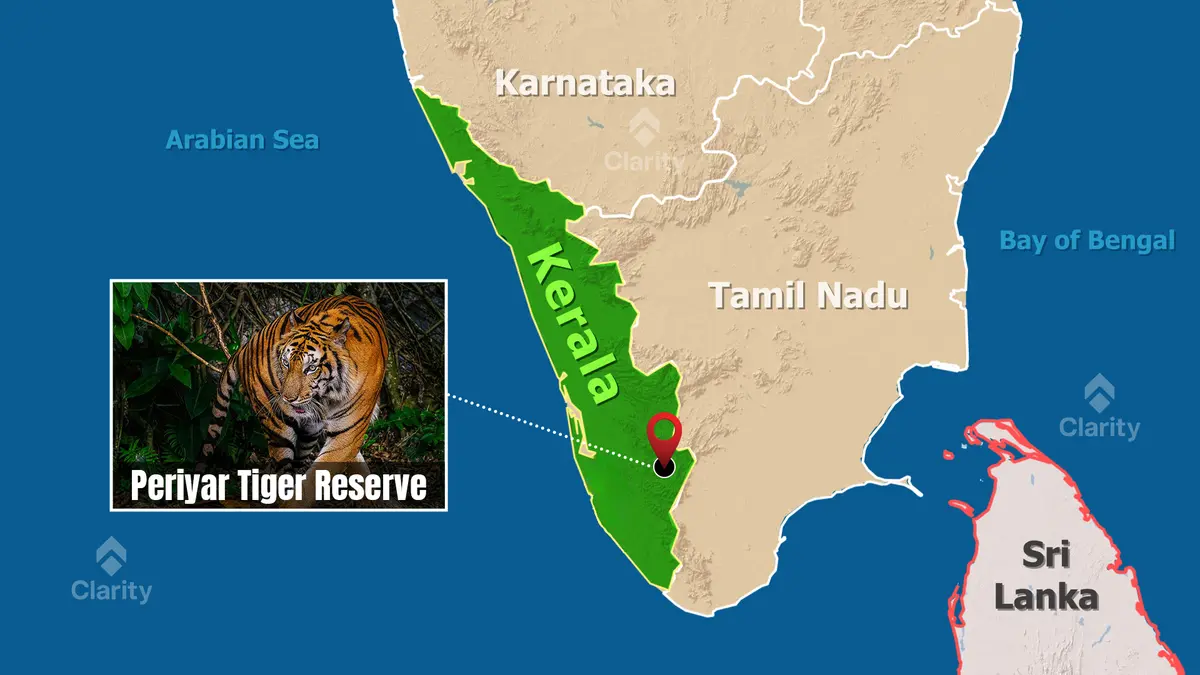
Periyar Tiger Reserve lies in Kerala’s southern Western Ghats, and it extends across Idukki and Pathanamthitta districts.
The reserve protects the watersheds of the Periyar and Pamba rivers, and its forests surround the well-known Periyar Lake.
The lake is a reservoir created after the Mullaperiyar Dam’s construction in 1895. Submerged tree trunks still mark this landscape.
The reserve contains evergreen, semi-evergreen and moist deciduous forests, and it also has grasslands, streams and reservoir habitats.
How did the protected area develop?
- Travancore created Nellikkampatty Game Sanctuary in 1934.
- The area became Periyar Wildlife Sanctuary in 1950.
- Periyar joined Project Tiger during 1978–79.
- A central portion received national park protection in 1982.
- Kerala formally notified the tiger reserve in 2007.
The National Tiger Conservation Authority records 881 square kilometres as core area, and the buffer covers another 44 square kilometres.
The total tiger reserve area is therefore 925 square kilometres. A core receives stronger habitat protection than its surrounding buffer.
Prelims facts: Periyar is in Kerala’s Western Ghats. It protects Periyar and Pamba watersheds and joined Project Tiger during 1978–79.
What is the African catfish?
The African catfish is scientifically called Clarias gariepinus. Its natural range covers much of Africa and parts of West Asia.
It is an air-breathing freshwater fish, and it can survive poor oxygen conditions and move across wet ground.
The fish grows rapidly and eats many kinds of prey. Its diet can include fish, frogs, insects and smaller aquatic animals.
These qualities support commercial farming within its native range, and outside that range, they can make the fish highly invasive.
How did it become an ecological problem?
People introduced African catfish into many countries for aquaculture, and some escaped or entered natural water bodies through deliberate releases.
In Indian freshwater systems, the fish can compete with native species. It can also consume smaller native fish and their young.
Hardiness allows it to survive conditions that exclude sensitive native species. Floods can help it enter connected streams and wetlands.
India prohibits its culture and breeding, and removal programmes must also prevent live transport, escape or renewed farming.
Important correction: Gee’s golden langur does not naturally occur in Periyar. Its native range lies mainly in Assam and Bhutan.
What does the new initiative propose?
The Kerala University of Fisheries and Ocean Studies leads the initiative, and Smrithy Raj heads the project team.
Partners include the Periyar Tiger Conservation Foundation. The University of Kerala and the Indian Council of Agricultural Research also participate.
- Teams will remove African catfish from reserve waters.
- Experts will teach scientific handling and hygienic processing.
- The catch can become jerky, pickles and pet chews.
- Training will cover packaging and quality assurance.
- Local Eco Development Committees can market approved products.
- Income can reward continued removal and monitoring.
Eco Development Committees link nearby communities with protected-area management, and their activities combine livelihoods with conservation duties.
Why is this called a circular model?
A circular model turns unwanted biological material into useful products, and it reduces waste while financing further removal.
Ordinary capture campaigns can stop when project funding ends, and a viable product may support continued effort and local employment.
This approach also avoids simply dumping removed fish, and controlled processing can convert an ecological problem into an economic input.
Why is Periyar’s freshwater diversity important?
The reserve’s streams contain several narrowly distributed freshwater fish, and the news report mentions nine point-endemic fish species.
A point-endemic species occurs naturally in one extremely small location, and losing that habitat could remove the entire species.
Freshwater species often receive less attention than tigers, but healthy streams support wildlife, forests and downstream human communities.
What safeguards are necessary?
- Captured fish should never return alive to open water.
- Demand must not encourage illegal African catfish farming.
- Processing must meet food and animal-product safety rules.
- Removal should use methods that spare native aquatic life.
- Teams should measure native-fish recovery over several seasons.
- Community payments should remain fair and transparent.
Removal alone may not eliminate every fish, and barriers against re-entry and regular surveillance are equally important.
Conclusion
Periyar’s project combines invasive-species control with livelihoods, and strong safeguards can make this model useful for other protected freshwater systems.