

Why in news?
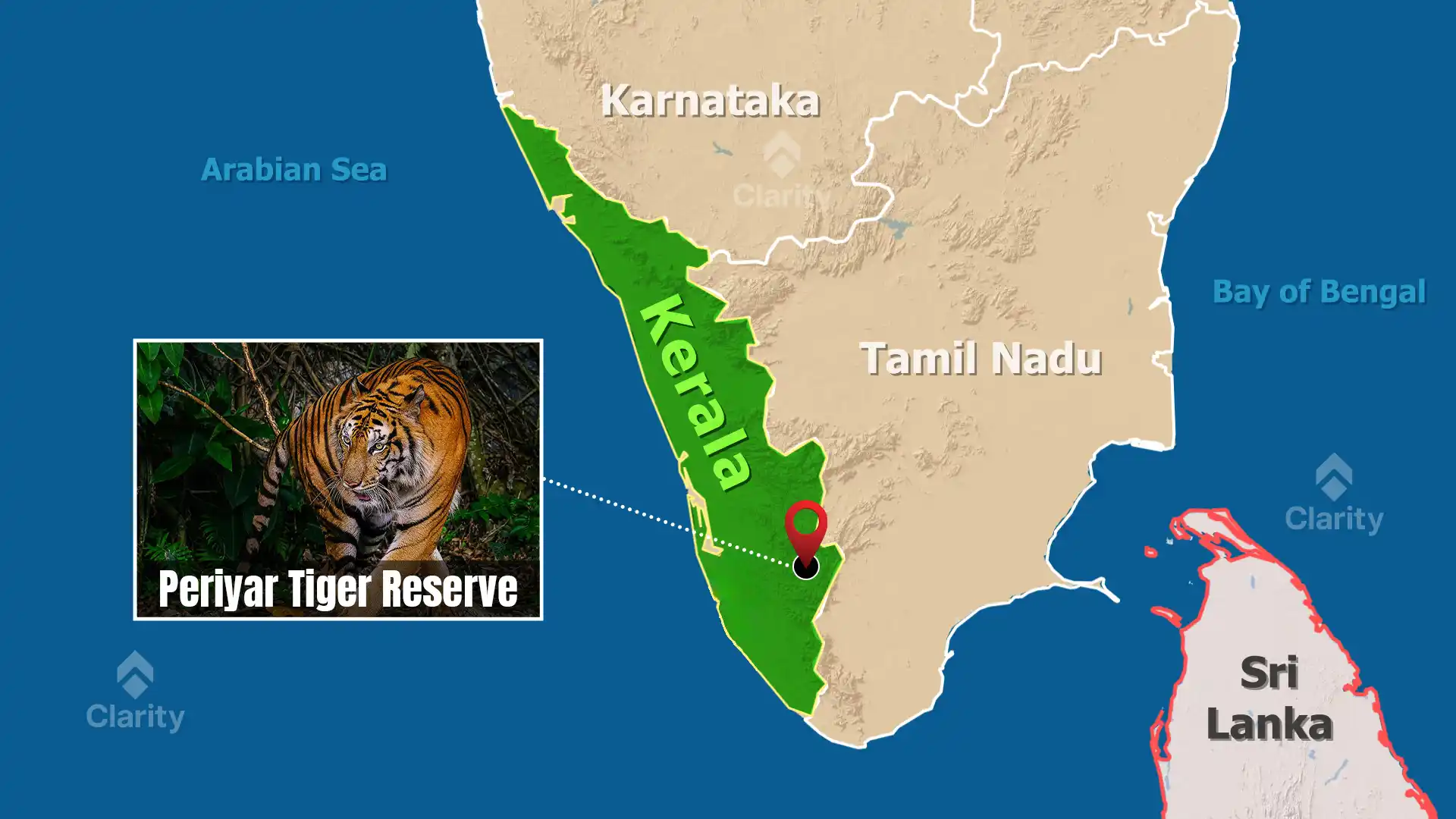
The Periyar Tiger Reserve in Kerala has launched the third phase of India’s nationwide tiger estimation project. Forest staff will set up camera traps in a grid pattern across the park to record images of tigers and other wildlife. This initiative aims to improve knowledge about tiger numbers, movements and habitats ahead of the next All‑India Tiger Estimation.
Background
Periyar Tiger Reserve, located in the Western Ghats of Kerala, covers around 925 square kilometres. Declared a wildlife sanctuary in 1950 and a tiger reserve in 1978, it is home to tigers, elephants, Indian bison (gaur) and numerous bird species. The sanctuary includes the famous artificial Periyar Lake, created by the Mullaperiyar Dam in the 1890s.
India conducts a national tiger census every four years. The process involves three phases: forest beat surveys, line transects for ungulate counts and camera trapping for individual identification. The third phase, now underway, collects photographic evidence to identify each tiger’s unique stripe pattern.
What the current phase involves
- Grid method: The park is divided into 2 × 2 kilometre grids. Cameras are placed at strategic locations within each grid.
- Training and deployment: Forest guards and volunteers undergo training in handling cameras, collecting data and ensuring minimal disturbance to wildlife.
- Data analysis: Images from camera traps are analysed to count individual tigers, estimate their home ranges and study their behaviour.
- Community involvement: Local tribal communities and eco‑development committees participate by assisting forest staff and promoting conservation awareness.
Significance
- The project provides scientific data to assess tiger populations, which helps in planning conservation measures.
- Camera traps also capture other wildlife, giving insights into prey availability and ecosystem health.
- Engaging local communities fosters a sense of ownership and reduces conflicts between people and wildlife.
- The exercise supports India’s goal of doubling tiger numbers and maintaining healthy habitats.
Conclusion
Periyar Tiger Reserve’s camera‑trap monitoring is a crucial part of India’s tiger conservation efforts. By collecting accurate data and involving local communities, it strengthens our understanding of these magnificent animals and their habitats.
Source: The Hindu