

Why in news?
A recent report highlighted wildlife habitat around the Perry Nuclear Power Plant in Ohio, United States. The plant occupies a 1,100-acre site on Lake Erie’s southern shore. Company records say more than 850 acres contain natural forests and marshes. The National Institute for Urban Wildlife certified the site as an urban wildlife sanctuary in 1993. Its wetlands support spotted turtles, scientifically named Clemmys guttata. The protected land surrounds an operating reactor; the reactor itself did not become a sanctuary.
The plant and its protected land
Perry has one operating boiling-water reactor in North Perry, Ohio. The site lies about 64 kilometres north-east of Cleveland. Its land was acquired for power generation, safety and site control. Only part contains industrial structures. Reduced development across the remaining property allowed forests, ponds and marshes to persist.
The sanctuary designation covers natural habitat rather than the generating unit. Company material lists herons, kingfishers, ducks and geese among its wildlife. It also mentions the rare crane-fly orchid. Nuclear-site security can reduce casual human disturbance. Formal habitat management is still necessary because security alone does not protect water quality or species.
Why the spotted turtle matters
The spotted turtle has a dark shell marked with small yellow spots. It uses shallow wetlands, wet meadows and slow water with vegetation. Females mature slowly and produce relatively few eggs. Adult loss can therefore affect a population for many years. Roads, wetland drainage and illegal collection create serious pressures.
The United States Fish and Wildlife Service reviewed the species under federal law. In September 2025, it found federal listing was not warranted at that time. That decision does not mean the species faces no danger. Conservation status can also differ under state rules. Habitat protection remains important across its eastern and Great Lakes range.
Lake Erie’s geography
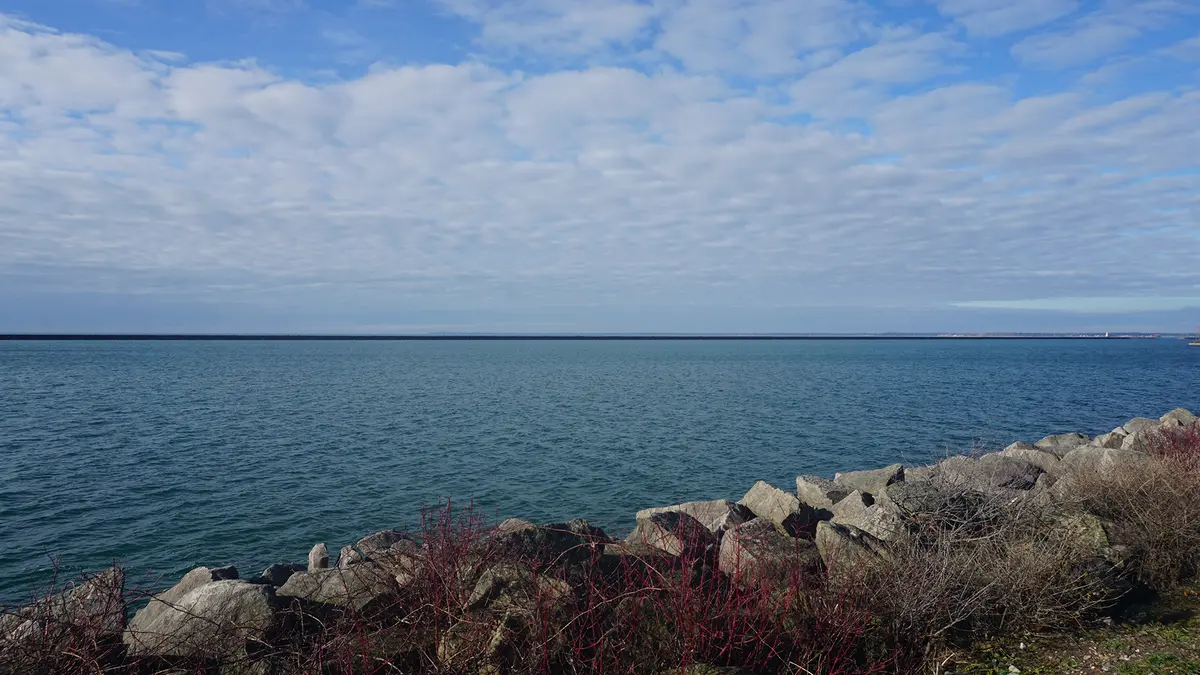
Lake Erie forms part of the Great Lakes system shared by the United States and Canada. Ontario lies along its northern shore. Michigan, Ohio, Pennsylvania and New York adjoin its American shores. Water enters mainly through the Detroit River from the upper Great Lakes. It leaves through the Niagara River towards Lake Ontario.
Lake Erie is the shallowest Great Lake and the smallest by volume. Its average depth is about 19 metres. Shallow water warms quickly and supports high biological productivity. It also responds rapidly to pollution and nutrient loading. Urban and agricultural land dominates much of the watershed. Wetlands therefore provide valuable filtration and flood storage.
The nuclear licence and environmental review
The United States Nuclear Regulatory Commission renewed Perry’s operating licence in July 2025. The new expiry date is 7 November 2046. The decision followed separate safety and environmental reviews. Licence renewal permits continued operation. It does not remove the operator’s duties for inspections, emergency planning and environmental compliance.
Reactor operation and wildlife conservation must be assessed separately. Cooling systems, transmission lines and site work can affect local habitats. Regulators examine environmental impacts during licensing. The operator must monitor protected areas and industrial risks throughout operation. A sanctuary label cannot substitute for measurable environmental performance.
Why industrial buffer land can help nature
Large infrastructure sites sometimes contain undeveloped buffers. When disturbance remains low, these areas can shelter wildlife within heavily altered landscapes. They may connect wetlands, forests and shorelines. Long ownership can also support stable management. Similar benefits can occur around reservoirs, defence lands and utility corridors.
The effect is not automatically positive. Fences can block animal movement, while roads can fragment habitat. Invasive species may spread without active control. Industrial contamination can create long-term harm. Conservation value depends on monitoring, restoration and safe operations. Public access limits should not prevent independent environmental oversight.
Lessons for wetland management
Perry shows that working landscapes can contain significant habitat. Authorities should map these areas before approving new construction. Wetland connections beyond the plant boundary also deserve protection. A turtle population cannot remain healthy within one isolated parcel forever. Safe movement and wider watershed quality matter.
The site also demonstrates the value of accurate language. The sanctuary was deliberately certified in 1993. It was not a sudden event caused by licence renewal. Low disturbance helped create favourable conditions over decades. Conservation planning should recognise that history rather than present it as an accidental overnight transformation.
What the current claim means
The Perry site contains an established urban wildlife sanctuary with more than 850 acres of natural land. Spotted turtles use its wetlands. The operating reactor remains a regulated industrial facility. Its surrounding habitat, not the reactor, carries the sanctuary designation.
Conclusion
Perry’s grounds illustrate how protected buffers can preserve wetlands beside major infrastructure. The result is meaningful because Lake Erie’s wider watershed faces heavy human pressure. Continued value requires active habitat care, transparent monitoring and strict nuclear oversight. The spotted turtle also needs connected wetlands beyond one property. Industrial land can support conservation, but only responsible management turns low disturbance into lasting ecological protection.