
Why in news?
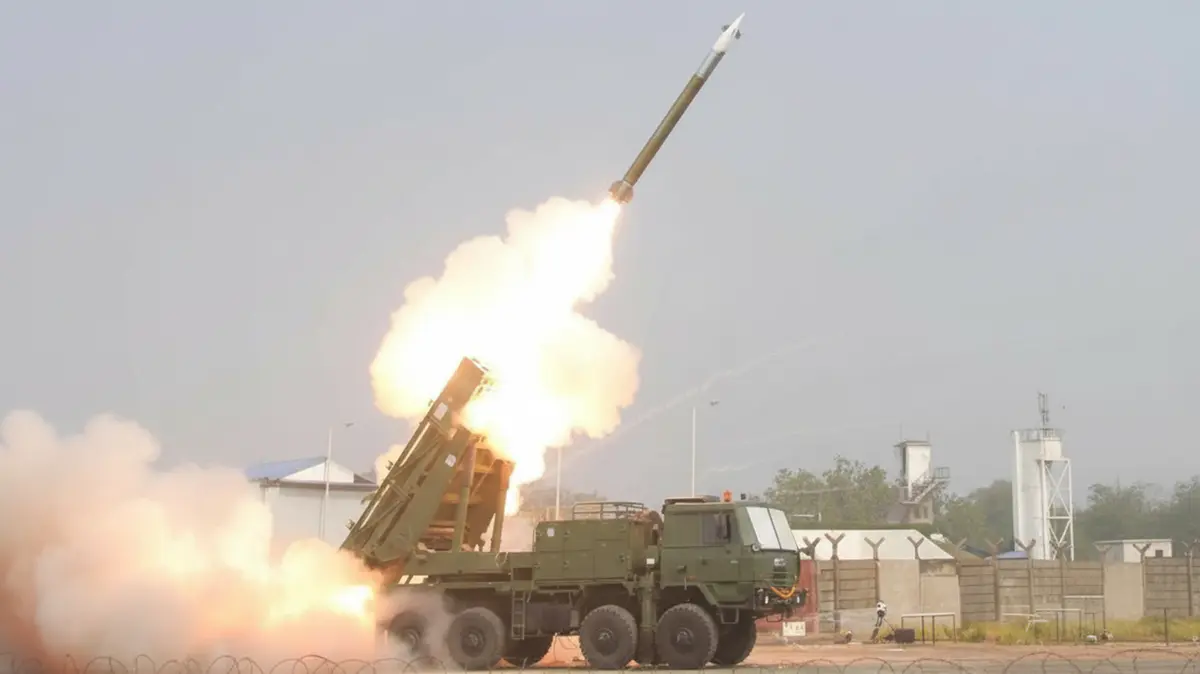
The Defence Research and Development Organisation (DRDO) tested the Pinaka Long Range Guided Rocket. The 8 July test occurred at Chandipur’s Integrated Test Range. The rocket struck a target at the user-defined minimum range of 60 kilometres.
Background
Artillery guns fire individual shells through a barrel, and a multiple-launch rocket system fires several rockets in rapid succession.
Such a salvo can cover a wider target area. Guided rockets add precision and reduce the number needed for one target.
India began developing Pinaka during the 1980s, and the system was intended to reduce dependence on imported rocket artillery.
The name Pinaka comes from the bow associated with Lord Shiva. Early Pinaka units supported operations during the 1999 Kargil conflict.
What is the Pinaka system?
Pinaka is an indigenous Multiple Launch Rocket System for the Indian Army. DRDO designed the system with public and private industry.
A complete unit involves more than the rocket, and it includes launchers, command vehicles, loaders and replenishment vehicles.
- The launcher carries sealed rocket pods, and the command post calculates and transmits firing data.
- The loader moves fresh rocket pods onto the launcher, and support vehicles provide communication, maintenance and survey assistance.
How did Pinaka evolve?
- Early Pinaka rockets provided area fire at shorter ranges, and enhanced versions increased range and improved propellants.
- Guided Pinaka added navigation and control for accurate strikes, and the new LRGR extends precision engagement towards 120 kilometres.
LRGR means Long Range Guided Rocket, and it remains a rocket-artillery weapon, although it uses a guidance system.
A maiden trial during 2025 demonstrated the full 120-kilometre range. The July 2026 trial examined the user-defined minimum range.
July 2026 flight test
- The test took place at the Integrated Test Range in Chandipur, Odisha.
- The rocket completed planned in-flight manoeuvres, and range instruments tracked its entire flight.
- The rocket followed the predicted path and struck accurately, and the existing Pinaka launcher fired the long-range rocket.
Important accuracy point: The July trial occurred at 60 kilometres. That was the chosen minimum test range, not the rocket’s stated maximum design range.
Which laboratories developed it?
The Armament Research and Development Establishment led the design, and the High Energy Materials Research Laboratory worked on energetic materials.
The Defence Research and Development Laboratory supported the project, and research Centre Imarat contributed guidance and control expertise.
The Integrated Test Range coordinated the flight trial, and the Proof and Experimental Establishment also supported testing.
What does backward compatibility mean?
The new rocket can use an in-service Pinaka launcher. The Army need not replace every launcher for the longer-range ammunition.
This feature lowers transition costs and simplifies training, and one launcher family can support rockets intended for different ranges.
Why is guidance important?
An unguided rocket follows a path set mainly at launch, and wind and small errors may move its impact point.
A guided rocket can correct its path during flight. It can target artillery positions, command centres and logistics sites more precisely.
Precision is valuable in mountains and near civilian areas, and it does not remove the need for accurate target information.
Rocket, missile and launcher
Rocket: The projectile carries its own propellant; Guided rocket: It also corrects its path. Launcher: The vehicle or equipment fires the rocket, and these are not interchangeable terms.
Conclusion
The LRGR expands Pinaka from area fire towards long-range precision attack, and launcher compatibility is a major operational advantage. Further trials and induction decisions will determine its final service role.