

Why in news?
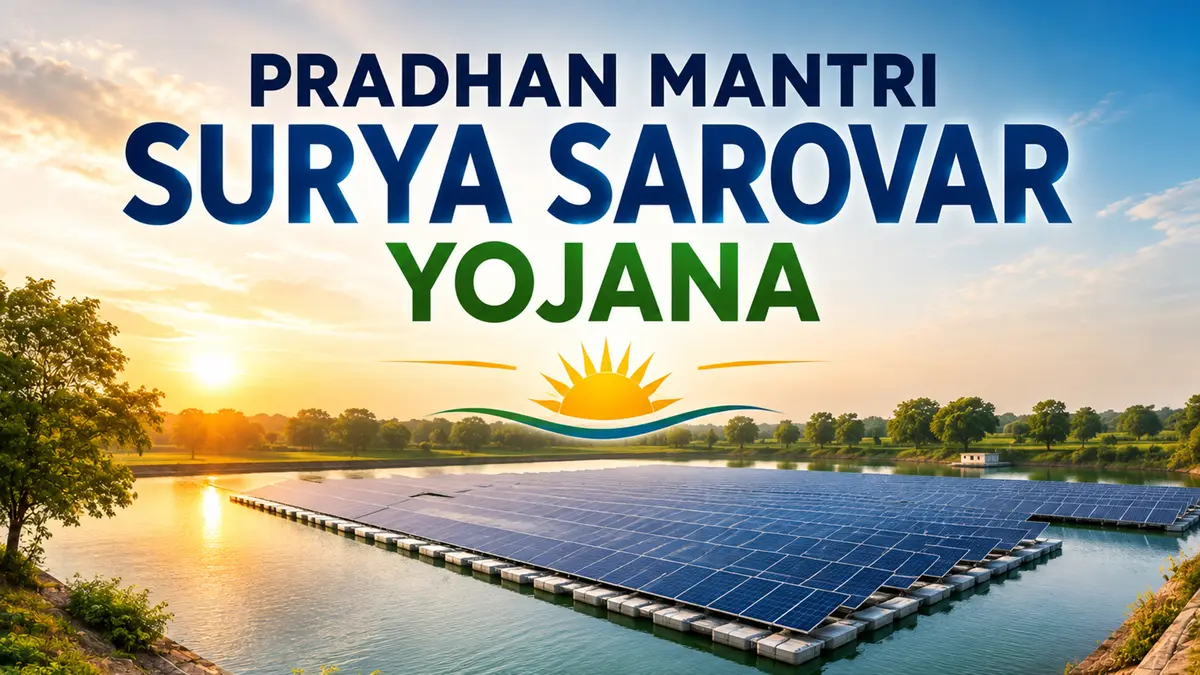
The Union Cabinet approved Pradhan Mantri Surya Sarovar Yojana on 31 July 2026.
Its total approved outlay is ₹5,070 crore for floating solar projects with storage.
The scheme targets 5,000 megawatts of solar capacity and 10,000 megawatt-hours of storage.
Projects may use suitable reservoirs, industrial ponds and other inland water bodies.
Background
Solar photovoltaic cells convert sunlight directly into electricity through semiconductor materials.
Ground-mounted projects need large connected land parcels, which can face competing demands.
Floating solar photovoltaic systems place panels upon buoyant platforms anchored to water bodies.
Cables carry their electricity to inverters, transformers and the wider power network.
Energy storage can shift some daytime generation to later periods of demand.
Scheme design
The scheme is commonly abbreviated as PM-SSY after its full title.
Projects will be sanctioned from 2026–27 through 2030–31.
Approved financial support may continue to be disbursed through 2032–33.
The Ministry of New and Renewable Energy is the responsible Union ministry.
Every state and Union Territory may benefit through eligible projects.
Capacity and storage explained
The programme targets 5,000 megawatts of floating solar generating capacity.
Each project must include co-located storage lasting at least two hours.
Multiplying 5,000 megawatts by two hours gives 10,000 megawatt-hours.
Megawatts measure instantaneous power, while megawatt-hours measure energy delivered over time.
The official assessment estimated 102.18 gigawatt-peak of suitable national floating-solar potential.
Gigawatt-peak describes the rated maximum output of photovoltaic modules under standard conditions.
Financial assistance
Eligible projects can receive Central Financial Assistance of ₹1 crore per megawatt.
This payment becomes available after the project completes successful commissioning.
Each project may also receive up to ₹50 lakh for feasibility studies.
These studies can examine water depth, underwater shape, flows and environmental conditions.
Bathymetry measures underwater depth and terrain, while hydrography studies water-body characteristics.
Potential benefits
- Existing reservoirs can produce power without acquiring equivalent land areas.
- Storage can smooth output changes and support electricity-grid reliability.
- Water may cool modules, although performance depends upon project conditions.
- Some projects may reduce evaporation, but outcomes vary with coverage and climate.
- Domestic demand may support floats, modules, batteries and associated services.
The government reported roughly 700 megawatts of existing floating capacity during approval.
It estimated 10 million tonnes of annual carbon-dioxide reductions from the programme.
It also estimated about 16,000 to 17,000 full-time-equivalent employment opportunities.
These are official projections rather than measured outcomes from completed projects.
Challenges
Anchoring must withstand changing water levels, winds, waves and reservoir operations.
Projects need safe electrical design, corrosion control and access for maintenance.
Large surface coverage may affect light, water quality, fisheries and aquatic ecology.
Careful site studies therefore remain essential before capacity receives financial approval.
Conclusion
PM-SSY combines land-saving solar deployment with storage, while making site assessment a central safeguard.