
Why in news?
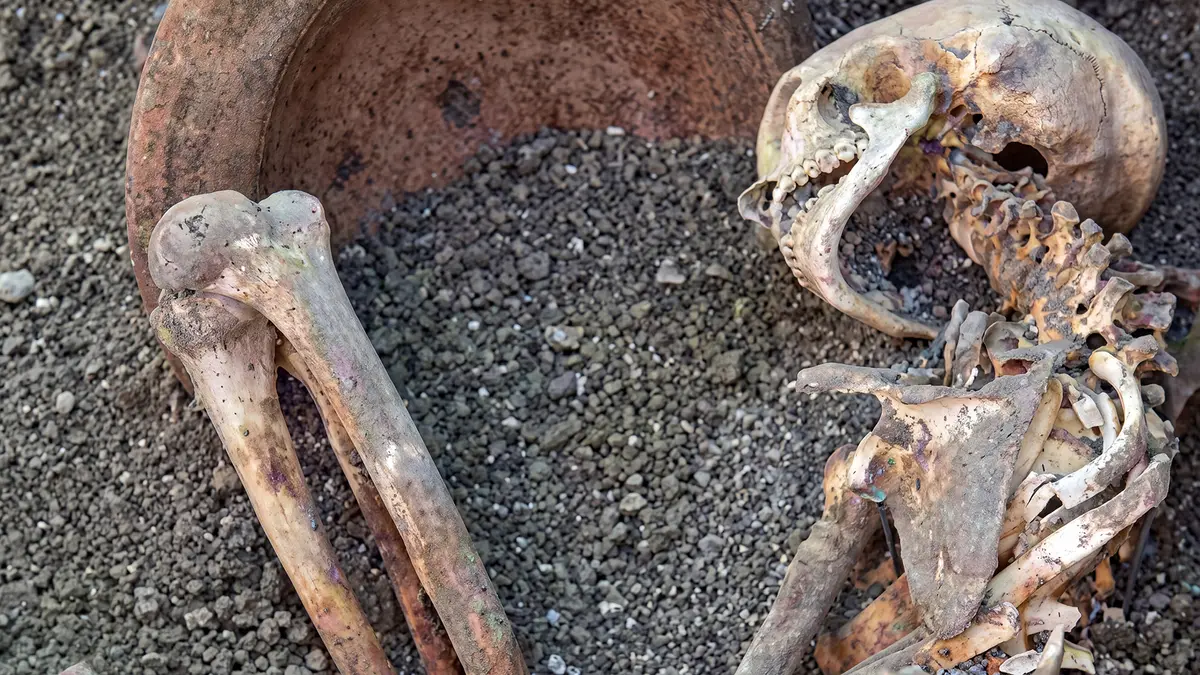
Archaeologists at the Pompeii Archaeological Park have used artificial intelligence to reconstruct the face and last moments of a man who died during the eruption of Mount Vesuvius in AD 79. The digital portrait, created from skeletal remains and artefacts, shows him hunched forward and using a terracotta mortar as a shield against falling debris.
Background on Pompeii
Pompeii was an ancient Roman town near modern‑day Naples, Italy. It was founded around the 6th century BC by the Samnites and later absorbed into the Roman Republic in 80 BC. Situated on a lava spur near the mouth of the Sarno River and at the base of Mount Vesuvius, Pompeii grew into a prosperous city of about 10–12 thousand people.
The town boasted paved streets, a municipal water system, an amphitheatre and a gymnasium. Its economy thrived on trade and agriculture. On 24 August 79 CE, however, Vesuvius erupted violently, burying Pompeii under metres of ash and pumice. The sudden burial preserved buildings, mosaics and even food in remarkable detail. Excavations began in the 18th century, making Pompeii one of the world’s most important archaeological sites and a UNESCO World Heritage Site.
The AI reconstruction
- Findings: Archaeologists discovered the remains of an adult male near the southern gate of Pompeii, close to the Porta Stabia area and a nearby necropolis. Beside the skeleton were a terracotta mortar, an oil lamp, a small iron ring and ten bronze coins — everyday items he apparently grabbed while fleeing.
- AI process: Researchers from the University of Padua combined excavation data, skeletal measurements and the objects found with computer models. The AI generated a lifelike image showing the man with the mortar raised over his head as volcanic debris rained down.
- Interpretation: The image is not a photograph but a scientifically grounded reconstruction. It provides insight into how residents tried to escape the eruption, personalising the tragedy of Pompeii.
- Scholarly views: The park’s director, Gabriel Zuchtriegel, said that AI complements traditional archaeology by processing huge amounts of data. It should be used to enhance, not replace, human expertise.
Conclusion
The AI‑driven portrait brings us closer to the people who once lived in Pompeii. By blending modern technology with archaeological evidence, researchers can tell more human stories from the ruins and attract wider public interest in preserving cultural heritage.
Source: India Today

