

Why in news?
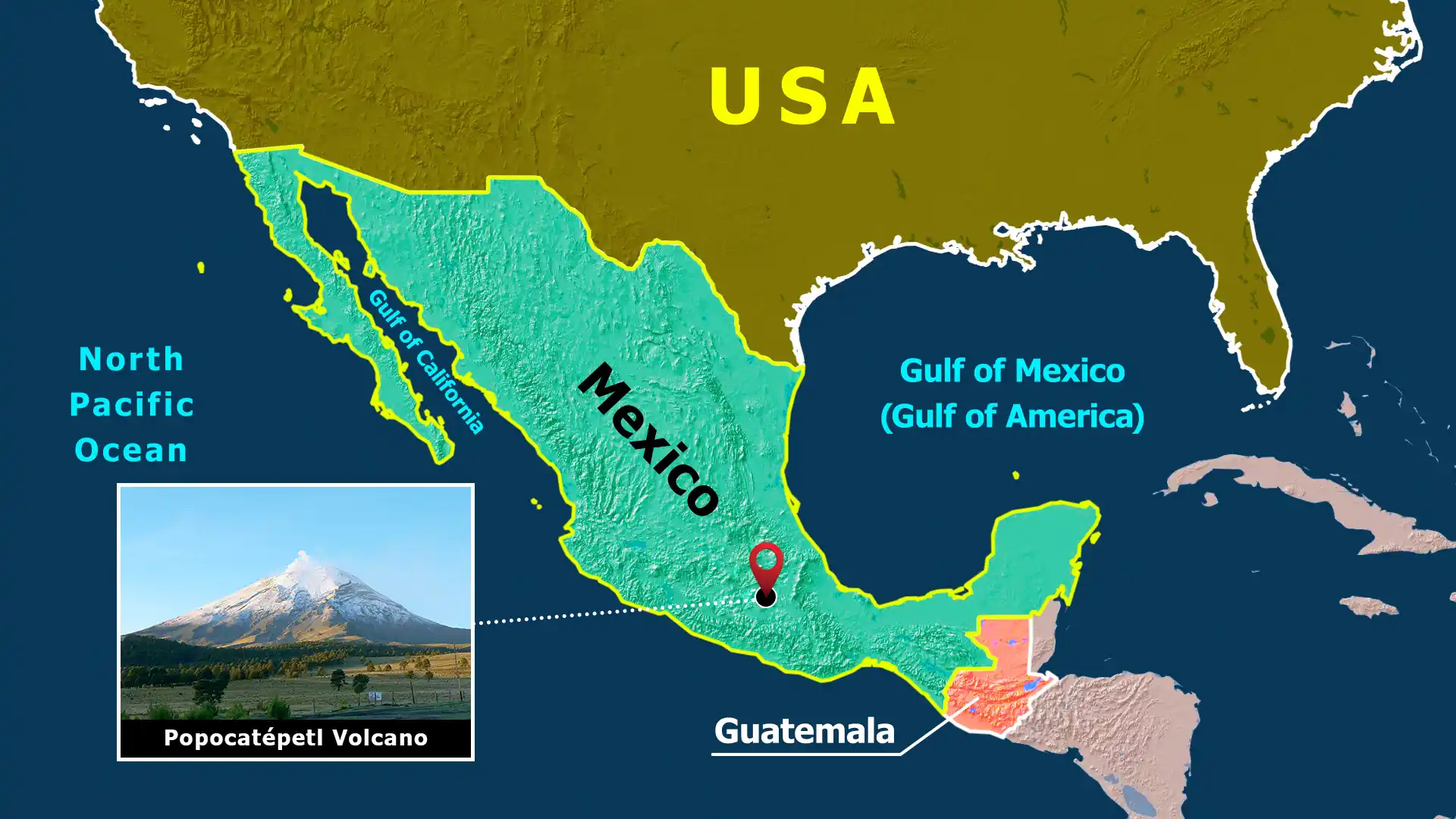
A team from Mexico’s National Autonomous University used seismic data and artificial intelligence to create the first three‑dimensional image of the magma chambers inside Popocatépetl volcano. The volcano, located just 70 km southeast of Mexico City, is among the most active in the Americas. Around 25 million people live within 100 km of its summit, so precise knowledge of its internal structure is essential for hazard assessment.
Background
The name Popocatépetl derives from the Nahuatl words popōca (smoke) and tepētl (mountain), literally meaning “Smoking Mountain.” Rising to 5,452 metres, it is the second‑highest peak in Mexico and a stratovolcano, built from alternating layers of lava and volcanic ash. It sits on the Trans‑Mexican Volcanic Belt, which forms part of the Pacific Ring of Fire – a horseshoe‑shaped zone stretching 40,000 km around the Pacific Ocean where subducting tectonic plates generate most of Earth’s volcanoes and earthquakes. Popocatépetl has been intermittently active since at least the early 16th century. Its eruptions produce ash plumes, lava domes and explosive blasts.
3D imaging of the volcano’s interior
- Seismic network: Researchers placed 22 seismographs around the volcano to record tremors. Data from these instruments were analysed by machine‑learning algorithms to construct a three‑dimensional model of the crust beneath the volcano.
- Magma reservoirs: The resulting cross‑section reveals several magma pockets at depths of roughly 5 km, 10 km and 18 km. The shallow chambers feed the current eruptions, while deeper pockets may supply magma over longer time scales.
- Hazard assessment: By mapping the pathways through which magma travels, scientists can better anticipate the style and scale of future eruptions. The 3D model also shows how the volcano’s plumbing system responds to tectonic stresses from the Ring of Fire.
The Ring of Fire
The Pacific Ring of Fire is a belt of intense seismic and volcanic activity encircling the Pacific Ocean. It contains more than 450 volcanoes and accounts for about 90 percent of all earthquakes worldwide. Along this zone, oceanic plates subduct beneath continental plates, generating deep ocean trenches, volcanic arcs and frequent earthquakes. Regions such as the Andes in South America, the Cascade Range in North America, the Aleutian Islands in Alaska, and the island arcs of Japan and Indonesia all lie along the Ring of Fire.
What is a stratovolcano?
A stratovolcano, also called a composite volcano, is a steep‑sided, symmetrical cone constructed from alternating layers of hardened lava flows, ash, cinders and volcanic debris. Repeated eruptions build up the cone over tens of thousands of years. Stratovolcanoes often have a crater at the summit with a central vent, but lava can also erupt from fissures on the flanks. Because the magma is typically viscous, pressure builds up inside the chamber, making these volcanoes prone to explosive eruptions. Famous examples include Mount Fuji (Japan), Mount St Helens and Mount Rainier (United States) and Cotopaxi (Ecuador). Popocatépetl fits this class, with an internal magma chamber situated 5–10 km below the summit.
Significance
- Improved early warning: The 3D model helps volcanologists refine eruption forecasts by showing how magma accumulates and moves within the volcano. This information aids civil protection agencies in planning evacuations and issuing timely alerts to nearby communities.
- Understanding plate tectonics: Studying Popocatépetl sheds light on the dynamics of subduction zones and how the Ring of Fire generates volcanism. Insights from these studies can be applied to other stratovolcanoes worldwide.
- Public awareness: Highlighting the geological setting and eruption history of the volcano underscores why continuous monitoring is essential. With tens of millions of people living near the volcano, effective communication of hazards and preparedness measures can save lives.
Conclusion
Popocatépetl’s new 3D map is a technological breakthrough that blends seismology with artificial intelligence. By understanding the volcano’s hidden magma system and its links to the wider Ring of Fire, scientists can better anticipate future eruptions and help protect the densely populated regions surrounding this “Smoking Mountain.”
Source: The Hindu