
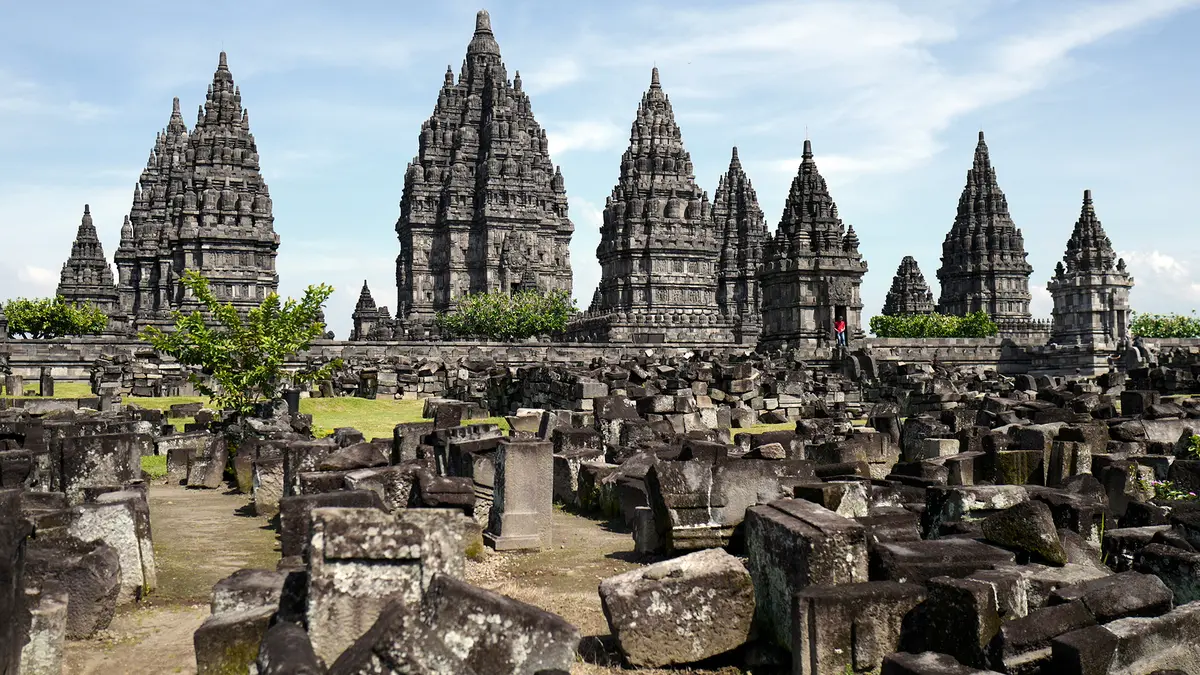
Why in news?
Prime Minister Narendra Modi visited Prambanan on 8 July 2026, and Indonesian President Prabowo Subianto accompanied him. Both leaders unveiled a plaque for an Indian conservation project. The Archaeological Survey of India will support conservation and restoration work.
Background
Prambanan is a major Hindu temple complex on Java island. It stands near Yogyakarta, beside Central Java, and is Indonesia’s largest Hindu temple complex.
The complex was built during the ninth century CE. It is linked with the Medang or Ancient Mataram kingdom, and construction is commonly associated with King Rakai Pikatan.
The main complex is dedicated to the Hindu Trimurti, and the three principal deities are Shiva, Vishnu and Brahma. Shiva receives the most prominent central temple.
Prambanan is also called Roro Jonggrang or “Slender Maiden.” This name comes from a popular Javanese legend. The legend is associated with a Durga image inside the Shiva temple.
Historical development
- Ninth century: Rulers of the Medang kingdom began and expanded the complex.
- Early eleventh century: Political power shifted towards eastern Java.
- Later period: Earthquakes, volcanic activity and abandonment damaged many structures.
- Seventeenth century: The ruins became known again to outside observers.
- From 1918: Systematic restoration began using original stones and careful reconstruction.
- 1991: UNESCO placed the Prambanan Temple Compounds on the World Heritage List.
Architecture and layout
The original Prambanan complex contained 240 temples, and most smaller temples now survive only as stone bases or ruins. The central sacred zone contains the best-known structures.
Six large temples stand in two facing rows, and three are dedicated to Shiva, Vishnu and Brahma. Their facing temples honour the deities’ animal vehicles.
- Nandi is associated with Shiva; Garuda is associated with Vishnu.
- Hamsa or Angsa is associated with Brahma.
The central Shiva temple rises about 47 metres, and it is the tallest structure in the complex. Its chambers contain images linked with Shiva, Ganesha, Agastya and Durga.
Stone reliefs depict the Ramayana story, and visitors follow the narrative while moving around the galleries. Vishnu’s temple also carries reliefs connected with Krishna.
The towers symbolise the sacred mountain Meru, and Indian religious ideas influenced their design. Javanese builders adapted those ideas into a distinct local architectural form.
What does the UNESCO property include?
The World Heritage property is broader than the main Hindu enclosure. It includes Prambanan, Sewu, Lumbung and Bubrah temple compounds. Buddhist and Hindu monuments therefore share the wider cultural landscape.
This coexistence reflects Java’s connected religious history, and it also shows interaction between Hindu and Buddhist royal traditions. The property is recognised under UNESCO cultural criteria (i) and (iv).
India’s conservation project
India and Indonesia discussed conservation cooperation during President Prabowo’s 2025 India visit. The 2026 plaque marked the project’s formal launch, and the Archaeological Survey of India will provide technical expertise.
ASI means the Archaeological Survey of India, which is India’s principal organisation for archaeological research and monument conservation. It functions under the Ministry of Culture.
Conservation must preserve original material and structural authenticity, and Prambanan also lies in an earthquake-prone and volcanic region. Engineering support must therefore respect both heritage and safety.
Conclusion
Prambanan represents the deep cultural links between India and Indonesia. Its 240-temple plan and 47-metre Shiva temple are major facts. India’s new role adds a contemporary conservation dimension.