
Why in news?
Maharashtra will build a memorial to warrior Jivaji Mahale near Pratapgad Fort. The first phase has received ₹1 crore. Jivaji protected Chhatrapati Shivaji Maharaj during the 1659 encounter with Afzal Khan. The project also aims to promote heritage tourism.
Background
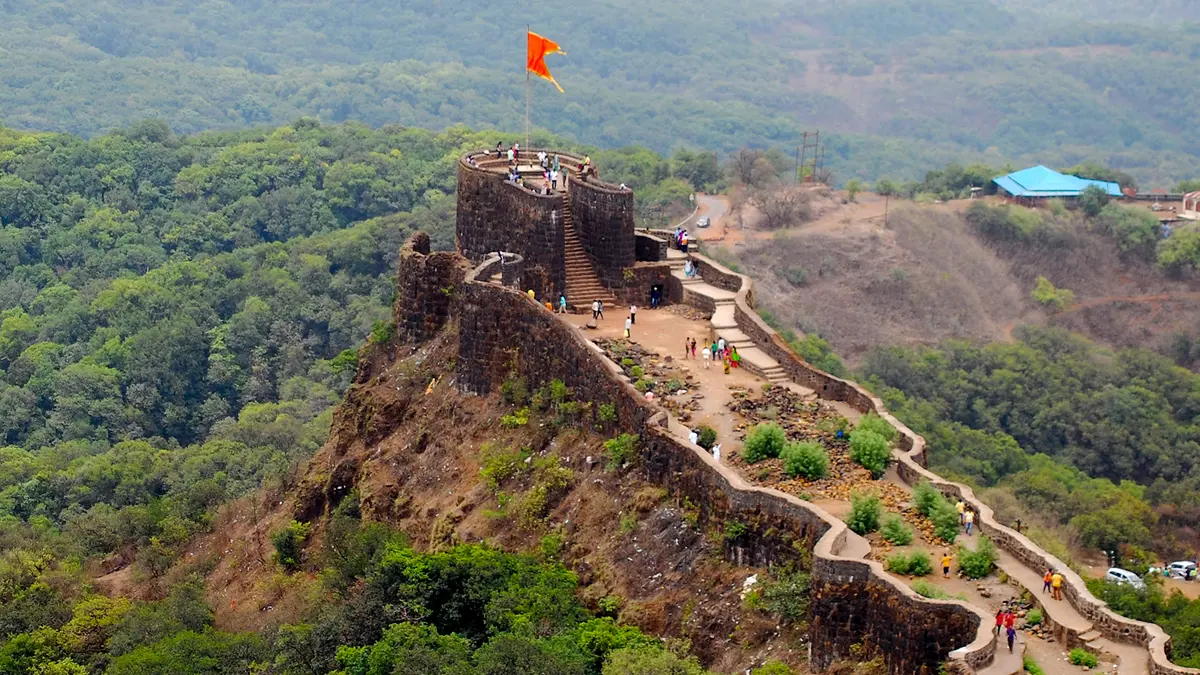
Pratapgad is a hill-forest fort in Maharashtra’s Satara district, and it stands near Mahabaleshwar in the rugged Western Ghats.
In the seventeenth century, these mountains separated the Deccan plateau from coastal Konkan. Narrow passes controlled movement between both regions.
Chhatrapati Shivaji Maharaj ordered a new fort at this strategic location. His minister Moropant Pingle supervised its construction around 1656.
The fort protected the Par Pass and nearby river valleys. Its steep slopes also reduced the advantage of a larger invading army.
Battle of Pratapgad: events in order
- The Bijapur Sultanate sent general Afzal Khan against Shivaji in 1659.
- Shivaji avoided an open battle against the larger Bijapur force.
- Both leaders agreed to meet below Pratapgad with limited attendants.
- The meeting on 10 November 1659 became violent.
- Shivaji survived the encounter, while Afzal Khan was killed.
- Maratha forces then attacked the unsettled Bijapur army nearby.
- The victory increased Shivaji’s military reputation and regional influence.
Accounts differ on some details of the personal encounter, but its date and larger political importance are well established.
Who was Jivaji Mahale?
Jivaji Mahale served as a trusted soldier and bodyguard of Shivaji, and he accompanied Shivaji during the dangerous meeting.
Historical tradition credits him with stopping Afzal Khan’s armed attendant, Sayyid Banda. This intervention protected Shivaji during the sudden fighting.
Maharashtra observes Shiv Pratap Din on 10 November, and the day remembers the battle and those who fought there.
What happened to the fort later?
- Pratapgad remained an important Maratha stronghold after the 1659 victory.
- It passed to the East India Company during the 1818 Anglo-Maratha conflict.
- Independent India later developed the area as a historical destination.
- Jawaharlal Nehru unveiled Shivaji’s equestrian statue there on 30 November 1957.
Architecture and location
- The fort rises about 1,080 metres above sea level.
- It has upper and lower defensive sections adapted to the hill.
- Strong bastions watch the surrounding slopes and old travel routes.
- A temple dedicated to Bhavani stands within the fort complex.
- The site is roughly 21 kilometres from Mahabaleshwar.
World Heritage status
The United Nations Educational, Scientific and Cultural Organization (UNESCO) inscribed the Maratha Military Landscapes of India in 2025.
The inscription became India’s 44th World Heritage property. It qualified under cultural criteria (iv) and (vi).
Criterion (iv) recognises outstanding fortification design, while criterion (vi) recognises important historical associations.
This World Heritage property contains twelve component forts, and eleven are in Maharashtra, while Gingee Fort is in Tamil Nadu.
The group represents Maratha defence across hills, plateaus, islands and coasts, and Pratapgad is its hill-forest component.
Important distinction: Pratapgad is not a separate World Heritage property, and it is one component of the twelve-fort serial property.
About the proposed memorial
The memorial is planned near the fort’s foothills, not as a new fort structure. Its first phase will commemorate Jivaji Mahale’s role.
Careful design can support local tourism and historical learning, and construction must still respect the wider heritage landscape.
Conclusion
Pratapgad links geography, military planning and the rise of Maratha power. Jivaji Mahale’s proposed memorial highlights individual courage within that history, and good interpretation should preserve both evidence and local memory.