

Why in news?
The Standing Committee of the National Board for Wildlife reviewed pygmy-hog conservation during July.
It recommended including the species under India's Species Recovery Programme.
The programme operates through the Integrated Development of Wildlife Habitats scheme.
This inclusion did not change the animal's International Union for Conservation of Nature category.
Background
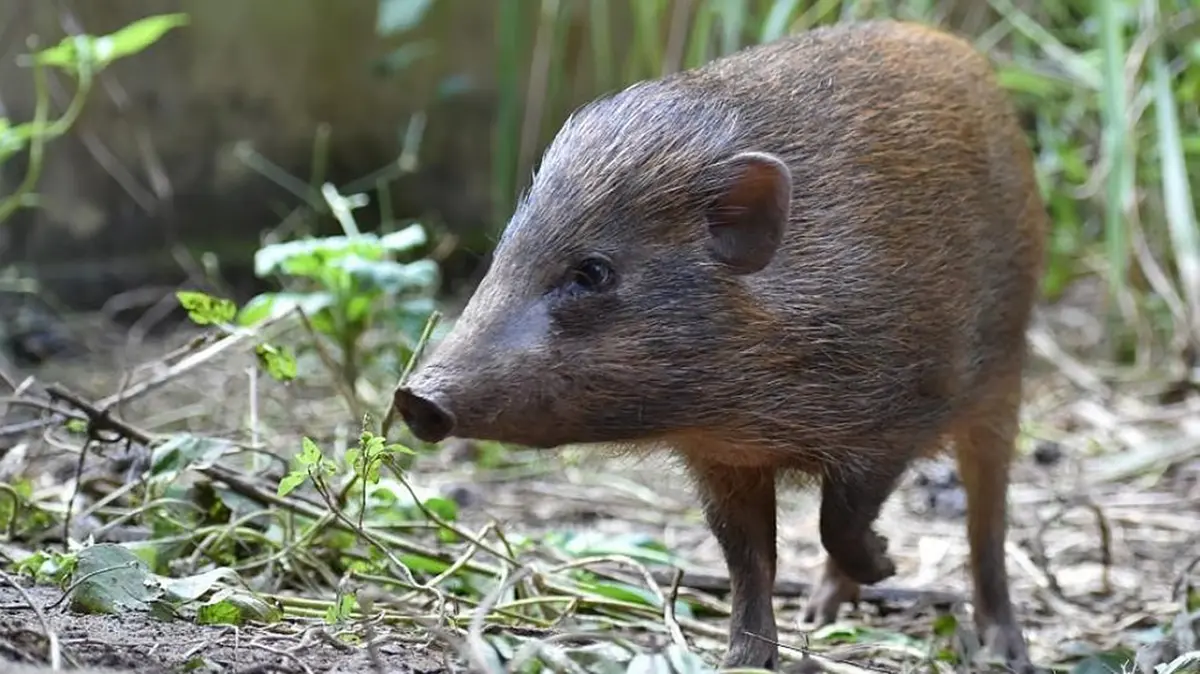
The pygmy hog's scientific name is Porcula salvania.
It belongs to the pig family Suidae and is the only living Porcula species.
Adults measure roughly 65 centimetres long and about 25 centimetres high.
These dimensions make it the world's smallest living wild pig.
The species is endemic to tall, wet alluvial grasslands near Himalayan foothills.
Its remaining and reintroduced populations occur within protected grasslands of Assam.
Habitat and behaviour
Pygmy hogs require dense, seasonally flooded grasslands with varied grass heights.
They forage for roots, tubers, insects and other small animal material.
Both sexes construct grass nests, an unusual and memorable feature among wild pigs.
Nests provide shelter from weather and concealment within the tall vegetation.
The hog acts as an indicator of healthy sub-Himalayan grassland ecosystems.
Protecting its habitat also benefits the Bengal florican, hispid hare and other specialists.
Decline and rediscovery
The species once ranged through foothill grasslands from northern India towards Assam.
Conversion, poorly timed burning, grazing, invasive plants and woodland expansion reduced its habitat.
Scientists feared the species had vanished before its rediscovery in Assam during 1971.
By the 1990s, the last natural population survived mainly around Manas.
Six animals entered a conservation-breeding programme from Manas during 1996.
Recovery efforts
The Pygmy Hog Conservation Programme began as a formal partnership during the mid-1990s.
Its partners include Assam's Forest Department, conservation organisations and specialist scientific groups.
The work combines conservation breeding, grassland restoration, release and post-release monitoring.
Captive-bred hogs have entered four protected grasslands across Assam.
These are Sonai Rupai, Orang, Bornadi, also written Barnadi, and Manas.
During June 2026, fifteen hogs returned to Manas's Kuribeel grasslands.
The programme reported 194 captive-bred releases across Assam after that operation.
Conservation status
The International Union for Conservation of Nature currently lists the species as Endangered.
It was previously assessed as Critically Endangered, explaining many older descriptions.
The species is listed in Appendix I of the international wildlife-trade convention.
It also receives strong protection under India's Wild Life (Protection) Act.
What the national programme can support
- States can receive focused assistance for habitat and population recovery actions.
- Managers can coordinate breeding, releases, research and long-term field monitoring.
- Grassland restoration can address invasive plants and inappropriate burning cycles.
- Community involvement can improve protection while recognising local resource needs.
- Genetic planning can protect diversity within small breeding populations.
Conclusion
The programme decision strengthens national support for a species already recovering through sustained grassland conservation.