

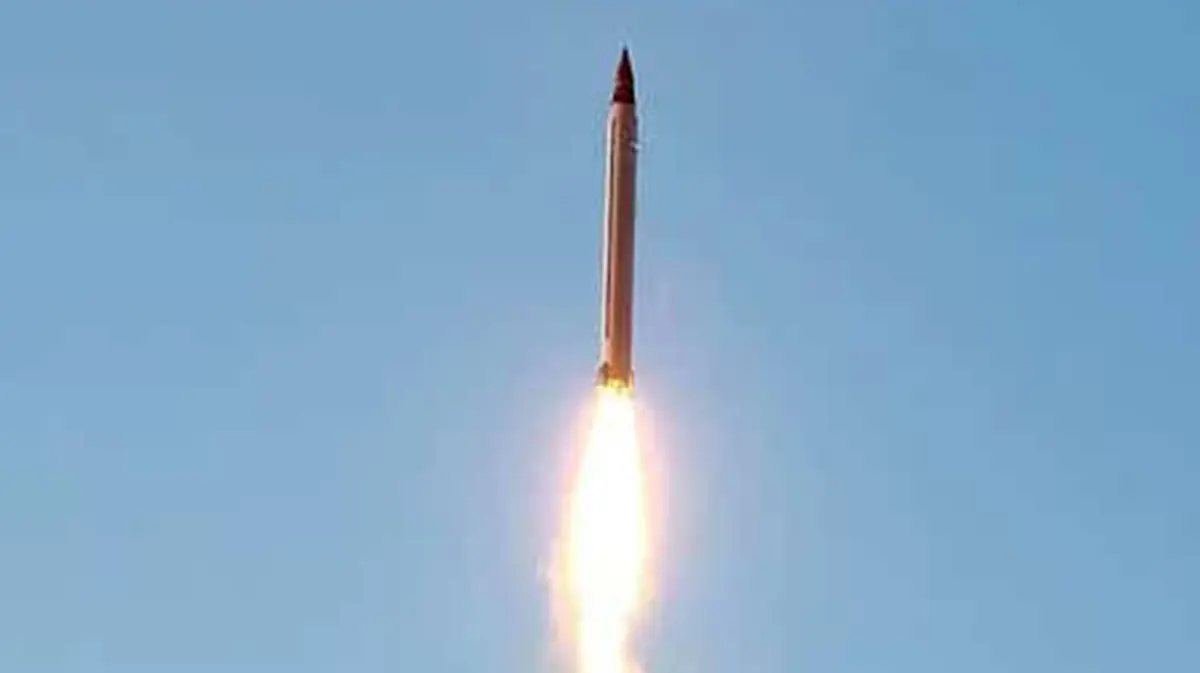
Why in news?
The Qadr-F returned to attention during renewed Iranian missile operations in 2026. Iranian state-linked reporting identified it among weapons used in June; that identification originated with Iranian official sources. Independent confirmation of every missile type launched was not publicly available.
What is known about the system
Qadr-F is generally classified as a liquid-fuel medium-range ballistic missile; it belongs to Iran’s Shahab-3 and Qadr missile family. Independent assessments trace the family to the North Korean Nodong design. Iran subsequently modified its airframe, guidance and re-entry systems.
The Islamic Revolutionary Guard Corps has claimed a range near 2,000 kilometres for Qadr-F. Such figures should remain attributed to the operator.
Public sources do not offer uniform estimates for tested range, payload or accuracy. Configuration changes can also alter those values.
How a ballistic missile works
A ballistic missile receives powered acceleration during its early flight; it then follows a largely ballistic path before re-entry. Range alone does not determine military effect. Reliability, accuracy, payload, launch preparation and defences all matter.
Liquid-fuel missiles may require more launch preparation than modern solid-fuel systems. That can increase their exposure before launch.
However, a mature force can use prepared sites and dispersed launchers. Salvos can also strain even advanced air-defence networks.
Qadr-F should not be described as hypersonic merely because it reaches high speed. Ballistic re-entry speed differs from sustained hypersonic manoeuvring.
Evidence and information warfare
Missile claims during conflict serve operational and political purposes; governments may emphasise reach, precision or damage to strengthen deterrence. Verification requires launch imagery, debris, radar tracks or satellite evidence. Even then, closely related variants can be difficult to distinguish.
Iranian sources said Qadr-F joined Emad and Kheibar Shekan missiles in Operation Nasr. Wider reporting confirmed exchanges, but not every Iranian designation.
A responsible assessment must therefore separate three questions. A launch occurred, its type was claimed, and its precise impact may remain uncertain.
The legal and strategic setting
United Nations Security Council Resolution 2231 endorsed the 2015 nuclear agreement. It also contained time-limited language concerning certain Iranian missile activity; those missile restrictions reached their scheduled endpoint in October 2023. Later political disputes did not automatically extend the original clause.
That history still shapes diplomacy around Iran’s missile programme. Regional governments view the arsenal through both conventional and nuclear-risk lenses.
Missile defence can reduce damage, but it cannot promise perfect interception. Escalation control therefore remains as important as technical defence.
Conclusion
Qadr-F represents an older but still relevant part of Iran’s missile inventory; its significance lies in reach, numbers and signalling. Claims about range, use and damage need careful attribution. Precision in language is especially important during an active regional confrontation.