
Why in news?
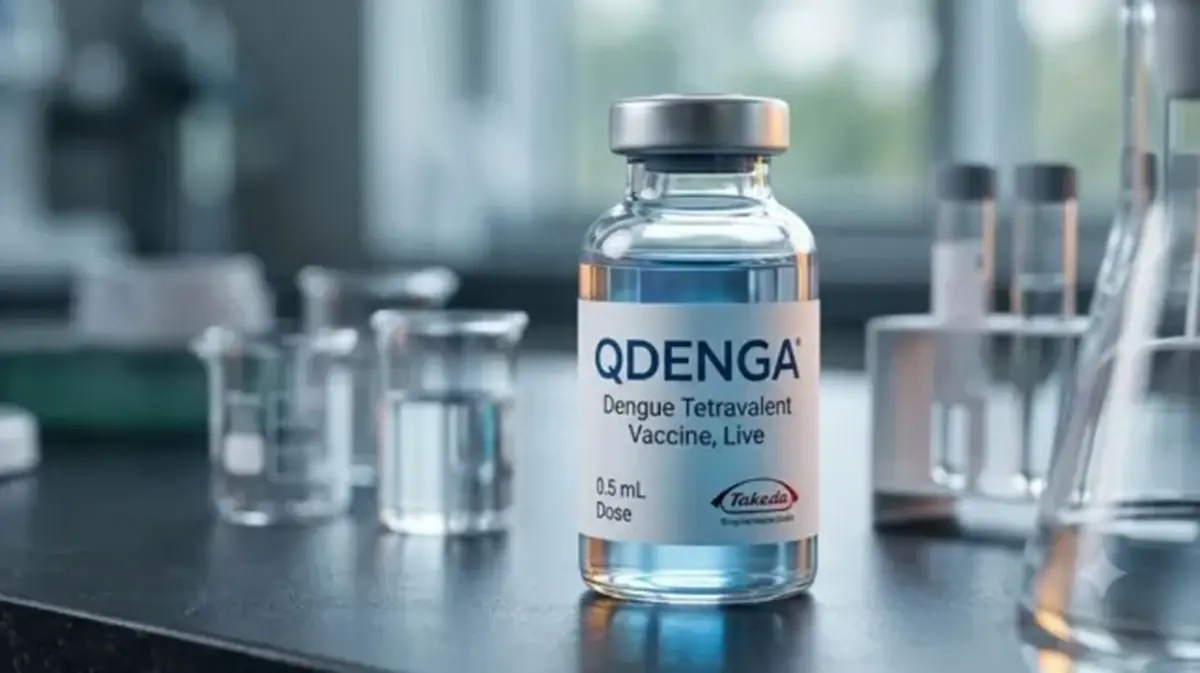
India approved QDENGA for people aged four to sixty years. It is India’s first approved vaccine against dengue. The Drug Controller General of India granted the market authorisation. Indian supplies are expected during the first half of 2027.
Background
Dengue spreads mainly through infected female Aedes aegypti mosquitoes, while Aedes albopictus plays a smaller role.
These mosquitoes commonly bite during daytime and breed inside small water-filled containers.
Scientists label the four dengue virus types DENV-1, DENV-2, DENV-3 and DENV-4.
Most infections are mild or silent, but severe dengue can cause bleeding, shock and organ damage.
Why can a later dengue infection become dangerous?
An infection gives lasting protection mainly against its original virus type.
Protection against other types is weaker, making some later infections more dangerous and vaccine development harder.
What is QDENGA?
QDENGA is Takeda’s vaccine brand, while its scientific development code is TAK-003.
On 10 May 2024, QDENGA became the second dengue vaccine receiving World Health Organization prequalification.
QDENGA is live-attenuated, meaning it contains living viruses weakened for controlled immune training.
It is tetravalent because it targets all four dengue virus types together.
It places genetic components from three types within a weakened DENV-2 backbone.
How will the vaccine be given in India?
- The approved age group covers people from four through sixty years.
- The schedule contains two doses separated by three months.
- Each 0.5-millilitre dose is injected subcutaneously, meaning below the skin.
- India’s authorisation does not require a dengue test before vaccination.
- It permits vaccination regardless of a person’s earlier dengue exposure.
The approval came under Form CT-20 of the New Drugs and Clinical Trials Rules, 2019.
By then, forty-three countries had approved QDENGA for different national uses.
More than 32 million doses had also been distributed worldwide.
Do not confuse two decisions: India approved ages four to sixty for market use. The World Health Organization recommends programme use mainly for children aged six to sixteen. That recommendation applies in places with high dengue transmission.
What did the major trial find?
The main phase-three study involved over 20,000 children across dengue-endemic Asian and Latin American countries.
Two-dose efficacy reached 80.2 per cent against confirmed dengue during the following twelve months.
Hospitalisation efficacy reached 90.4 per cent by eighteen months, indicating reduced risk rather than complete protection.
An additional Indian study examined safety and immune responses among people aged four to sixty.
How does regulatory approval differ from a public programme?
Market authorisation permits supply but does not place QDENGA inside India’s public immunisation programme.
Public use requires separate decisions, while initial availability is expected through private healthcare settings.
Important safety points
People should obtain vaccination only after suitable advice from qualified medical professionals.
Live vaccines require special caution during pregnancy, breastfeeding or serious immune deficiency.
A clinician must check the approved Indian product information before administration.
Vaccination cannot replace early diagnosis, proper hydration and timely medical treatment.
Why mosquito control remains necessary
- People should remove stagnant water from coolers, pots, tyres and containers.
- Water storage vessels should remain covered and should be cleaned regularly.
- Repellents, screens and protective clothing reduce contact with daytime-biting mosquitoes.
- Surveillance helps authorities detect local outbreaks and organise quick control measures.
Prelims focus: Dengue has four types, while QDENGA is tetravalent and live-attenuated. Its approved two-dose schedule uses a three-month interval.
Conclusion
QDENGA adds an important preventive tool against India’s recurring dengue burden.
Its benefits must still accompany mosquito control, surveillance and timely clinical care.