
Why in news?
A local report described an alleged forest-guard firing inside Raimona National Park’s Athiabari Range. Phungkha Basumatary was reportedly suspected of involvement in illegal tree felling. His body had not been recovered when the first report appeared. Authorities had not then issued a detailed statement establishing the incident’s full circumstances.
Background
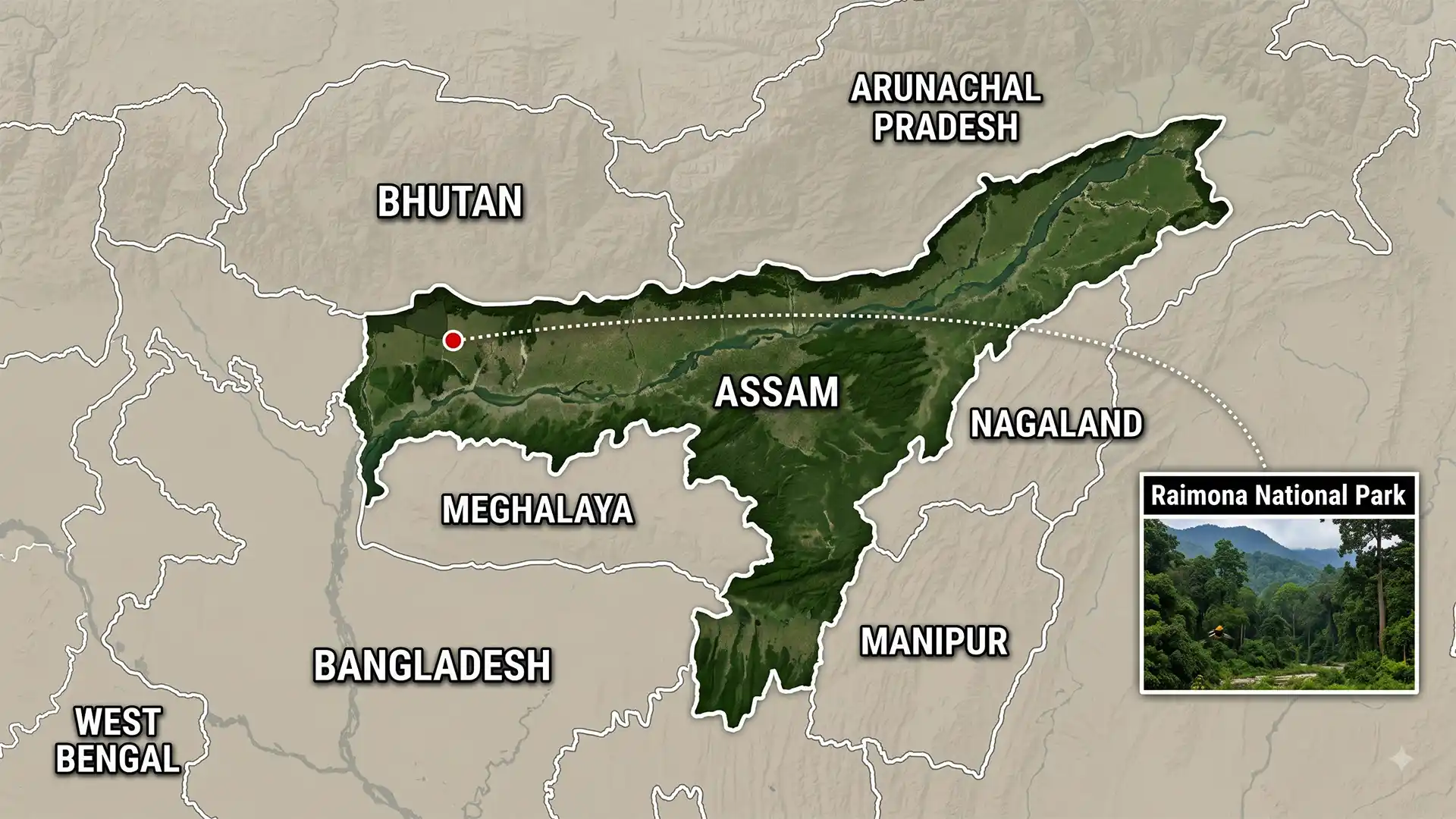
Raimona lies in Kokrajhar district within Assam’s Bodoland Territorial Region.
The Assam government notified it as a national park on 8 June 2021.
Its notified area covers 422 square kilometres within the Kachugaon Forest Division.
The park occupies Assam’s western edge along the international boundary with Bhutan.
Location and wider landscape
Raimona occupies the southern foothills of the Eastern Himalaya.
Its elevation extends from low valleys towards hill country exceeding one thousand metres.
Bhutan’s Phibsoo Wildlife Sanctuary adjoins the landscape towards the north.
West Bengal’s Buxa Tiger Reserve provides another major protected area nearby.
Together, these forests support cross-border movement by elephants and other wide-ranging animals.
Administration and forest ranges
The park falls within the Gossaigaon subdivision and the Kachugaon Forest Division.
Its management landscape includes Athiabari, Sanfan, Central or Kachugaon, and Raimona forest ranges.
The reported July incident concerned Athiabari Range, not the entire protected landscape.
A national park receives protection under the Wild Life (Protection) Act, 1972.
Grazing and private rights face stronger restrictions than those generally allowed inside wildlife sanctuaries.
Biodiversity importance
The golden langur is Raimona’s best-known flagship primate and a major conservation priority.
The forests also support Asian elephants, gaur, tigers, clouded leopards and diverse hornbills.
Riverine patches, grasslands and semi-evergreen forests create varied habitats across the park.
Contiguous habitat becomes especially valuable when climate pressures alter animal ranges and seasonal movements.
Protection and enforcement questions
Illegal logging can fragment habitat, open forest roads and intensify future encroachment.
Forest staff therefore require intelligence, equipment, training and lawful enforcement procedures.
Every use of force must remain proportionate, accountable and independently examined when death is alleged.
A prompt investigation should preserve evidence, locate the missing person and record all witness accounts.
Transparent findings protect both local communities and officials performing legitimate conservation duties.
Conclusion
Raimona’s ecological value requires firm forest protection alongside lawful, transparent and community-sensitive enforcement.