Why in news?
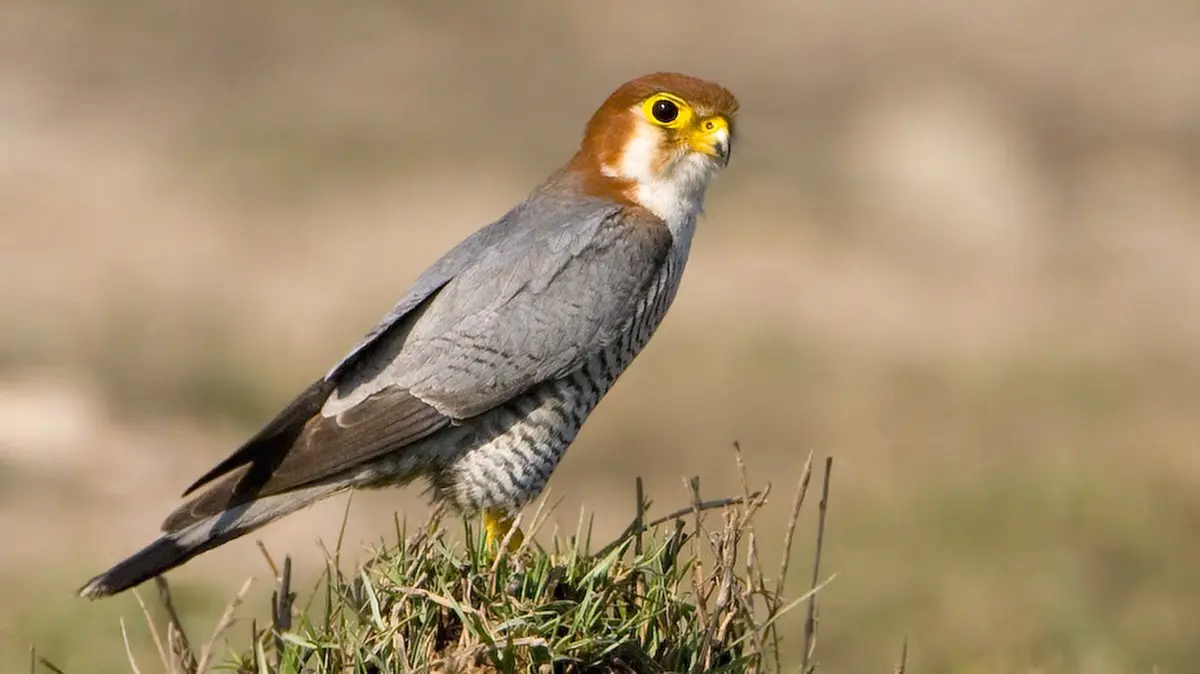
Researchers recently recorded a rare sighting of the red‑necked falcon in Kawal Tiger Reserve, Telangana. The bird, seldom seen in the region, was photographed by ornithologists while it hunted over open woodland. The sighting has drawn attention to the reserve’s rich birdlife and the need to protect raptor habitats.
Background
The red‑necked falcon (Falco chicquera) is a small falcon found in two disjunct populations—one across sub‑Saharan Africa and the other in South Asia. The Asian birds measure 28–34 cm in body length with a wingspan of 55–70 cm and weigh around 160–250 grams. They are distinguished by a reddish‑brown crown and nape, bluish‑grey upperparts and white underparts marked with fine bars.
In the Indian subcontinent the species occurs in open country, dry deciduous forests, scrublands and agricultural fields. It preys mainly on small birds such as pigeons and passerines, but also takes rodents, bats, reptiles and insects. Nesting usually occurs in old nests of crows or in palm tree cavities; the clutch typically contains three or four eggs. Both parents care for the young, with the female incubating and the male bringing food.
Kawal Tiger Reserve and the sighting
- Kawal Tiger Reserve lies in the northern part of Telangana near the Godavari River. Declared a tiger reserve in 2012, it covers a core area of about 893 sq km with an additional buffer zone.
- The reserve’s Southern Tropical Dry Deciduous forests support 260 species of birds, 34 species of reptiles and 75 species of mammals. In addition to tigers, it is home to leopards, gaur, sambar and numerous raptors.
- During a wildlife survey in early 2026, ornithologist Dr M. Venkat observed a red‑necked falcon perched on a dry branch. The bird later performed rapid hunting flights, confirming its presence in the reserve.
Conservation concerns
- The International Union for Conservation of Nature (IUCN) lists the red‑necked falcon as Near Threatened in Asia because of habitat loss, pesticide use and declines in prey populations.
- Deforestation, agricultural expansion and disturbance at nesting sites reduce suitable habitats. Because falcons nest in tree holes and old nests, the removal of tall trees poses a major threat.
- Observations like the Kawal sighting help document the species’ distribution and highlight the need to protect remaining dry forests and grasslands.
Conclusion
The sighting of a red‑necked falcon in Kawal Tiger Reserve underscores the biodiversity value of dry deciduous forests. Protecting nesting trees, controlling pesticides and preserving open hunting grounds are essential to ensure that this elegant raptor continues to grace India’s skies.