
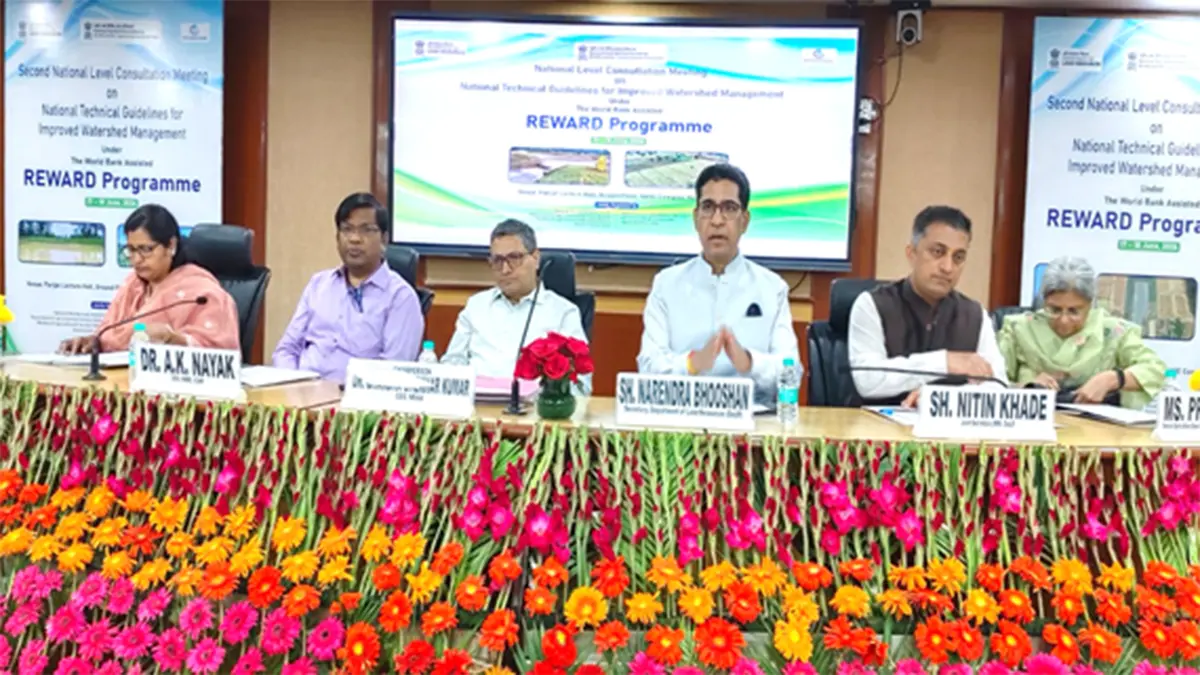
Why in news?
The National Rainfed Area Authority (NRAA) organised the second national consultation on draft National Technical Guidelines for watershed development under the REWARD programme on 17–18 June 2026. Officials from the Department of Land Resources, World Bank, Karnataka and Odisha state governments and other agencies attended the meeting in New Delhi.
Background
REWARD stands for “Rejuvenating Watersheds for Agricultural Resilience through Innovative Development.” It is a World Bank financed programme implemented by the Ministry of Rural Development through the Department of Land Resources. The programme, running from 2021–2026, has a budget of about US $167.7 million. Funding comes from the World Bank (US $115 million), the states of Karnataka and Odisha (US $46.7 million) and the central government (US $6 million). The objective is to strengthen national and state capacities to adopt science‑based watershed management for climate resilience and improved livelihoods.
Consultation highlights
- Science and technology: Speakers stressed the need for a science‑driven approach using remote sensing, drones and digital tools to map watersheds, monitor progress and deliver advisories to farmers.
- Community participation: Participants emphasised participatory planning, empowering local communities, especially women and marginal farmers, and simplifying guidelines to ensure adoption.
- Climate resilience: The draft guidelines aim to improve soil moisture, recharge groundwater, promote agroforestry and integrate livestock and fisheries to enhance income and sustainability in rain‑fed areas.
- Result areas: REWARD focuses on building strong institutions and policies (result area 1) and promoting science‑based watershed development for climate resilience and enhanced livelihoods (result area 2).
Conclusion
The consultation on REWARD guidelines underscores the importance of integrated watershed management for water‑scarce regions. With proper scientific support, community engagement and sustained investment, the programme can improve productivity, incomes and ecological health in India’s rain‑fed landscapes.