

Why in news?
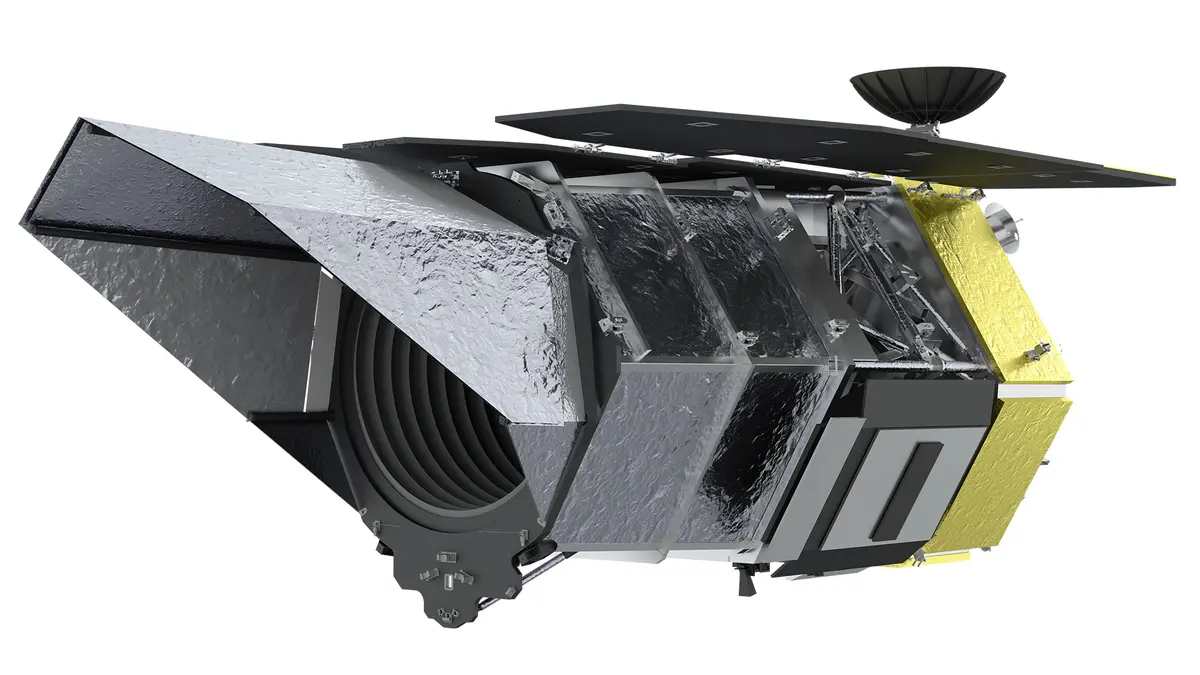
The National Aeronautics and Space Administration scheduled the Nancy Grace Roman Space Telescope for launch on 30 August.
Launch and destination
NASA scheduled liftoff for 11:26 Coordinated Universal Time. That corresponds to 4:56 p.m. Indian Standard Time.
A SpaceX Falcon Heavy will depart from Launch Complex 39A in Florida. Launch timings can still change for technical or weather reasons.
Roman will travel towards the Sun–Earth second Lagrange point. This region lies roughly 1.5 million kilometres beyond Earth, away from the Sun.
The observatory will follow a large quasi-halo orbit around that point. The stable geometry supports uninterrupted viewing and communications.
Same mirror, much wider view
Roman’s primary mirror is 2.4 metres wide, like Hubble’s. Its survey camera covers vastly more sky per exposure.
The two main instruments
The Wide Field Instrument uses eighteen detectors and a 288-megapixel camera. Its view covers roughly a full-moon-sized patch of sky.
NASA says Roman can image at least one hundred times Hubble’s field. That scale makes large, repeated surveys practical.
The Coronagraph Instrument will suppress light from nearby stars. It is a technology demonstration for directly imaging faint planets and surrounding dust.
Roman’s primary exoplanet survey will use gravitational microlensing. Foreground gravity briefly magnifies light from a more distant star.
What scientists want to learn
Wide surveys will map galaxies across cosmic time. Their clustering and apparent distortions can test how cosmic expansion has changed.
The mission will also measure weak gravitational lensing and supernova distances. Together, these methods probe dark energy and cosmic structure.
Microlensing can detect planets far from their stars and even unbound worlds. This complements nearby-planet surveys using transits.
Roman data will enter public archives without proprietary periods for core surveys. Open access can multiply discoveries beyond the original science teams.
Mission limits
NASA defines a five-year primary mission and a ten-year goal. Actual lifetime will depend on systems performance and operating resources.
Roman will not replace Hubble or Webb. Its distinctive strength is fast, repeated coverage across a large infrared field.
A survey observatory
Roman trades narrow, prolonged viewing for breadth and repetition. That design can reveal rare objects and population-wide patterns.
Conclusion
If launched as scheduled, Roman will transform wide-field infrared astronomy. Its greatest value may emerge from discoveries nobody planned.