
Why in news?
President Droupadi Murmu reached Bucharest for a State Visit on 23 July 2026. It was the first Indian presidential State Visit there in nearly three decades. She held talks with Romanian President Nicușor Dan. Both sides agreed to deepen economic, educational, scientific and defence cooperation.
Background
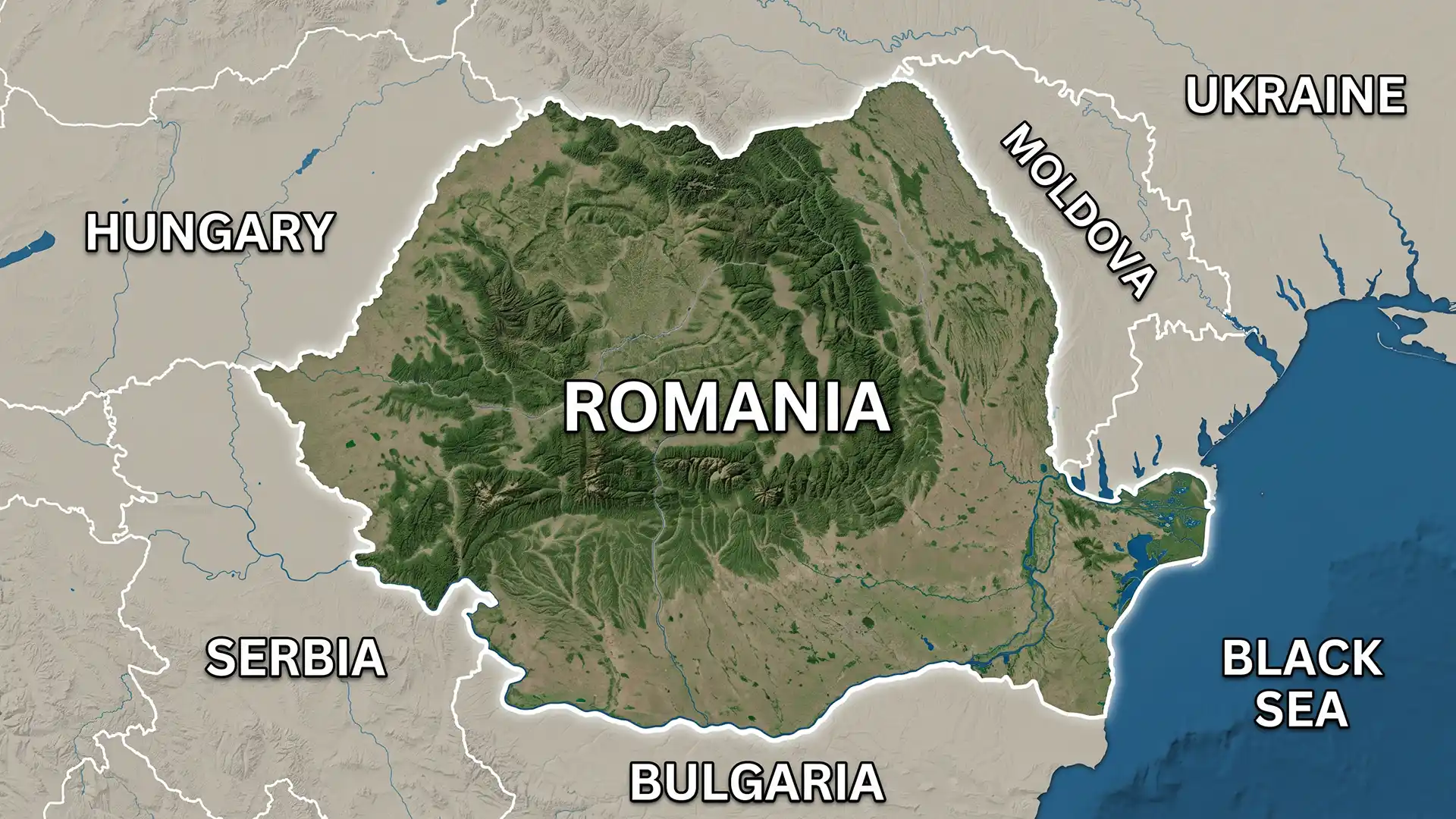
Romania lies in south-eastern Europe, where Central Europe meets the Balkans. Bucharest is its capital and largest city.
Romanian is the official language, while the Romanian leu remains the currency instead of the euro.
The country is a semi-presidential republic, with a President heading the state and a Prime Minister leading government.
Location and neighbours
- North and east: Romania shares a border with Ukraine.
- East: Moldova borders Romania on the east.
- South: Bulgaria lies across much of the lower Danube boundary.
- South-west: Romania shares a land border with Serbia.
- West: Hungary forms Romania’s western land neighbour.
- South-east: Romania has a coastline on the Black Sea.
Major physical features
The Carpathian Mountains curve through central Romania, dividing the Transylvanian basin from lower outer plains.
Moldoveanu Peak, within the Southern Carpathians, is Romania’s highest point at 2,544 metres.
The Danube River forms much of Romania’s southern boundary. It then bends north and east towards the Black Sea.
The Danube Delta spreads across Romania and Ukraine, containing channels, reed beds, lakes and internationally important wetlands.
A short chronological history
- 1859: Moldavia and Wallachia elected the same ruler and formed a political union.
- 1877–1878: Romania declared independence, which received international recognition after war.
- 1881: The country became the Kingdom of Romania.
- 1918: Transylvania and other territories joined after the First World War.
- 1947: The monarchy ended, and a communist republic was established.
- 1989: A revolution ended communist rule and opened democratic transition.
- 2004: Romania joined the North Atlantic Treaty Organization (NATO).
- 2007: Romania became a member of the European Union.
- 31 March 2024: Romania removed internal Schengen checks at air and sea borders.
- 1 January 2025: It removed internal land checks and became a full Schengen member.
History of relations with India
India and Romania established diplomatic relations on 14 December 1948, followed by educational, cultural, industrial and technical cooperation.
Romanian universities educate Indian medical and engineering students, while Indian professionals and companies operate across Romania.
The countries will complete eighty years of diplomatic relations in 2028, designated the India–Romania Year of Innovation.
What happened during the 2026 visit?
- Both leaders agreed to work towards doubling bilateral trade within three years.
- They supported stronger business links and more resilient supply chains.
- They agreed to expand joint research under a science cooperation programme.
- An Indian Studies Chair will open at the University of Bucharest.
- The Indian Council for Cultural Relations will support that academic chair.
- A new understanding will strengthen bilateral cooperation in sports.
- India will double Romania’s training opportunities under its technical programme.
- They supported defence exchanges, training, capacity building and closer industry links.
The Indian Technical and Economic Cooperation (ITEC) Programme provides these training opportunities.
Why is Romania important for India?
- Romania offers access to European Union markets and industrial supply chains.
- Its Black Sea location gives it growing strategic and transport importance.
- It has strengths in engineering, energy, information technology and manufacturing.
- It can support education, research and skilled-worker partnerships with India.
India and the European Union concluded free-trade negotiations on 27 January 2026.
The agreement still needs legal and domestic procedures before taking effect.
Conclusion
The 2026 visit moved an old friendship towards practical cooperation through trade, research, education and innovation.