

Why in news?
Roselle gained attention through recent crop research and renewed interest in natural fibres. Indian programmes are evaluating its food and industrial uses; the crop offers edible calyces, leaves and seeds alongside stem fibre. That combination creates opportunities, but also complicates crop planning.
Identity and a changing scientific name
Indian agricultural literature usually calls roselle Hibiscus sabdariffa. It belongs to the mallow family, Malvaceae. Kew’s 2026 taxonomic backbone now treats that name as a synonym. Its accepted name is Sabdariffa gossypiifolia.
World Flora Online still lists Hibiscus sabdariffa as accepted; scientific databases can differ while classifications are being updated.
Crop reports therefore continue using the familiar older name. Both names may appear in current literature for the same cultivated plant.
What is commonly eaten
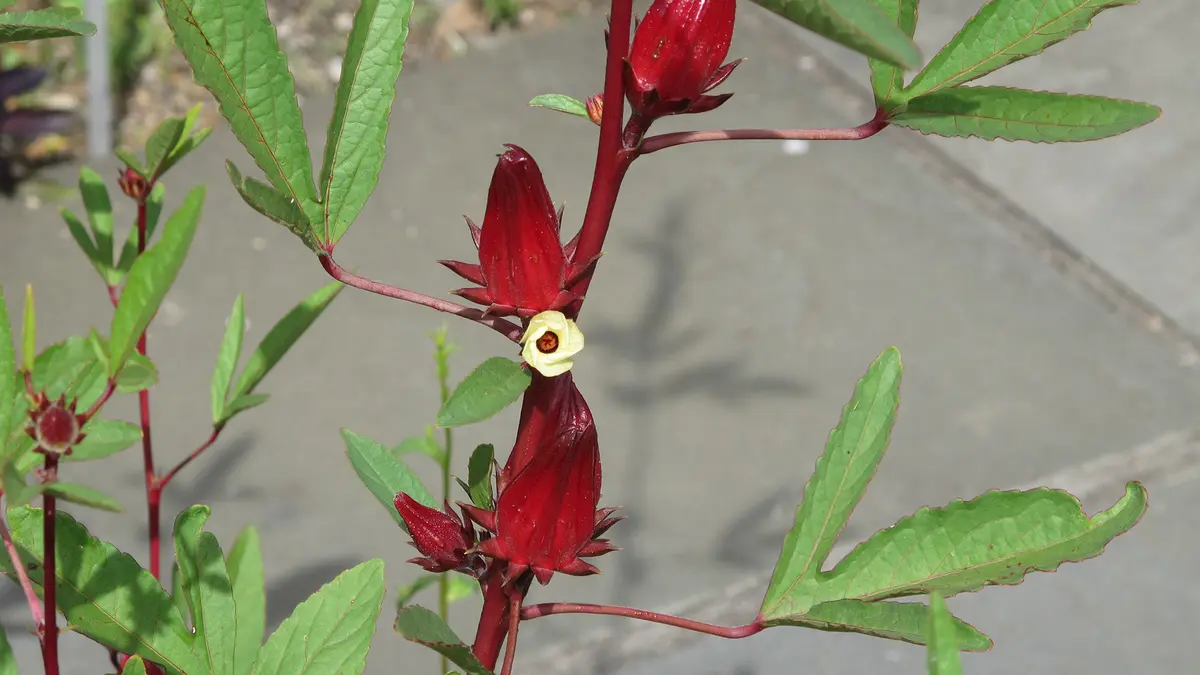
The red, fleshy structure used in drinks and preserves is the calyx; it surrounds the seed capsule after flowering. Calling every roselle product “hibiscus flower” can obscure this distinction. Leaves and seeds also have separate food uses.
Food, fibre and other products
Roselle calyces provide colour, acidity and flavour to beverages, jams and sauces; their pigments include anthocyanins. Young leaves are cooked as vegetables in several Indian regions. Seeds can supply oil, protein and material for animal feed.
The stem produces bast fibre, which occurs beneath the outer bark. Roselle fibre is grouped with mesta in Indian crop statistics.
Fibre can enter cordage, paper, composites and packaging. Quality depends on variety, harvest timing and retting.
Retting loosens fibre bundles from the stem. Poorly managed retting can pollute water and reduce fibre quality.
Recent Indian research
The Indian Council of Agricultural Research developed HSLC 1 for fresh calyx production. Its recommended zone spans several States and the Northeast. The official report gives a fresh calyx yield of 42.60 quintals per hectare. It lists maturity near 120 to 130 days.
Those figures describe tested recommendations, not a guaranteed farm result. Rainfall, soil, management and market type affect performance.
The Council’s Central Research Institute for Jute and Allied Fibres also studies roselle. Its work connects crop breeding with new fibre applications.
Recent genotype evaluation in Assam examined yield and earliness. Regional testing matters because day length strongly affects flowering in roselle.
Opportunities for farmers
Roselle can diversify rainfed farming where suitable cultivars are available. Multiple products may spread risk across food and fibre markets; however, dual-purpose claims need realism. A cultivar optimised for calyces may not deliver the best fibre yield.
Fresh calyces are bulky and perishable. Farmers need nearby processing, drying standards and assured buyers before expanding acreage.
Value addition can retain more income locally. Producer groups may share dryers, grading equipment and packaging facilities.
Natural fibre demand may support composites and plastic substitutes. Environmental benefits still depend on processing energy and product durability.
Nutrition claims need restraint
Roselle contains organic acids, minerals and plant pigments. Composition changes with cultivar, processing and serving size; a nutritious food is not automatically a treatment for disease. Clinical claims require controlled human evidence and safe dosage information.
Concentrated extracts may interact with medicines or alter blood pressure. Food promotion should not become unregulated medical advertising.
Conclusion
Roselle is a versatile crop with genuine food and fibre potential. Its value lies in matching varieties with markets and local processing; research must continue beyond yield trials. Farmer returns, water-safe retting and truthful nutrition labels will determine sustainable expansion.