
Why in news?
Astronomers analysing five years of data from the Atacama Large Millimetre/Sub‑millimetre Array (ALMA) announced in 2026 that they had found clear evidence of a wind blowing away from Sagittarius A* (Sgr A*), the supermassive black hole at the centre of the Milky Way. A cone‑shaped cavity about three light‑years across, devoid of cold molecular gas, suggests that Sgr A* has been expelling material for at least 20,000 years.
Background
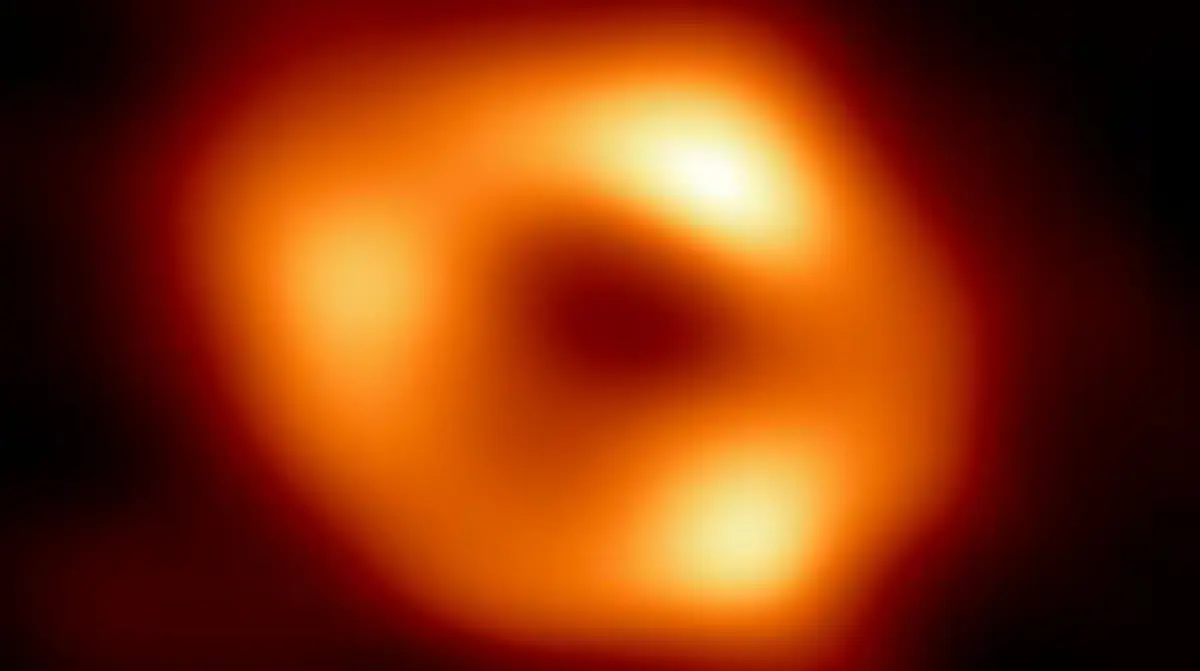
Sagittarius A* is a compact radio source located roughly 26,000 light‑years from Earth in the constellation Sagittarius. Radio astronomer Karl Jansky first detected static from this direction in the early 1930s. In 1974 Bruce Balick and Robert Brown identified the source, naming it Sgr A*. Subsequent measurements of stars orbiting near the centre of our galaxy led by astronomers like Reinhard Genzel and Andrea Ghez showed that an object about four million times heavier than the Sun lies there, leaving little doubt that Sgr A* is a supermassive black hole. In 2022 the Event Horizon Telescope produced the first image of Sgr A*, showing a ring of bright material encircling a dark shadow.
What the new study found
- Deep observation: Scientists used ALMA to map cold molecular gas in the central few light‑years of the galaxy. By subtracting the bright radio emission from the black hole, they obtained the deepest and sharpest image yet of the surrounding gas.
- Three‑light‑year cavity: The data revealed a conical cavity roughly one parsec (3 light‑years) long and half a parsec wide, almost devoid of cold gas. The cavity’s shape and size are difficult to explain by stellar winds alone.
- Evidence for a black‑hole wind: Researchers concluded that only a wind launched from Sgr A* could clear such a cavity. As matter falls towards a black hole, magnetic fields and intense radiation can accelerate some of it outward at high speed, producing jets or winds. The discovery confirms that even relatively quiet black holes like Sgr A* produce outflows.
- Duration and implications: The wind appears to have been blowing for at least 20,000 years, hinting that the black hole goes through periods of low‑level activity between more dramatic outbursts. Understanding these winds helps scientists learn how black holes influence the evolution of their host galaxies.
Conclusion
The identification of a wind from Sagittarius A* is a major step in understanding how supermassive black holes interact with their surroundings. It shows that even when a black hole is not accreting large amounts of matter, it can still expel energy and shape the environment in the centre of a galaxy. The finding also demonstrates the power of long‑term observations and advanced telescopes in uncovering subtle phenomena in our cosmic neighbourhood.