

Why in news?
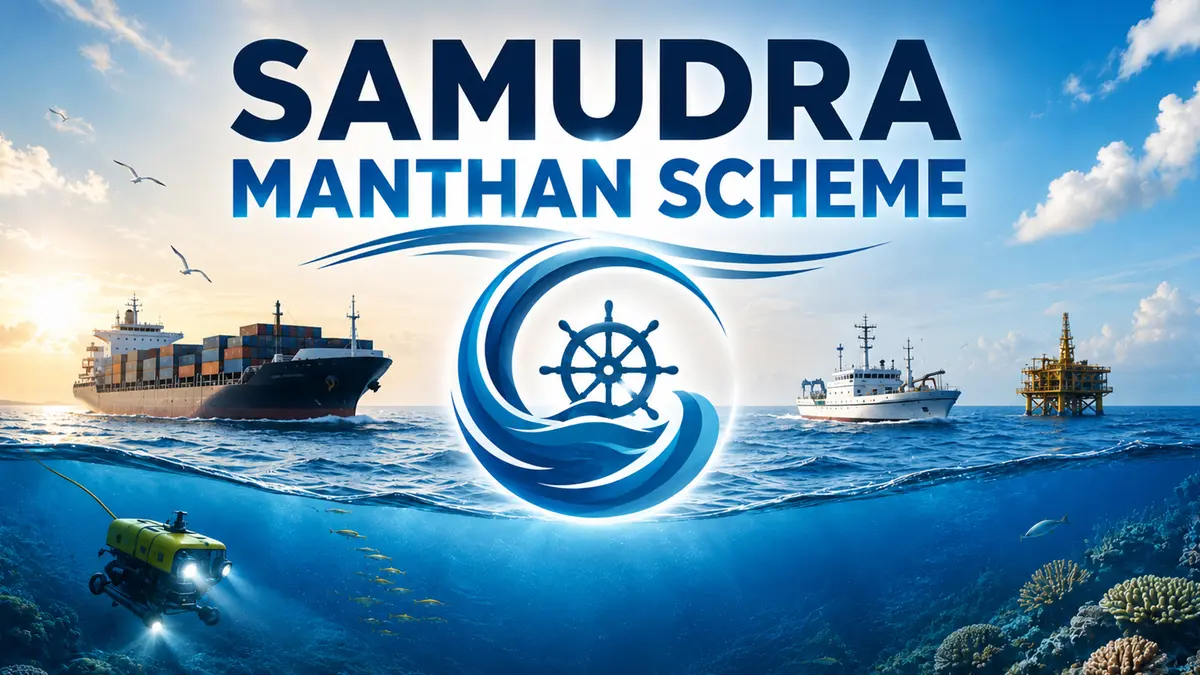
The Union Cabinet approved the Samudra Manthan scheme on 31 July 2026.
This National Offshore Exploration Scheme has an approved outlay of ₹84,084 crore.
The Ministry of Petroleum and Natural Gas will implement it through 2030–31.
The scheme supports offshore surveys, exploratory drilling, common infrastructure and specialised industrial capacity.
Background
India imports much of the crude oil and natural gas needed by its economy.
Increasing domestic discoveries can improve energy security, although exploration remains uncertain and expensive.
Offshore resources lie beneath seabeds away from the mainland and islands.
Deepwater areas require specialised rigs, vessels, sensors, subsea equipment and emergency systems.
Costs and technological risks generally increase with water depth and geological complexity.
Nature of the scheme
Samudra Manthan is a Central Sector Scheme of the petroleum ministry.
Under this category, the Union Government funds and administers the approved programme.
The Cabinet approved implementation through the financial year ending March 2031.
The announcement follows the Prime Minister's Independence Day address from August 2025.
That address proposed a modern exploration effort using the Samudra Manthan metaphor.
Major interventions
- Large surveys will acquire, process and interpret higher-quality seismic data.
- Exploratory wells will target deepwater and ultra-deepwater prospects more rapidly.
- Scientific drilling will investigate frontier basins with limited existing information.
- Common production and evacuation facilities may serve multiple offshore discoveries.
- An integrated manufacturing and services zone will support oilfield equipment and expertise.
- Digital management, training, technology adoption and international engagement will support implementation.
How offshore exploration proceeds
Geologists first combine basin history with magnetic, gravity and seismic information.
Seismic surveys send controlled energy through rocks and record returning subsurface reflections.
Processed images can reveal folds, faults and structures that might trap hydrocarbons.
Only drilling can directly test whether a chosen structure actually contains hydrocarbons.
A discovery then requires appraisal to estimate size, quality, flow and commercial viability.
Production begins only after investment decisions, infrastructure, approvals and development work.
Expected outcomes and their limits
The government expects reserve additions exceeding 600 million metric tonnes of oil equivalent.
A tonne of oil equivalent compares energy quantities from different fuels on one basis.
The 600-million figure is a programme expectation, not an independently established reserve today.
Officials also expect more employment, domestic manufacturing, investment and offshore production capacity.
Actual results will depend upon geology, prices, technology, regulation and project execution.
Environmental safeguards
Offshore work can disturb seabeds, create underwater noise and increase accidental-spill risks.
Fishing grounds, marine mammals, coastal ecosystems and disaster preparedness therefore require attention.
Project approvals and monitoring remain necessary despite the Cabinet's scheme-level approval.
Conclusion
Samudra Manthan builds exploration capability, but geological success and responsible development remain separate tests.