
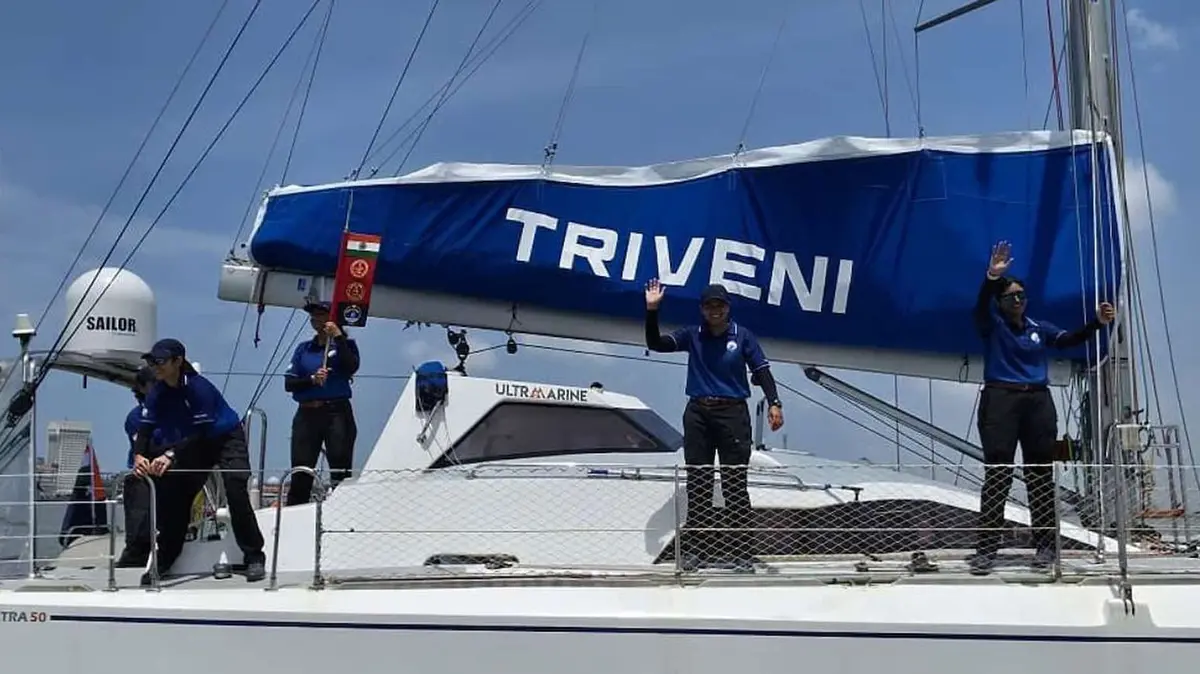
Why in news?
Nine women officers completed the Samudra Pradakshina sailing expedition. The journey lasted 314 days and covered nearly 25,500 nautical miles. It was India's first all-women, tri-service sailing circumnavigation. Defence Minister Rajnath Singh welcomed the crew on 22 July 2026.
Background
Circumnavigation means travelling around Earth, but sailing records must meet recognised geographical conditions.
The route must cross every longitude meridian and the Equator before finishing where it began.
Samudra Pradakshina crossed the Equator twice and also crossed the International Date Line.
The International Date Line broadly follows 180 degrees longitude, and crossing it changes the calendar date.
The crew rounded Cape Leeuwin, Cape Horn and the Cape of Good Hope.
These headlands are the Great Capes, which expose sailors to powerful winds, currents and waves.
What was the expedition?
The Defence Minister virtually flagged off Samudra Pradakshina from Mumbai on 11 September 2025.
It ended in Mumbai on 22 July 2026 after lasting more than ten months.
The crew sailed nearly 25,500 nautical miles across four oceans, equalling roughly 47,200 kilometres.
Measurement: One nautical mile equals exactly 1.852 kilometres and relates directly to Earth's latitude.
Recognised sailing rules require at least 21,600 nautical miles under sail, without canals or powered transit.
Who participated?
Ten women officers were named when the expedition began, while nine completed the voyage.
The final official release does not explain this change. The returning officers represented the Army, Navy and Air Force.
Lieutenant Colonel Anuja Varudkar led the expedition. Squadron Leader Shraddha P Raju served as deputy leader.
Bringing all three services together made the mission tri-service and tested shared planning and leadership.
The launch release described three years of progressive training. The completion release highlighted nearly two years of intensive preparation.
These descriptions appear to count different phases. Neither release explains the difference.
A shore team provided continuous support throughout the journey.
First-ever record: The launch release described this as the world's first tri-service, all-women sailing circumnavigation.
What vessel did they use?
The officers used the Indian Army Sailing Vessel Triveni, an indigenously built 50-foot vessel.
A sailing vessel depends upon wind and crew skill across sail management, navigation and repairs.
The vessel's Indian construction demonstrated domestic design and engineering capability. It also reduced reliance upon imported platforms.
Why was Cape Horn especially difficult?
Cape Horn lies near the southern end of South America. The Drake Passage separates this region from Antarctica.
Strong westerly winds travel around the Southern Ocean with little land obstruction.
Powerful currents, cold water and rapidly changing weather make this passage dangerous.
The successful passage earned the crew membership of the Cape Horners' sailing fraternity.
Why does the mission matter?
- It was the first tri-service, all-women circumnavigation sailing expedition from India.
- It demonstrated endurance, navigation skills and emergency readiness during prolonged isolation.
- Joint training improved practical coordination among India's three armed services.
- Foreign port calls created goodwill and supported India's military diplomacy.
- The indigenous vessel displayed Indian maritime engineering before international audiences.
Military diplomacy uses defence exchanges to build trust. Port calls, exercises and training often serve this purpose.
The crew also supported marine research with the National Institute of Oceanography.
Planned work covered microplastics, ocean life and public awareness about marine health.
Conclusion
Samudra Pradakshina combined women's leadership, maritime skill, tri-service coordination and indigenous capability within one demanding voyage.