

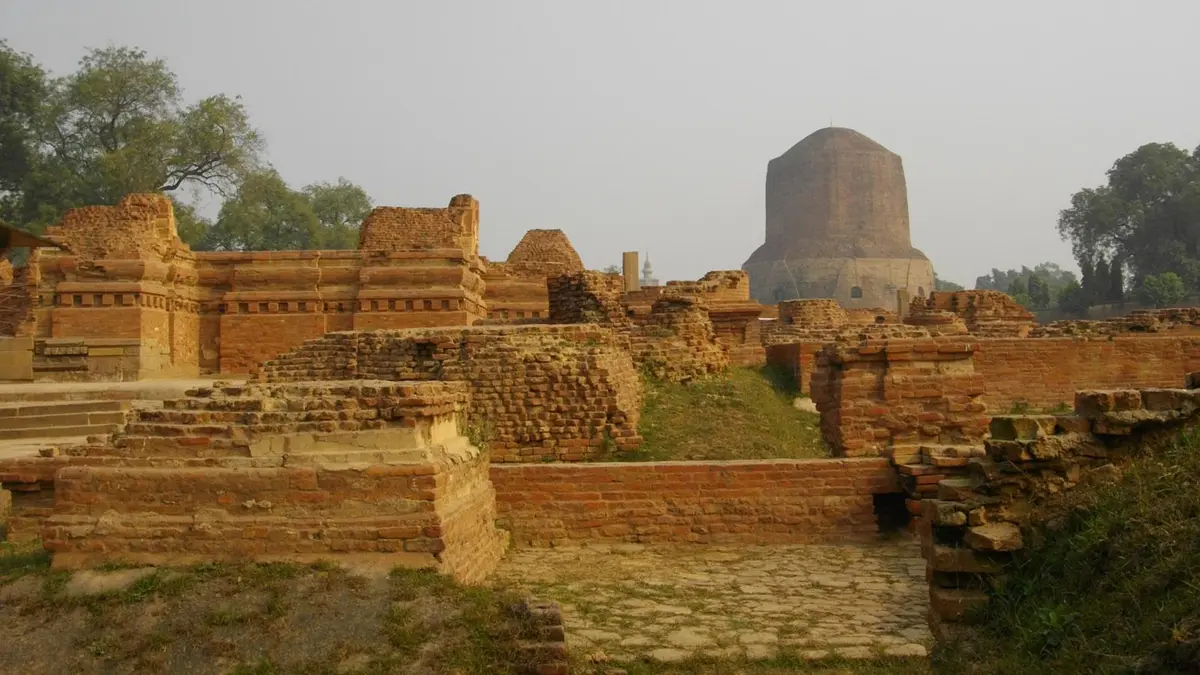
Why in news?
UNESCO inscribed the Ancient Buddhist Site of Sarnath on 25 July 2026. The decision came during the World Heritage Committee’s 48th session. That session was held at Busan in the Republic of Korea. Sarnath became India’s 45th World Heritage property.
Background
Sarnath is an ancient Buddhist site near Varanasi in Uttar Pradesh.
Buddhist traditions also call it Isipatana, Rishipatana or Mrigadava, meaning Deer Park.
After attaining enlightenment at Bodh Gaya, the Buddha reached Sarnath and taught five former companions.
This event occurred during the sixth century BCE according to Buddhist tradition.
Why was the first sermon important?
The sermon is called Dharmachakra Pravartana, meaning “turning the Wheel of Dharma”.
It explained the Four Noble Truths and the Noble Eightfold Path.
The five listeners became the earliest disciples, and their community began the Buddhist Sangha.
Sangha generally refers to the organised community of Buddhist monks and nuns.
Four principal Buddhist pilgrimage places
| Place | Present location | Event |
|---|---|---|
| Lumbini | Nepal | Birth of the Buddha |
| Bodh Gaya | Bihar, India | Enlightenment |
| Sarnath | Uttar Pradesh, India | First sermon |
| Kushinagar | Uttar Pradesh, India | Mahaparinirvana |
Lumbini, Bodh Gaya and Sarnath now hold World Heritage status, while Kushinagar does not.
A chronological history of Sarnath
| Period | Main development |
|---|---|
| Sixth century BCE | The Buddha delivered his first sermon to five disciples. |
| Fifth–fourth centuries BCE | Early settlement activity preceded major Mauryan construction. |
| Third century BCE | Emperor Ashoka supported stupas, monasteries and a stone pillar. |
| Kushana period | Monastic activity and Buddhist image-making expanded. |
| Fourth–sixth centuries CE | Gupta patronage produced celebrated Sarnath sculpture. |
| Fifth century CE | Chinese pilgrim Faxian described Buddhist life in the region. |
| Seventh century CE | Chinese pilgrim Xuanzang recorded major monasteries and monuments. |
| Twelfth century CE | The centre declined and suffered major destruction. |
| 1794 | Digging linked with Jagat Singh drew new attention to the ruins. |
| Nineteenth–twentieth centuries | Survey and excavation revealed the ancient religious complex. |
| 1998 | India placed Sarnath on its World Heritage Tentative List. |
| January 2025 | India submitted the complete nomination for international evaluation. |
| September 2025 | An international expert mission examined conservation and management. |
| 25 July 2026 | The World Heritage Committee approved inscription. |
Archaeology reveals a sixteen-century settlement sequence, extending from pre-Mauryan times to the twelfth century CE.
A serial World Heritage property
A serial property has separate components sharing one heritage value, and Sarnath contains two protected parts.
| Component | Area | Main elements |
|---|---|---|
| Chaukhandi Stupa | About 2.02 hectares | The monument marks the meeting with the five disciples. |
| Archaeological Remains of Sarnath | About 6.03 hectares | Stupas, monasteries, shrines and the Ashokan pillar remain. |
The components total 8.05 hectares, surrounded by a 72.2-hectare buffer protecting archaeology, views and setting.
Important monuments
1. Chaukhandi Stupa
This Gupta-period brick mound marks the Buddha’s meeting with his five former companions.
A Mughal-period octagonal tower commemorates Emperor Humayun’s visit to Sarnath.
2. Dhamek Stupa
Dhamek is the site’s most prominent standing stupa, with geometric and floral carving below.
Several rebuilding phases shaped the present structure, while tradition connects its area with the first sermon.
3. Dharmarajika Stupa
Ashoka is associated with the original stupa, but only its foundation survives today.
Large-scale dismantling during 1794 destroyed much of the monument.
4. Mulagandhakuti
The excavated Mulagandhakuti marks an ancient temple or shrine area.
It differs from the modern Mulagandha Kuti Vihara, built by the Mahabodhi Society during the twentieth century.
5. Ashokan pillar
A polished sandstone pillar once stood here, and its broken shaft remains near the original position.
The celebrated Lion Capital is preserved in the site museum.
Lion Capital and India’s national symbols
The capital shows four lions standing back-to-back above a circular abacus.
The abacus includes an elephant, bull, horse and lion, with wheels separating the figures.
India adopted an adapted Lion Capital as its State Emblem and placed a 24-spoked Ashoka Chakra on its flag.
Both symbols connect modern India with Mauryan artistic heritage.
The Sarnath school of art
Sarnath became a major Gupta sculpture centre, where artists created Buddha images from fine Chunar sandstone.
Figures show calm faces, smooth modelling and very thin robes.
The teaching Buddha displays the Dharmachakra Pravartana mudra, symbolising his first teaching at Sarnath.
How World Heritage inscription works
- A country first places the property on its Tentative List.
- It prepares a nomination explaining Outstanding Universal Value.
- Advisory experts evaluate heritage value, protection and management.
- The World Heritage Committee takes the final inscription decision.
- The country must then protect the accepted heritage value.
Sarnath met cultural criterion (iii), recognising exceptional testimony to a cultural tradition.
Criterion (vi) covers direct association with events or living traditions.
Important World Heritage numbers
- Sarnath became India’s 45th World Heritage property and Uttar Pradesh’s fourth.
- India ranked sixth globally by number of listed properties.
- India ranked second within the Asia-Pacific region.
- India had 69 properties on its Tentative List.
- Each state party may nominate only one property annually.
The Archaeological Survey of India handles India’s World Heritage matters nationally.
Established during 1904, Sarnath Museum is described by the Press Information Bureau as India’s earliest site museum.
What must happen after inscription?
- Tourist numbers must remain compatible with fragile archaeological remains.
- Construction around the buffer zone requires careful control.
- Drainage must prevent water damage to ancient brickwork.
- Interpretation should distinguish ancient and modern religious buildings.
- Local communities should benefit from responsible cultural tourism.
Conclusion
Sarnath links the Buddha’s first teaching, Mauryan statecraft and centuries of Buddhist creativity.