
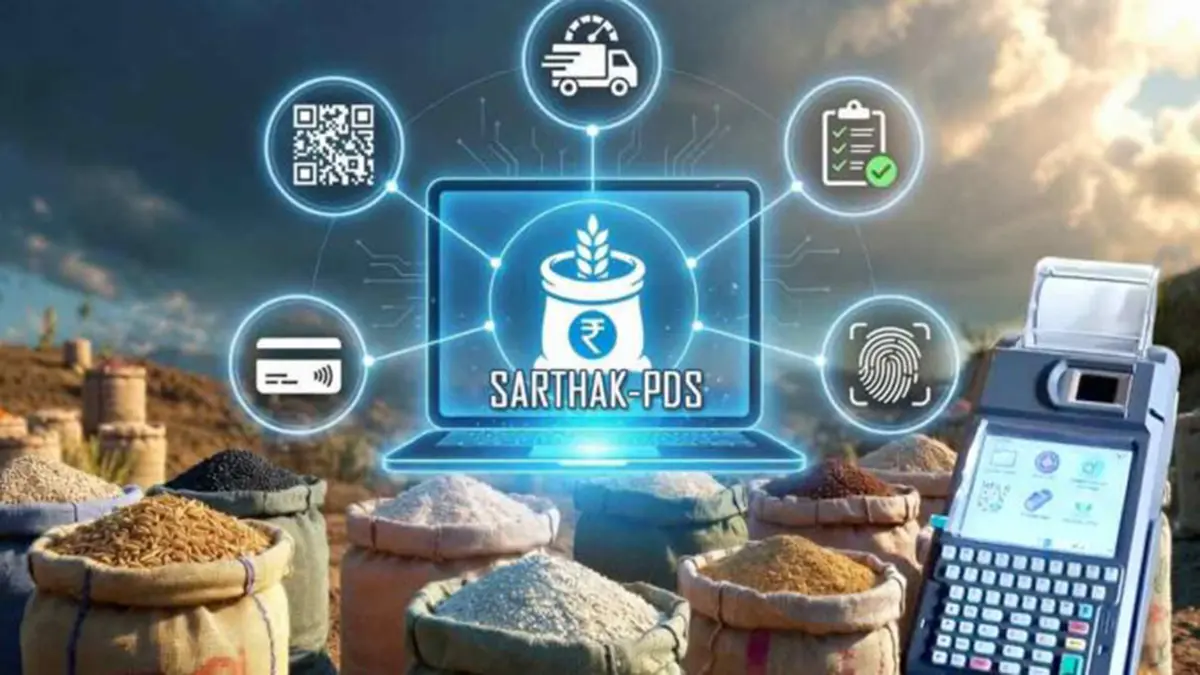
Why in news?
The Cabinet Committee on Economic Affairs approved a new umbrella programme called SARTHAK PDS, which stands for Sustainable and Resilient Transformation and Holistic Advancement of Public Distribution System. The scheme combines funding for the movement of foodgrains and fair price shop margins with modernisation efforts under the SMART PDS initiative and will be in force until March 2031.
Background
India’s Public Distribution System (PDS) began as a rationing programme during the Second World War. Initially covering a few cities, it expanded after independence to become a nationwide network of fair price shops supplying subsidised grains to poor households. The system was formalised through successive Five Year Plans and strengthened with the National Food Security Act 2013, which made food entitlements a legal right. Over the past decade the government introduced digitisation and portability measures such as end‑to‑end computerisation, Integrated Management of PDS and the One Nation One Ration Card system.
Key features of SARTHAK PDS
- Unified umbrella: The scheme merges two existing components – assistance for intra‑state transport of foodgrains and fair price shop dealers’ margin, and the technology‑driven SMART PDS reforms – into one administrative framework.
- Modern digital architecture: SARTHAK aims to build a single interoperable architecture using advanced technologies such as artificial intelligence, machine learning, natural‑language processing and blockchain. It seeks to create unified databases for ration cards and beneficiaries, enabling real‑time monitoring of supply chains and inventory.
- Enhanced transparency: State‑level command and control centres will use AI‑enabled analytics to detect anomalies and resolve grievances. Standard operating procedures will be certified to international quality standards so that citizens can track entitlements and redress issues efficiently.
- Financial support: The central government will allocate funds for transporting grains from depots to shops and for paying dealers’ margins. The total outlay is estimated at approximately ₹25,530 crore for the Five Year (2025‑26 to 2029‑30) period.
- Duration: The scheme is planned to run up to 31 March 2031, providing a stable policy horizon for states to undertake reforms.
Why it matters
- Streamlined delivery: By unifying schemes and adopting modern technology, SARTHAK aims to ensure that subsidised foodgrains reach beneficiaries without leakages or duplication.
- Digital inclusion: The programme builds upon mobile apps like Mera Ration and portable biometric systems, enabling migrants to access their entitlements anywhere in India.
- Transparency and accountability: Unified databases and AI‑driven analytics will make it easier to detect diversions of grain, ghost ration cards and other irregularities.
- Support for dealers: Assured margins and transport subsidies will improve the viability of fair price shops, encouraging them to invest in digital equipment and deliver better services.
Conclusion
SARTHAK PDS represents a major step towards a transparent and technologically robust food distribution system. By merging transportation support with digital reforms and providing a long‑term funding commitment, the scheme aims to protect the food security rights of millions of citizens while enhancing efficiency and accountability.