

Why in news?
The latest winter census conducted by the Uttar Pradesh forest department recorded 20,628 Sarus cranes across the state—an increase of 634 birds, or about 3.1 percent, from the previous year. The Etawah division reported the largest population with 3,304 birds, while Mainpuri counted 2,899. Nearly 10,000 citizens participated in the survey, underscoring growing public support for wildlife conservation.
Background
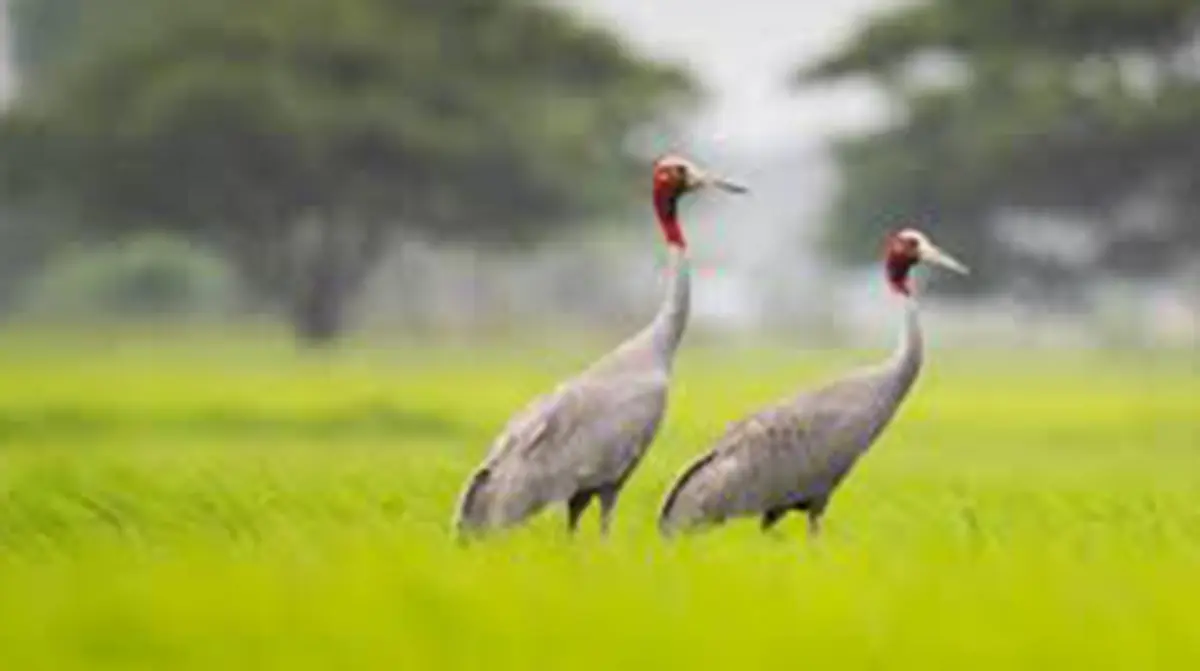
The Sarus crane (Grus antigone) is the tallest flying bird on Earth, standing about 5.8–6 feet tall and weighing roughly 6 kg. Adults have grey plumage, red skin on the head and upper neck, and long red legs. The species is listed as Vulnerable on the IUCN Red List, with an estimated global population of 20,000–30,000 individuals.
The Indian subspecies inhabits wetlands and agricultural fields in north‑western India, Nepal’s Terai and parts of Pakistan. Sarus cranes pair for life and build nests on small wetland mounds. They feed on aquatic plants, grains, insects and small vertebrates. Threats include habitat loss due to draining of wetlands, collisions with power lines, chemical poisoning and human disturbance.
Census results
- Population increase: The number of Sarus cranes rose from 19,994 in 2024 to 20,628 in the 2025–26 winter count. In 2023 the population was 19,196, indicating a steady upward trend.
- Distribution: Besides Etawah and Mainpuri, forest divisions such as Auraiya (1,283), Shahjahanpur (1,078), Gorakhpur (950) and Kannauj (826) reported high numbers.
- Moderate presence: Twenty‑nine divisions recorded between 100 and 500 cranes, while another twenty‑nine recorded fewer than 100 birds.
- Citizen involvement: About 10,000 volunteers joined forest officials in counting the cranes, highlighting community interest in the state bird’s conservation.
Conservation outlook
- Positive trend: The increase suggests that wetland conservation and community outreach programmes are having an effect.
- Ongoing threats: Rapid urbanisation, pesticide use and the conversion of wetlands for agriculture still threaten the species; continued protection of wetlands and awareness campaigns are essential.
- Research and monitoring: Long‑term studies by organisations such as the International Crane Foundation help identify critical habitats and mitigate threats.
Conclusion
The rising population of Sarus cranes in Uttar Pradesh is a heartening sign for India’s state bird. Sustained efforts to protect wetlands, reduce human disturbances and engage local communities will be key to ensuring that this elegant crane continues to thrive.
Sources: Hindustan Times