
Why in news?
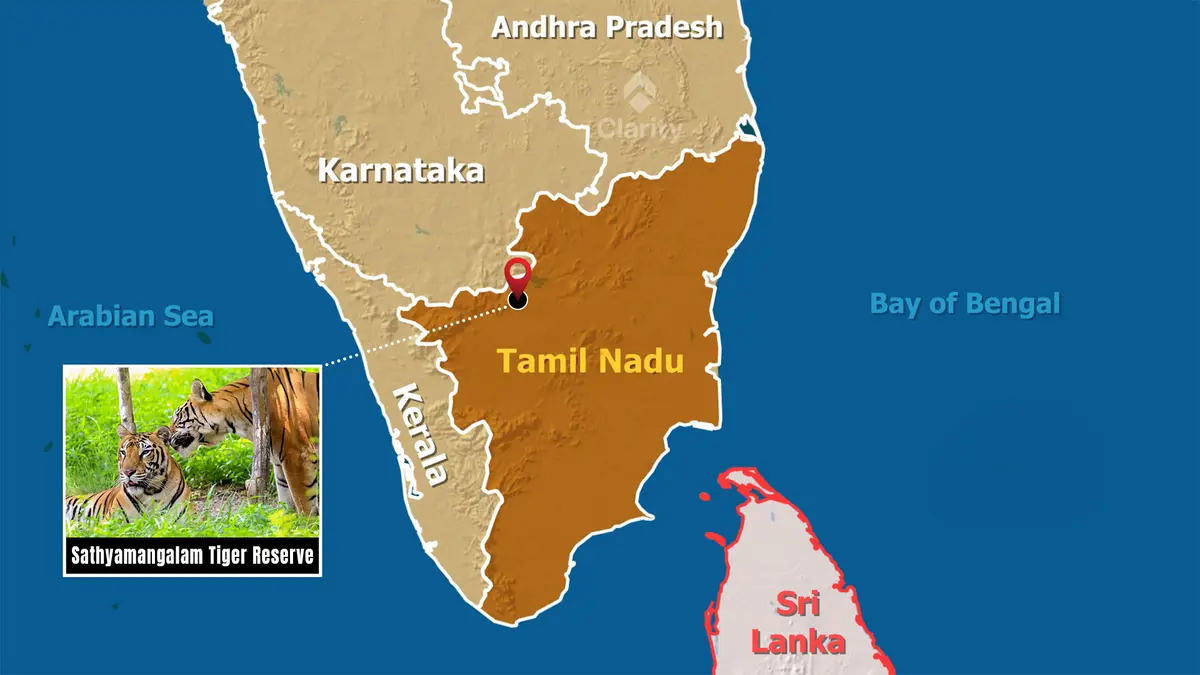
Officials sealed 21 resorts near Sathyamangalam Tiger Reserve. The action followed directions from the Madras High Court. Authorities had identified 23 commercial properties for closure under the enforcement plan. Two properties obtained temporary protection from the High Court.
Background
Sathyamangalam lies in north-western Tamil Nadu’s Erode district; its forests occupy a meeting zone between two major hill systems.
These are the Western Ghats and the Eastern Ghats; the landscape allows animals to move between large protected forests.
Such movement maintains feeding routes, breeding access and genetic exchange.
How did the protected area develop?
- Tamil Nadu notified the Sathyamangalam Wildlife Sanctuary during 2008.
- The state later proposed stronger landscape protection for tigers.
- Sathyamangalam received its official designation as a tiger reserve during 2013.
- The reserve combined protected core habitat with a surrounding buffer.
- Management now covers conservation alongside human needs in the buffer.
The Wildlife Protection Act, 1972 provides the legal tiger-reserve framework; section 38V governs notification and planning for tiger reserves.
Where is the reserve located?
The reserve covers about 1,408.41 square kilometres; its core measures about 793.49 square kilometres.
Its buffer measures about 614.91 square kilometres.
Prelims numbers: Core is 793.49 square kilometres; buffer is 614.91; total is 1,408.41.
It includes parts of the Sathyamangalam and Erode forest divisions; the reserve belongs to the wider Nilgiri Biosphere Reserve landscape.
It connects with Mudumalai, Bandipur and Biligiri Ranganatha Temple forests; Biligiri Ranganatha Temple Tiger Reserve is often shortened to BRT.
The Great Moyar corridor supports wildlife movement across this connected landscape.
What is the difference between core and buffer?
| Feature | Core area | Buffer area |
|---|---|---|
| Main purpose | Secure habitat for tiger conservation | Support coexistence and reduce pressure on core |
| Legal land type | Usually national park or sanctuary | May include forest and non-forest land |
| Human use | More strictly protected | Regulated multiple use may continue |
| Management need | Habitat and prey protection | Livelihoods, corridors and compatible development |
Common confusion: A buffer permits some human use; it is not an unrestricted construction zone.
Every activity must still follow applicable forest, wildlife and planning laws.
What happened to the resorts?
An environmental activist filed a public interest case before the Madras High Court.
The petition questioned resort construction in sensitive buffer locations.
The disputed properties lay in Hasanur, Germalam and Thalamalai panchayat areas.
A panchayat is an elected institution for rural local governance.
The court directed authorities to act against properties lacking required clearances; Erode district officials then formed three enforcement teams.
They identified 23 establishments for sealing; two obtained interim stays from the High Court.
The remaining 21 establishments were sealed on 16 July 2026.
An interim stay temporarily pauses action while a court examines the dispute.
It does not finally declare the construction lawful.
Which permissions were questioned?
The case concerned approvals from the Hill Area Conservation Authority; this Tamil Nadu body examines development in notified hill areas.
The litigation also referred to the National Board for Wildlife; the National Board for Wildlife is shortened to NBWL.
NBWL is a statutory body under the Wildlife Protection Act, 1972.
Its approval role depends upon the project’s location and legal category.
Case-specific point: The report describes missing clearances here; it does not create one universal rule for every buffer property.
Local building, land-use and pollution permissions may also apply.
Why can resorts harm wildlife corridors?
- Buildings and fences can narrow traditional animal movement routes.
- Night lighting can disturb wildlife behaviour during naturally dark hours.
- Vehicle traffic increases collision risk, noise and disturbance along forest roads.
- Improper food waste can attract wild animals towards people and buildings.
- Excessive groundwater extraction can reduce water availability for nearby forest habitats.
- Sewage can pollute streams used by animals and communities.
A corridor need not contain a large resident animal population; its value comes from allowing safe movement between habitats.
Blocking corridors can isolate populations and increase local conflict.
What vegetation occurs in Sathyamangalam?
Rainfall and elevation vary widely across the reserve; this variation supports several forest types.
- Dry thorn forest occurs in hotter, drier sections.
- Dry and moist deciduous forests occur across larger slopes.
- Semi-evergreen forest patches appear in wetter and more sheltered locations.
- Riverbanks support important riparian vegetation and movement routes for wildlife.
Riparian vegetation grows beside rivers and streams; common plant groups include teak, sandalwood, bamboo and terminalia trees.
Which animals live there?
The reserve protects tigers, leopards, elephants and dholes; dholes are wild dogs native to Asia.
Other mammals include gaur, sloth bears, deer and wild boar; its elephant movement routes have national conservation importance.
Healthy prey populations support large carnivores within the landscape.
How should tourism be managed?
- Construction should follow approved land-use zones and carrying limits.
- Night traffic and loud events need strict controls.
- Wastewater should receive complete treatment before any release into the surrounding environment.
- Operators should avoid building fences across established animal movement paths.
- Local communities should receive lawful jobs and tourism benefits.
- Monitoring should continue after any approval is granted.
Carrying capacity means the visitor pressure an ecosystem can sustain safely; ecotourism succeeds only when conservation remains its first condition.
Conclusion
The sealing drive shows why tiger-reserve buffers require planned development and enforceable wildlife safeguards.