

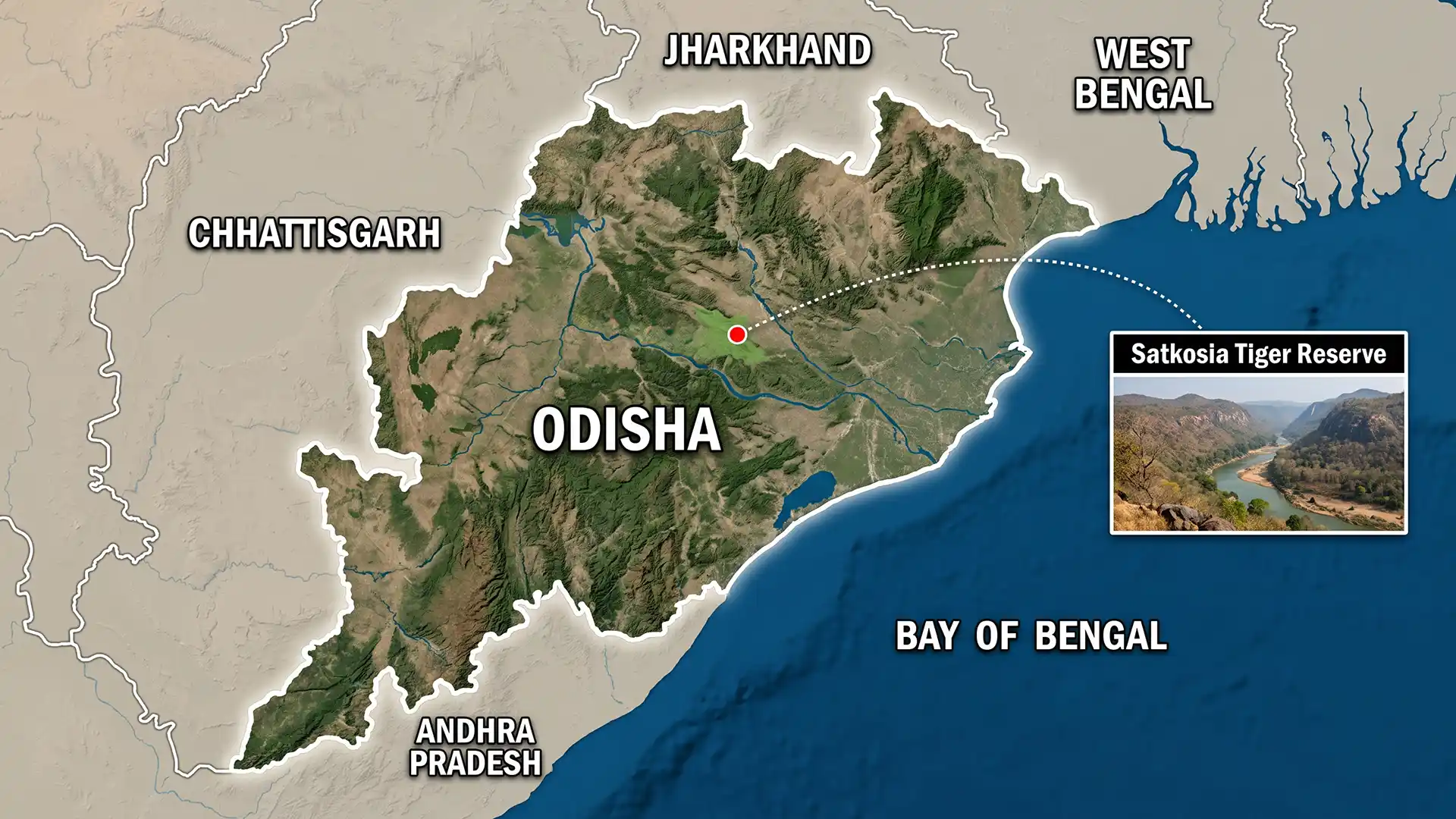
Why in news?
In May 2026 the Ministry of Environment, Forests and Climate Change issued a draft notification for an eco‑sensitive zone (ESZ) around Satkosia Tiger Reserve, proposing a buffer of about 548.7 sq km. The move aims to regulate development activities while conserving the reserve’s rich biodiversity. Some parts of the boundary have a zero‑kilometre ESZ due to nearby settlements, which has sparked debate among conservationists.
Background
Satkosia lies along a deep gorge carved by the Mahanadi River in Odisha. The name ‘Satkosia’ comes from the seven kos (about 14 miles) long gorge. The area was first notified as Satkosia Gorge Wildlife Sanctuary in 1976 to protect gharials and mugger crocodiles. In 1981 the adjacent Baisipalli Sanctuary was created south of the gorge. Together these sanctuaries cover about 964 sq km. They were declared Satkosia Tiger Reserve in December 2007 with a core area of about 524 sq km and a buffer of 440 sq km. After boundary adjustments in 2018, the reserve now spans 1,136.7 sq km and is part of the Mahanadi Elephant Reserve. Satkosia marks the meeting point of the Deccan Peninsula and Eastern Ghats biogeographic regions.
Ecology and features
- Landscape: The reserve consists of a 14‑mile‑long gorge with steep cliffs and a 32 km stretch of riverbed. Habitats range from moist and dry deciduous forests to riverine and riparian zones.
- Flora: Dominant tree species include Sal (Shorea robusta) in moist forests and Anogeissus latifolia, Terminalia tomentosa and Adina cordifolia in dry forests. The forests support varied understorey plants and provide habitat for medicinal herbs.
- Fauna: Satkosia hosts tigers, leopards, elephants, sloth bears, gaur, four‑horned antelope, sambar, barking deer and wild dogs. The riverine areas harbour gharial and mugger crocodiles, while islands in the gorge support Indian skimmers and other endangered birds.
- Key biodiversity area: BirdLife International recognises Satkosia as a Key Biodiversity Area because it harbours threatened species like the Indian skimmer and Bristled grassbird. It is also part of the Mahanadi Elephant Reserve, supporting a free‑roaming elephant population.
- Human pressure: More than 50 villages lie within the sanctuary. Main threats include fishing, livestock grazing, poaching, timber felling, mining and unregulated tourism. The proposed eco‑sensitive zone seeks to regulate such activities and promote low‑impact eco‑tourism.
Significance of the draft ESZ
- Regulation of development: The draft ESZ prohibits commercial mining, large industries, saw mills and new hydroelectric projects within the buffer zone. New commercial hotels and resorts are not permitted within 1 km of the reserve.
- Conservation vs. livelihoods: The zero‑kilometre ESZ in some directions reflects the presence of towns like Athmallik. Balancing conservation with local livelihoods is a key challenge.
- Ecosystem services: Satkosia’s forests and river support biodiversity, regulate water flow and provide ecotourism opportunities. Protecting the reserve aids both wildlife and people in the long term.
Conclusion
Satkosia Tiger Reserve encompasses a unique gorge ecosystem where the Mahanadi River cuts through the Eastern Ghats. The draft eco‑sensitive zone aims to safeguard this biodiversity hotspot while accommodating human needs. Careful implementation and participation of local communities will determine its effectiveness.
Sources: NIE