
Why in news?
Senegal’s President Bassirou Diomaye Faye became the new regional chairman on 19 July 2026. He will lead the Economic Community of West African States, known as ECOWAS. The election occurred during the 69th Ordinary Session in Freetown, Sierra Leone. He succeeded Sierra Leone’s President Julius Maada Bio.
Background
West African countries created ECOWAS through the Treaty of Lagos on 28 May 1975.
Its founders sought a common market, while a 1993 revision widened political and security responsibilities.
From its Abuja headquarters, ECOWAS promotes regional trade, free movement, peace, stability and democratic government.
English, French and Portuguese are its official working languages.
How is the chairperson selected?
The Authority of Heads of State and Government is ECOWAS’s highest body, comprising national leaders.
Members elect one serving national leader to chair the Authority for one year.
The elected chairperson guides yearly summits and represents ECOWAS, without standing above member countries.
The ECOWAS Commission carries out everyday administrative work from Abuja.
How many countries currently belong to ECOWAS?
ECOWAS now has twelve members because Burkina Faso, Mali and Niger withdrew in January 2025.
The remaining members are listed below for quick revision.
| Current ECOWAS members | ||
|---|---|---|
| Benin | Cabo Verde | Côte d’Ivoire |
| The Gambia | Ghana | Guinea |
| Guinea-Bissau | Liberia | Nigeria |
| Senegal | Sierra Leone | Togo |
Important update: Older pages may mention fifteen members, a figure outdated after the three formal withdrawals.
Senegal’s location and boundaries
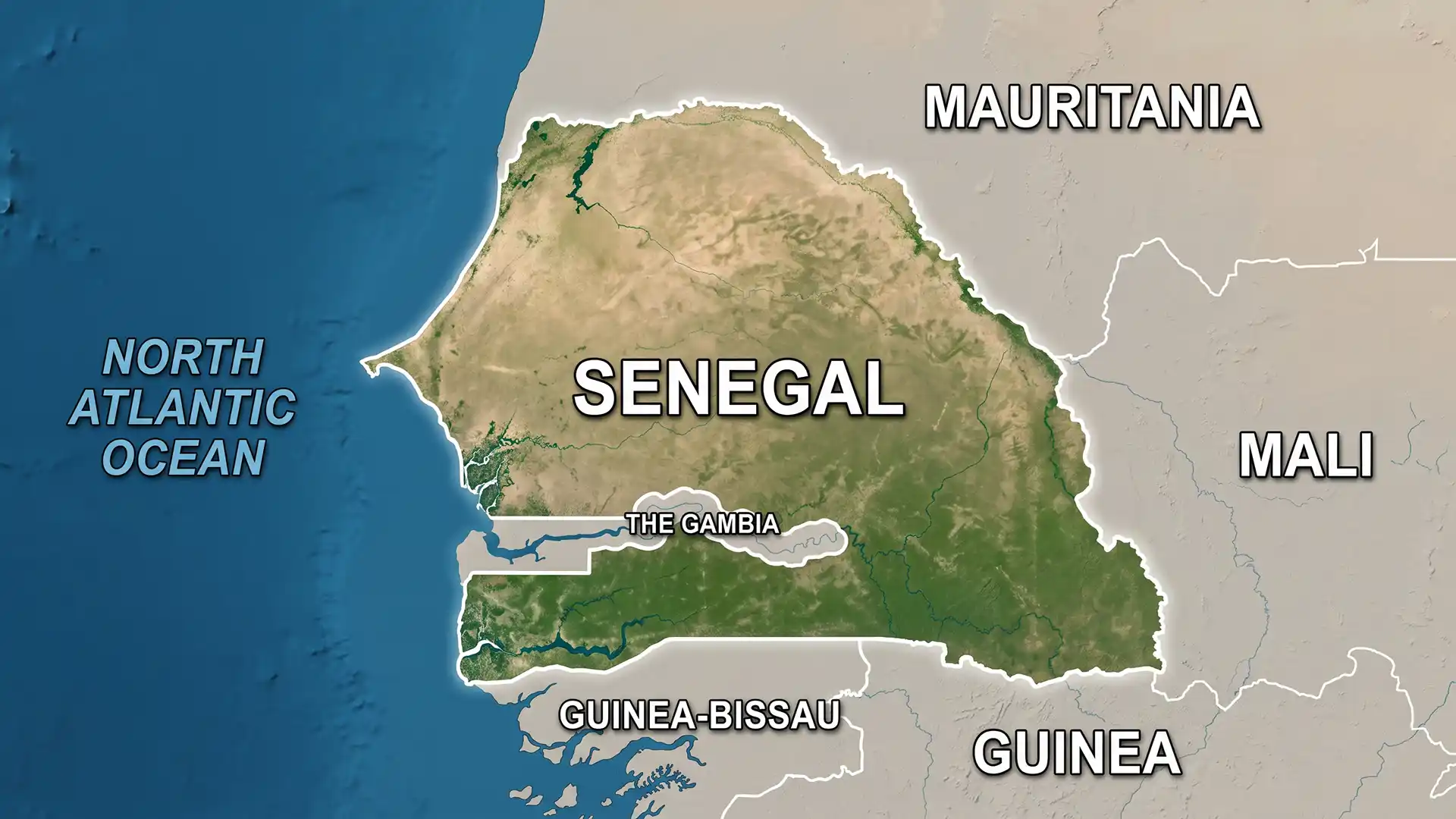
At Africa’s Atlantic-facing western edge, Senegal borders Mauritania, Mali, Guinea, Guinea-Bissau and The Gambia.
The Gambia forms a narrow river-following strip that almost separates Senegal’s southern Casamance region.
Dakar, the national capital, stands on the Cap-Vert Peninsula beside the Atlantic Ocean.
Pointe des Almadies on this peninsula is mainland Africa’s westernmost point.
Map caution: “Mainland Africa” matters because African islands extend farther west than Pointe des Almadies.
Physical geography
- Most land consists of low, gently rolling plains and sandy Sahel landscapes.
- The Senegal River forms much of the northern boundary with Mauritania.
- The Gambia and Casamance rivers drain important central and southern areas.
- The Saloum Delta contains mangroves, tidal channels, islands and important bird habitats.
- The climate is tropical, with a dry season and a summer rainy season.
- Rainfall generally increases from the dry north towards the greener south.
A short history of modern Senegal
- France gradually established colonial control and made Dakar an important administrative centre.
- Senegal and French Sudan formed the short-lived Mali Federation in 1959.
- The federation became independent from France on 20 June 1960.
- Political disagreements ended the federation during August 1960.
- Senegal then continued separately, with Léopold Sédar Senghor as its first President.
Senegal observes Independence Day on 4 April, remembering the 1960 agreement that transferred powers from France.
Why does the new chairmanship matter?
The bloc faces coups, extremism and difficult reconstruction after losing three large Sahel members.
Senegal’s chairmanship will therefore involve both economic integration and difficult political diplomacy.
Conclusion
Senegal now leads ECOWAS during a demanding period for West African cooperation.
For examinations, remember its five neighbours, unusual Gambia boundary and mainland westernmost point.