
Why in news?
A Union environment ministry expert committee opposed the proposed Sharavathi pumped-storage project. It warned about habitat fragmentation inside an ecologically sensitive Western Ghats landscape. The 2,000-megawatt project would use two existing reservoirs. Its report reached the Karnataka High Court.
Background
The Sharavathi River rises in Karnataka’s Western Ghats and flows westwards. It forms Jog Falls before reaching the Arabian Sea.
Large hydroelectric works later changed parts of this river valley, and the Linganamakki dam was completed during the 1960s.
The reservoir submerged forest and divided remaining wildlife habitat, and other dams and roads caused further separation between forest blocks.
The state protected the original Sharavathi Valley wildlife area in the 1970s. It later connected that area with important neighbouring forests.
In 2019, Karnataka expanded and renamed the protected area, and it became the Sharavathi Lion-Tailed Macaque Wildlife Sanctuary.
Location and extent
- The sanctuary covers about 930.16 square kilometres.
- It extends across Shivamogga and Uttara Kannada districts.
- The landscape lies within the biodiversity-rich Western Ghats.
- It includes forests around the Sharavathi and Aghanashini catchments.
- Its habitats include evergreen forest, moist forest and freshwater swamps.
The 2019 expansion added the Aghanashini conservation reserve and adjoining forests, and this created a larger connected conservation landscape.
Why is the lion-tailed macaque important?
The lion-tailed macaque has the scientific name Macaca silenus, and it is found naturally only in India’s Western Ghats.
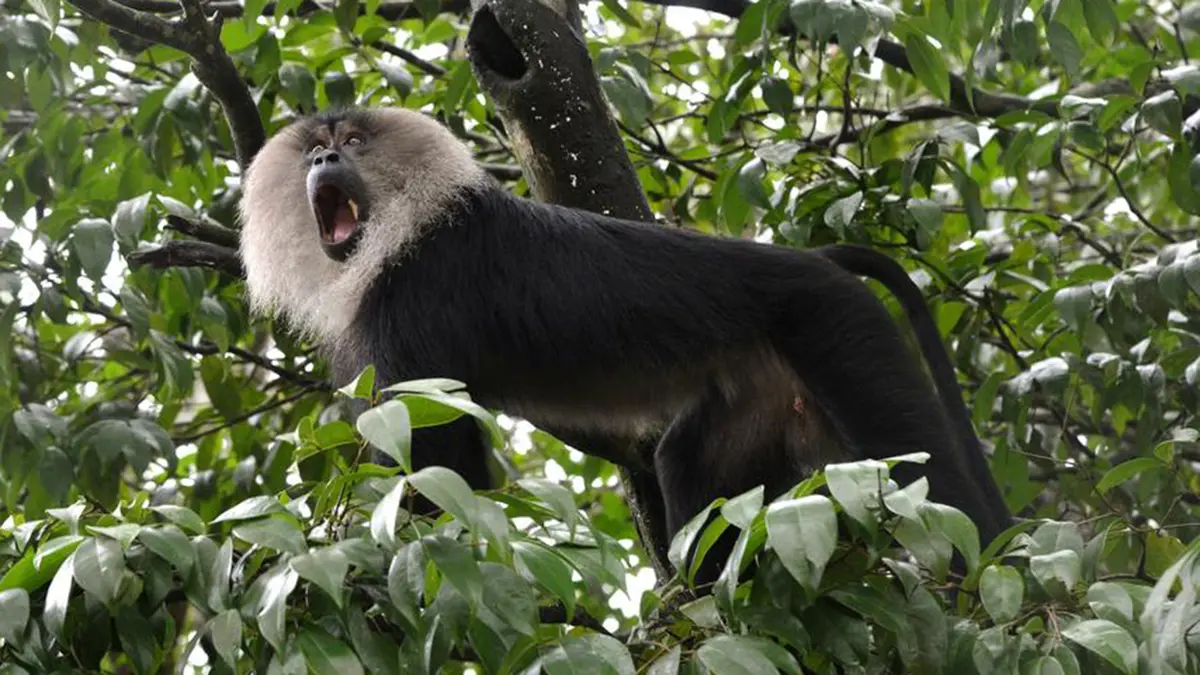
Its black body, silver-grey mane and tufted tail are distinctive, and the tail’s tuft resembles a lion’s tail.
The animal spends most of its time in the upper forest canopy. Fruits form a large part of its diet.
It rarely crosses open ground willingly, and a road or cleared corridor can therefore divide neighbouring groups.
The International Union for Conservation of Nature classifies the species as Endangered. Habitat loss and fragmentation remain its main threats.
Sharavathi supports the species’ northernmost viable population, and this gives the landscape special conservation value.
What is a pumped-storage project?
A pumped-storage project has two water reservoirs at different heights, and it acts like a very large rechargeable battery.
- Surplus electricity runs pumps during low-demand periods.
- The pumps move water from the lower reservoir uphill.
- Stored water is released during high electricity demand.
- Flowing water turns turbines and produces electricity.
- The same water can then repeat this operating cycle.
Important energy point: Pumped storage does not create net energy. It shifts electricity across time, and some energy is lost during each cycle.
About the proposed Sharavathi project
Karnataka Power Corporation Limited proposed the 2,000-megawatt scheme, and it would use the existing Talakalale and Gerusoppa reservoirs.
The proposal does not require a new dam, but underground works, roads and transmission lines still need construction.
The National Board for Wildlife gave in-principle approval in July 2025, and that approval included twenty-eight environmental conditions.
Why did the expert committee object?
- Construction could disturb wildlife continuously for around five years.
- New clearings may further divide an already fragmented landscape.
- Transmission lines could require additional tree removal.
- Canopy breaks would obstruct lion-tailed macaque movement.
- The area also supports tigers, leopards, gaur and several deer species.
- It functions as a wider wildlife corridor within the Western Ghats.
- The committee found the environmental assessment insufficient for these risks.
The committee stressed the valley’s cumulative damage, and it considered existing dams alongside the proposed project’s additional impact.
How did the court become involved?
Citizens challenged the project through a public-interest case in the Karnataka High Court. The court examined whether the approval process addressed ecological concerns.
The expert report was placed before a division bench, and it strongly recommended against wildlife approval for the project.
Present status: The committee’s report is a recommendation, not an automatic final cancellation. The court and competent authorities must consider it through their legal processes.
Development and conservation questions
Pumped storage can help balance solar and wind power, and those sources vary with sunlight and weather.
Yet a low-carbon project can still cause local ecological harm. Climate benefit does not remove the need for site-specific assessment.
Authorities must compare alternative sites, designs and storage technologies, and they must also count cumulative impacts from older projects.
Conclusion
Sharavathi contains an important, already fragmented Western Ghats ecosystem, and pumped storage can support renewable electricity, but location matters greatly. A lawful decision needs credible assessment of alternatives and cumulative harm.